
Ingredients
The vegetables
- 500 gsmall cucumbers
- or Lebanese cucumbers, quartered
- 300 gcarrots, in batons
- 300 gcauliflower, in small florets
- 2green mangoes, in slices
- optional but traditional
- 4green chillies, slit
- 1small turnip, in wedges
- optional
The pickling liquid
- 500 mlwhite vinegar
- at 5 percent acidity
- see the note
- 250 mlwater
- 3 tablespoonssalt
- non-iodised
- 2 tablespoonssugar
- optional, to round it
The spices
- 2 tablespoonsground turmeric
- this is what makes it yellow
- 1 tablespoonmustard seeds
- 1 tablespooncoriander seeds
- 1 teaspoonfenugreek seeds
- no more, see the note
- 1 teaspoonchilli powder
- or to taste
- 6 clovesgarlic, peeled
- a thumb of ginger, sliced
Equipment
- glass jars with lids
- sterilised
- a non-reactive pan
- stainless steel or enamel
- not aluminium or copper
- see the note
Directions
- Use vinegar at five percent acidity. Acid is what stops harmful bacteria growing. Check the label. Do not add more water than the recipe says.
- Use stainless steel or enamel. Use firm fresh ones. A soft vegetable goes limp in the jar. Wash them and dry them thoroughly. Cut them into pieces of similar size. Small ones go soft while large ones stay raw.
- Trim the blossom end off each one. Toss the cut vegetables with a little salt. Leave them an hour and drain them. Pat them dry after draining. Use a hard unripe mango. It should be sour and firm.
- Use glass rather than plastic containers. Wear gloves if you mind stained fingers. Use fenugreek sparingly. Wash them hot, then dry them in a low oven. Or run them through a dishwasher on hot.
- Use plastic-lined lids or a sheet of baking paper under a metal one. Toast the whole spices briefly in a dry pan. Thirty seconds until they smell. Keep the pan moving and take them off early. Start again if it happens. Bring the vinegar, water, salt and sugar to a simmer. Stir until they dissolve. Add them to the simmering liquid.
- Take it off after a minute. Pack the vegetables into the jars. Pack them firmly without crushing. Pour the hot liquid over to cover completely. Everything must stay under the liquid. Leave a centimetre or so at the top.
- Let the jars cool, then close them. The vegetables need to take up the vinegar and spice. Keep it in a cool dark place while it matures. A dark cupboard keeps the colour. Serve it cold in a small dish beside the rice. Anyone watching their salt should know that. Keep everything under the liquid.
Technique
- Use vinegar at five percent acidity and do not add more water than the recipe says. Acid is what stops harmful bacteria growing here — diluting it raises the pH, which is a safety matter rather than a matter of taste. Check the bottle, because some vinegars are weaker.
- If you want it less sharp, add sugar rather than water. Sugar softens the taste without weakening the acid.
- This is a vinegar pickle, not a ferment: the acid comes from outside rather than being produced in the jar, which makes it quicker and far more predictable. Turshu is the fermented kind, and the two look similar but work completely differently.
- Dry the vegetables thoroughly after washing. Water clinging to them dilutes the vinegar and works against the acidity you just measured.
- Trim the blossom end off each cucumber — it carries enzymes that soften pickles, and removing it is the standard fix for limp cucumber.
- Salting the cut vegetables for an hour and draining them draws water out, giving a crisper pickle and a stronger liquid. Pat them dry afterwards.
- Turmeric stains permanently — hands, cloth, plastic and worktops. Use glass rather than plastic containers, and wipe spills at once; a plastic tub takes a turmeric stain and never loses it.
- Use fenugreek sparingly. A teaspoon flavours the whole batch and a tablespoon turns it bitter.
- Use stainless steel or enamel, never aluminium or copper. Vinegar reacts with both and pulls metal into the food.
- Toast the whole spices for about thirty seconds, until they smell. They burn in seconds and mustard seeds pop and jump — burnt spice is bitter and cannot be fixed.
- Everything must stay under the liquid. Anything above the surface will mould, since the liquid works by excluding air.
- Unlike a ferment, a vinegar pickle can be sealed tight, because nothing produces gas. Metal lids corrode with vinegar over time, so use plastic-lined lids or put baking paper underneath.
- Give it a week before eating and two to three for the best of it. Eaten the next day it tastes raw and separate.
- Keep it dark while it matures — light fades the turmeric.
- Discard it for fuzzy or coloured mould, a slimy or ropy liquid, an off rather than sharp smell, or a bulging lid. If you are unsure, throw it out.
- Use a hard, sour, unripe mango. A ripe one turns to mush.
- Never pour hot liquid into a cold jar or set a hot jar on a cold surface — glass cracks from thermal shock. Simmering vinegar also gives off sharp fumes, so open a window.
Substitutions
- Turnip, kohlrabi, green beans, okra and small aubergines all pickle well here.
- Cider vinegar replaces white, giving a rounder flavour and a duller colour.
- Lemon slices replace green mango for sourness.
- Nigella seeds and fennel seeds both belong in the spice mix.
- Dates are added in some Gulf households for sweetness.
- Fresh turmeric root, grated, replaces the ground spice with a brighter colour.
Variations
- Torshi in Iran uses the same vegetables with more herbs.
- Indian achar sets the same vegetables in mustard oil instead of vinegar.
- Turshu is the brine-fermented Caucasian and Turkish counterpart.
- A single-vegetable jar of cucumber or cauliflower is common.
- Pickled green mango on its own, ambah, is a Gulf favourite.
- A sweeter version with more sugar is made for children.
History
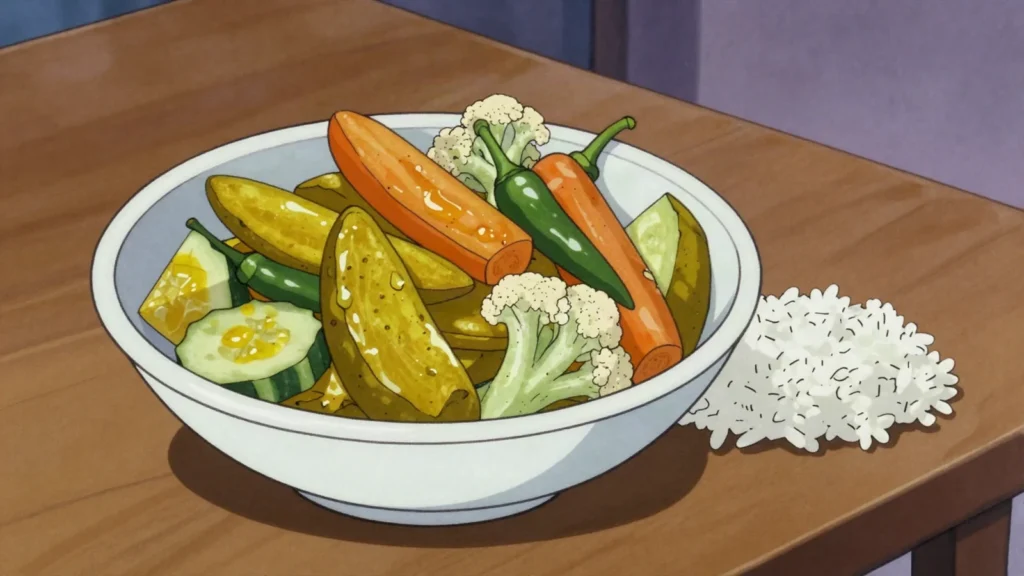
Cucumber, carrot and mango pickled with turmeric and chilli, a Gulf table fixture shaped by Indian achar.
Frequently asked questions
What is Mukhallal?
Mukhallal is a fermented & pickled from Bahrain: turmeric-yellow pickled vegetables served beside rice dishes. Cucumber, carrot and mango pickled with turmeric and chilli, a Gulf table fixture shaped by Indian achar.
How long does Mukhallal take to make?
Mukhallal takes 30 minutes plus 1 week of preparation and 10 minutes of cooking. The recipe makes makes 2 medium jars. It is rated easy to make.
What can I substitute in Mukhallal?
Yes, within limits. Turnip, kohlrabi, green beans, okra and small aubergines all pickle well here. Cider vinegar replaces white, giving a rounder flavour and a duller colour. Lemon slices replace green mango for sourness. Nigella seeds and fennel seeds both belong in the spice mix. Dates are added in some Gulf households for sweetness. Fresh turmeric root, grated, replaces the ground spice with a brighter colour.
What is the most important thing to get right in Mukhallal?
Use vinegar at five percent acidity. Acid is what stops harmful bacteria growing. Check the label. Do not add more water than the recipe says.