
Ingredients
The milk
- 1.5 litreswhole milk
- pasteurised, not UHT
- see the note
The starter
- 3 tablespoonsplain live yoghurt
- or tok doi from a previous pot
- with live cultures on the label
- at room temperature
The pot
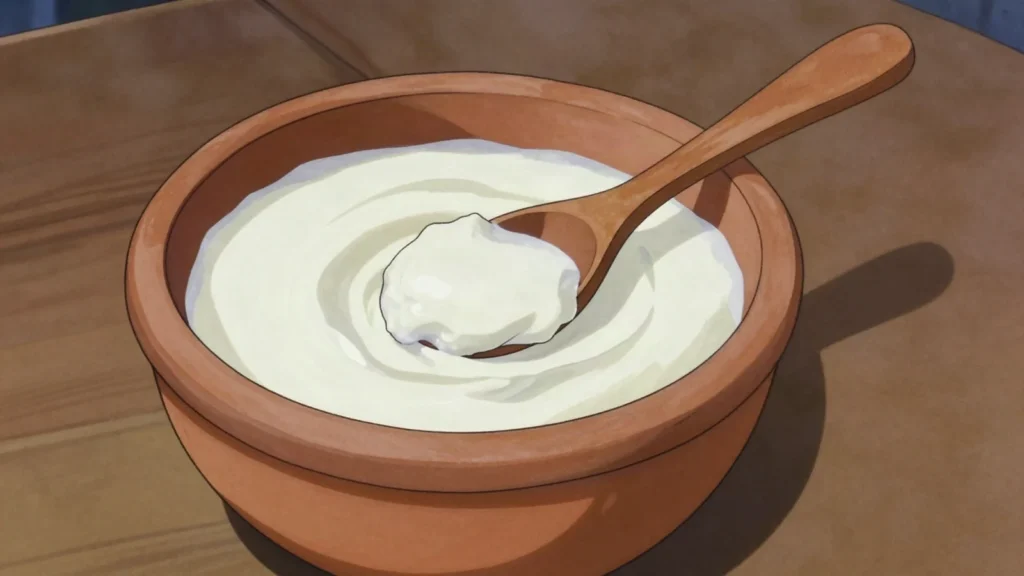
- an unglazed earthenware bowl
- a matir bhar or handi
- soaked in water 30 minutes first
- see the note
- or a ceramic bowl, if you have none
To serve
- on its own, after rice
- or with chira, flattened rice
- or muri, puffed rice
- sugar or salt, to taste
- sliced banana
- molasses, khejur gur, in winter
Directions
- Soak it in water for half an hour first. A bone-dry pot drinks the milk straight out of the curd.
- Wash it with hot water only. Do not use detergent. Use whole milk. Do not use UHT milk. Bring the milk to the boil and hold it there. Give it ten to fifteen minutes at a low boil.
- Stir it and watch it. Use a heavy pan. Cool the milk to about forty-five degrees. Never add the starter to hot milk. Use live yoghurt or doi from a previous pot. It must contain live cultures.
- Check the label. Slacken it with a little warm milk first. Pour it into the clay pot. Cover it and wrap it in a cloth.
- Keep it somewhere warm. Do not move it and do not stir it. Discard it if anything is wrong.
- Use clean pots and spoons. Never dip a used spoon into it. Start again from a fresh yoghurt when it does. It needs no cooking at all.
- Whisk it smooth first. Add it off the heat or on very low heat. Stir constantly. Never let it boil. Keep it covered and use a clean spoon.
Technique
- The unglazed clay pot is not decoration. Porous clay draws whey out through its walls as the curd sets, giving a firmer denser result, and a glass bowl gives a wetter looser one. It also cools slightly by evaporation and lends a faint earthy taste. Use a ceramic bowl if you have no pot — the curd will simply be looser, and the atlas says so rather than pretending the pot makes no difference.
- Soak a new clay pot in water for half an hour first. A bone-dry pot drinks the milk straight out of the curd.
- Wash clay pots with hot water only. Porous clay absorbs detergent and holds it, and the next batch tastes of soap.
- Do not use UHT milk — the proteins are denatured and it will not set properly, the commonest failure with any home curd.
- Boil the milk at a low boil for ten to fifteen minutes. Reducing it concentrates the milk and boiling denatures the whey proteins so they hold more water — together the single biggest lever on thickness. Longer incubation only makes it sourer.
- Never add the starter to hot milk. Above about fifty degrees the cultures die and nothing sets. Cool it to about forty-five — bearable on a clean finger for ten seconds.
- The starter must say live or active cultures on the label. Slacken it with a little warm milk first so it disperses evenly.
- Do not move or stir it while it sets. The gel is fragile as it forms and disturbing it gives lumps in whey instead of a clean curd.
- Set it longer than a mild yoghurt — sourness is the point of tok doi. In Bengali heat it sets in four or five hours; in a cool kitchen it takes far longer.
- Refrigerate it as soon as it sets, and give it a few hours cold before eating. Cold stops the souring where you want it and firms it further.
- Curd splits when heated. For doi maach or any cooked dish, whisk it smooth first, add it off the heat or on very low heat, stir constantly and never let it boil. A teaspoon of flour or gram flour whisked in stabilises it.
- Save three tablespoons for the next pot. A home culture drifts over many generations and eventually needs restarting from a fresh yoghurt.
- Never dip a used spoon into it, and judge it by smell: clean and sour is right, yeasty, putrid or ammoniac is not, and any mould or coloured patch means discard it.
- It is not mishti doi. That is the sweet caramelised curd from Bogra and a dessert; this is the plain counterpart that ends a savoury meal or goes into cooking.
- Milk boils over suddenly and catches on the base. Use a heavy pan, stir and watch it.
- The qatiq entry carries the fuller account of setting milk generally.
Substitutions
- Any plain live full-fat yoghurt substitutes directly.
- A ceramic or glass bowl replaces the clay pot, giving a looser curd.
- Buffalo milk gives a richer, thicker doi and is traditional in places.
- Any live yoghurt works as the first starter.
- Khejur gur can be replaced with jaggery or molasses out of season.
- Chira and muri are interchangeable as the grain to eat it with.
Variations
- Mishti doi is the sweet caramelised counterpart.
- Doi chira serves it over flattened rice with banana.
- Borhani thins and spices it into a wedding drink.
- Doi maach cooks fish in a curd gravy.
- Lassi blends it with water and sugar or salt.
- Ghol is the thin salted buttermilk drink of the same kitchens.
History
The unsweetened counterpart to Bogra’s famous mishti doi, set in porous earthenware that draws off whey.
Frequently asked questions
What is Tok Doi?
Tok Doi is a fermented & pickled from Bangladesh: plain sour set curd sold in clay pots, eaten after rice to cool the mouth. The unsweetened counterpart to Bogra’s famous mishti doi, set in porous earthenware that draws off whey.
How long does Tok Doi take to make?
Tok Doi takes 10 minutes plus 6 hours setting of preparation and 25 minutes of cooking. The recipe makes makes about 1 litre. It is rated easy to make.
What can I substitute in Tok Doi?
Yes, within limits. Any plain live full-fat yoghurt substitutes directly. A ceramic or glass bowl replaces the clay pot, giving a looser curd. Buffalo milk gives a richer, thicker doi and is traditional in places. Any live yoghurt works as the first starter. Khejur gur can be replaced with jaggery or molasses out of season. Chira and muri are interchangeable as the grain to eat it with.
What is the most important thing to get right in Tok Doi?
Wash it with hot water only. Do not use detergent. Use whole milk. Do not use UHT milk. Bring the milk to the boil and hold it there. Give it ten to fifteen minutes at a low boil.