
Ingredients
Yoghurt
- 1.5 litreswhole sheep milk, or full-fat cow milk
- 3 tbsplive kos from the last batch, or plain live yoghurt with no additives
- 1 pinchfine salt, optional
Equipment
- a heavy pan, a thermometer, a wide earthenware or glass bowl, a thick woollen blanket
Directions
- Heat the milk slowly to 85°C (185°F) in a heavy pan, stirring often so it does not catch, and hold it there for 10 minutes. This denatures the whey proteins and is what makes kos set thick and spoonable rather than slack.
- Take it off the heat and cool to 44°C (110°F), either by standing the pan in cold water or simply by waiting about 40 minutes, skimming or stirring back any skin that forms.
- Slake the starter in a cup with a ladleful of the warm milk until perfectly smooth, then stir it through the whole pan with a few gentle strokes.
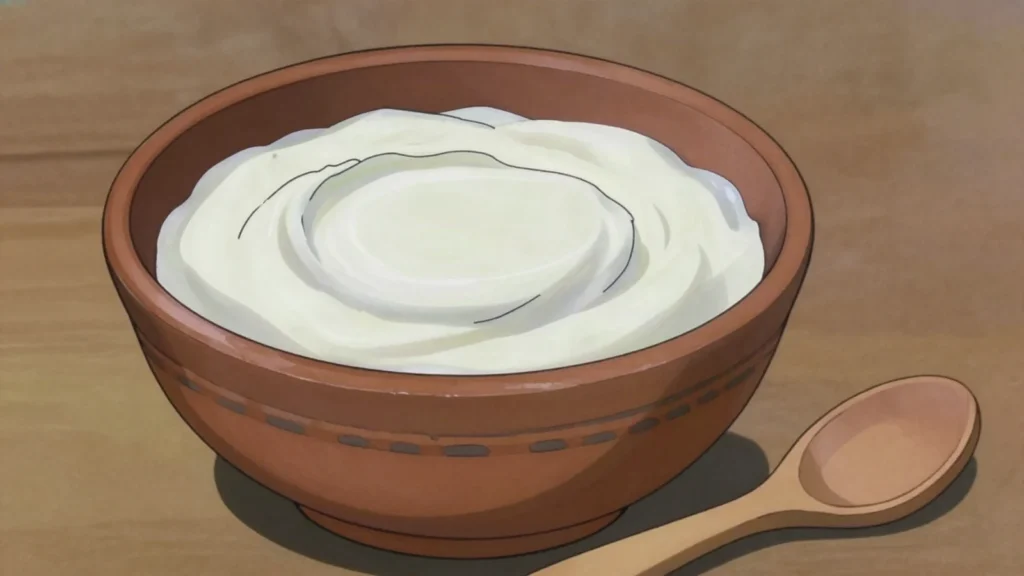
- Pour into a wide earthenware or glass bowl. A shallow, wide vessel sets a firmer, more even curd than a deep one.
- Cover with a plate and wrap the whole bowl in a thick blanket, or set it in an oven with only the light on, aiming to hold 42 to 45°C (115°F).
- Leave completely undisturbed for 4 to 5 hours. Moving the bowl during setting breaks the curd and weeps whey.
- It is ready when the surface is set firm enough to pull cleanly away from the side when you tilt the bowl, and tastes mildly tart rather than sharp.
- Chill uncovered for at least 6 hours to firm and mellow, then keep covered and use within a week, saving 3 tablespoons to start the next batch.
Technique
- Sheep milk kos is the Albanian ideal, with 6 to 7 percent fat, and sets so thick a spoon stands in it. Cow milk gives a looser set; adding 3 tablespoons of milk powder per litre compensates.
- Incubation temperature governs flavour. Around 42°C (110°F) gives a mild, creamy kos in 5 hours; at 46°C (115°F) it sours faster and tastes sharper within 3.
- Never stir once it is poured, and do not chase a thicker set with longer incubation. Past about 6 hours the acid tears the curd and whey pools on the surface.
Substitutions
- No live starter: a 125 g pot of plain unsweetened supermarket yoghurt with live cultures works, though the strain will drift after a few generations and needs refreshing.
- Goat milk sets more softly and tastes tangier; strain it through muslin for an hour if you want the Albanian thickness.
Variations
- Kos i kullar is hung in muslin for 8 hours to make a dense strained curd for spreading.
- The set yoghurt is the base of dhallë, is spooned over pilaf, and is baked into tavë kosi with rice and egg.
History
Central to Albanian cooking and the base of tavë kosi; households traditionally set it in clay bowls.
Frequently asked questions
What is Kos?
Kos is a fermented & pickled from Albania: thick set sheep or cow yoghurt, eaten plain or under baked dishes. Central to Albanian cooking and the base of tavë kosi; households traditionally set it in clay bowls.
How long does Kos take to make?
Kos takes 15 min of preparation and 5 hr incubating plus 6 hr chilling of cooking. The recipe makes 1.5 litres. It is rated easy to make.
What can I substitute in Kos?
Yes, within limits. No live starter: a 125 g pot of plain unsweetened supermarket yoghurt with live cultures works, though the strain will drift after a few generations and needs refreshing. Goat milk sets more softly and tastes tangier; strain it through muslin for an hour if you want the Albanian thickness.
What is the most important thing to get right in Kos?
Heat the milk slowly to 85°C (185°F) in a heavy pan, stirring often so it does not catch, and hold it there for 10 minutes. This denatures the whey proteins and is what makes kos set thick and spoonable rather than slack.