
Ingredients
The cassava
- 1.5 kgcassava root
- a sweet variety, peeled thickly
- read the safety note
- grated finely
- or 1.2 kg frozen grated cassava
The pudding
- 200 mlthick coconut cream
- 100 gsugar
- or grated palm sugar
- a pinch of salt
- 1 teaspoongrated fresh coconut
- optional
The coconut caramel
- 200 gpalm sugar
- or dark brown sugar
- 300 mlthick coconut cream
- a pinch of salt
For wrapping
- banana leaves
- softened over a flame
- or foil
- string, to tie
To serve
- warm or at room temperature
- cut into pieces
- with tea
Directions
- Peel away the brown skin and the pink layer beneath. Both come off together in one thick strip. Discard any root that tastes strongly bitter after cooking. Cut one open before grating. The flesh must be pure white throughout.
- Discard any root showing those signs. Frozen grated cassava is sold ready prepared. Cut it into lengths of about eight centimetres. Stand each piece upright. Cut down through the thick skin with a knife. Grate it on the fine side of a box grater. Do not purée it. Let it settle and pour off the top water. Keep the starch that settles at the bottom.
- Stir it back in. Put the grated cassava in a bowl. Add the coconut cream. Add the sugar and salt. Mix it thoroughly. It should be a thick sticky mass. Cut out the thick central rib. Spread the mixture on a leaf. Make it about two centimetres thick. Fold the leaf over it. Fold the ends under. Tie it with string. Wrap it firmly. It cooks for several hours.
- Use only stones known to be safe for this. Steam the parcels instead. Set them on a rack over boiling water. Cover the pot tightly. Steam them for about an hour. Check the level halfway. Top it up with boiling water. A pot that boils dry scorches badly. Steam escapes from a hot parcel. Let it stand five minutes first.
- Put the palm sugar in a heavy pan. Add a splash of water. Melt it over a medium heat. It sticks to skin and keeps burning. Keep children away from the pan. If it touches skin, run cold water over it for twenty minutes.
- Take the pan off the heat first. Add the cream gradually. Stand back. Adding cold liquid to hot sugar causes violent spitting. Add it slowly and off the heat. Return it to a low heat. Stir until smooth. Add the salt.
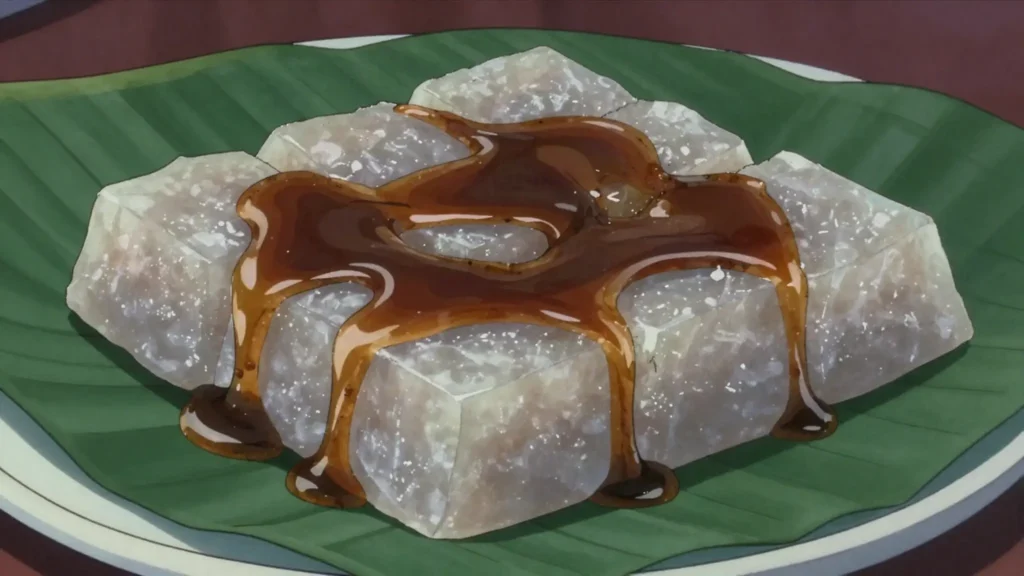
- Simmer it gently for five minutes. Do not let it boil hard. Keep it at a bare simmer. It should coat a spoon. Cut it into pieces. Pour the coconut caramel over. It is served warm or at room temperature. Steam it to reheat, fifteen minutes. The caramel keeps a week refrigerated.
Technique
- Cassava contains cyanogenic glycosides that release cyanide when the tissue is damaged. Use sweet cassava, peel away both the brown skin and the pink layer beneath, and cook it thoroughly. Never taste the raw grated mixture — worth stating for a sweet, where the temptation is greater — and discard any root that tastes strongly bitter after cooking.
- Cut a root open before grating. The flesh must be pure white; grey or blue streaks, black specks or dark rings mean it has begun to spoil, and that deterioration raises the harmful compounds.
- Do not squeeze the grated cassava dry. Unlike a cassava fritter, this pudding needs that starchy liquid to bind — if it is very wet, let it settle, pour off the top water and stir the settled starch back in.
- Cooked cassava turns from opaque white to translucent and slightly grey. That colour change is the reliable signal that it is done through.
- Keep the parcels about two centimetres thick. Thicker and the centre stays raw; thinner and it dries out.
- Pull out the tough fibrous cord down the centre of each root. It never softens.
- Molten sugar reaches far above boiling water, sticks to skin and keeps burning. Never touch or taste it hot, keep children away, and run cold water over any contact for twenty minutes.
- Take the pan off the heat before adding the coconut cream, and add it slowly. Cold liquid meeting hot sugar spits violently.
- Never let the caramel boil hard once the coconut cream is in. It splits into grainy oil — keep it at a bare simmer, and stop while it still seems slightly thin, since it thickens as it cools.
- Let the parcels stand five minutes and open them away from your face. The trapped steam scalds.
- Frozen grated cassava from a Pacific, Caribbean or African grocer saves all the peeling and grating and works perfectly well.
- Heated stones in an earth oven can explode — river stones and porous stones hold water that turns to steam under pressure. Only stones known locally to be safe are used, and steaming is the practical method at home.
- The pinch of salt is not a mistake. It makes the sweetness taste more and balances the coconut.
- It is meant to be dense, sticky and chewy rather than light or cakey. Lolo means coconut cream in Fijian, and vakalolo means with coconut cream — which is where the name comes from.
Substitutions
- Frozen grated cassava replaces fresh and removes the peeling and grating.
- Dark brown sugar replaces palm sugar in both the pudding and the caramel.
- Foil replaces banana leaves, without the leaf aroma.
- Grated taro or breadfruit can replace some of the cassava.
- Tinned coconut cream replaces fresh with no real loss.
- Steaming replaces the earth oven entirely and is the practical home method.
Variations
- Vakalolo cooked in a lovo earth oven is the festive version.
- Kasava cake, a baked version of the same mixture, is made across the Pacific.
- Purini is the Fijian steamed pudding, often made with flour.
- Cassava pone in the Caribbean uses the same grated root baked with coconut.
- Bibingka and other Pacific and Asian cassava cakes belong to the same idea.
- A version with grated coconut worked through the mixture is common.
Frequently asked questions
What is Vakalolo?
Vakalolo is a dessert from Fiji: sticky grated cassava pudding with coconut caramel, wrapped in leaves.
How long does Vakalolo take to make?
Vakalolo takes 40 minutes of preparation and 1 hour of cooking. The recipe makes serves 8. It is rated medium to make.
What can I substitute in Vakalolo?
Yes, within limits. Frozen grated cassava replaces fresh and removes the peeling and grating. Dark brown sugar replaces palm sugar in both the pudding and the caramel. Foil replaces banana leaves, without the leaf aroma. Grated taro or breadfruit can replace some of the cassava. Tinned coconut cream replaces fresh with no real loss. Steaming replaces the earth oven entirely and is the practical home method.
What is the most important thing to get right in Vakalolo?
Peel away the brown skin and the pink layer beneath. Both come off together in one thick strip. Discard any root that tastes strongly bitter after cooking. Cut one open before grating. The flesh must be pure white throughout.