
Ingredients
The cassava
- 1.5 kgcassava root
- manioc, peeled and grated
- a sweet variety only
- see the safety notes carefully
- 1 teaspoonsalt
The pork filling
- 500 gpork shoulder or belly
- cut into small dice
- or minced coarsely
- 1onion, finely chopped
- 3 clovesgarlic, crushed
- 1 teaspoonsalt
- black pepper
- 1hot chilli, chopped, optional
Sometimes added
- 150 mlcoconut cream
- into the cassava
- a handful of chopped island cabbage
- or spring onion
- a little grated ginger
The wrappers
- banana leaves
- cut into large rectangles
- passed over a flame to soften
- or laplap leaves
- strips of leaf or string, to tie
To serve
- hot, in the leaf
- with a squeeze of lime
- or a chilli sauce
- cold water or coconut water
Directions
- Discard any root that tastes sharp or bitter. The warning is about processing, not the plant. Cut roots deteriorate very quickly. Cut one open before buying several. It should smell clean and faintly sweet.
- Cut the root into manageable lengths. Cut off both ends of each length. Score the thick skin lengthways. Cassava skin is thick, brown and papery. Remove both, since both must come off. Do not use a vegetable peeler for this. Use a knife and peel the root thickly. Cut out the fibrous central core. Rinse the peeled flesh thoroughly.
- Grate it into a bowl and keep the liquid. Both are done in Vanuatu households. Add the salt to the grated cassava. Add coconut cream if you are using it. Mix it well through with your hands. Dice the pork small or mince it coarsely.
- Mix it with the onion and garlic. Add the salt, pepper and chilli. Add ginger or spring onion if using them. Mix it thoroughly with your hands. There is a food safety point about pork. Wash hands and boards after raw pork. Keep it away from anything ready to eat. Cut them into large rectangles. Cut along the grain, not across the ribs. Never leave a leaf over a flame unattended.
- Tear spare leaves into strips for tying. Foil works if leaves are unavailable. Lay a leaf rectangle flat, shiny side up. Spread a layer of grated cassava on it. Make a rectangle about two centimetres thick. Leave a clear border on every side. Lay a line of pork filling down the centre. Do not overfill or it will burst open.
- Use the leaf to help you roll it. Lift one edge of the leaf and fold it over. Keep rolling to enclose it completely. The filling should be sealed inside. Fold both ends of the leaf underneath. Tie the parcel with leaf strips or string.
- Tie it firmly so it holds together. It must not come apart in the water. Bring a large pot of water to the boil. Add a good pinch of salt to the water. They should be fully covered by water.
- Add more boiling water if they are not. Return it to a boil and then lower it. Keep it at a steady rolling simmer. Boil them for a full hour at least. Larger rolls may need longer than that. Check the water level occasionally. Top up with boiling water, never cold.
- Lift it out with tongs and let it rest. Rest it for five minutes before opening. Steam escapes and it scalds badly. The cassava should be firm and translucent. Cut into the centre and check the pork. It must be cooked right through with no pink. Serve them hot, still in the leaf. Squeeze lime over it if you like. Leftovers keep three days in the fridge. Boil them from frozen for forty minutes.
Technique
- Cassava contains linamarin, which converts to hydrogen cyanide when the tissue is damaged. Poisoning is documented and includes konzo, a condition causing permanent leg paralysis, in places where cassava is poorly processed. Sweet varieties, which is what shops abroad sell, need only thick peeling and thorough cooking; bitter varieties need extensive grating, soaking and fermenting or long sun-drying. Never eat cassava raw, never taste the raw grated pulp, peel it thickly, cook it right through, and discard any root that tastes bitter — bitterness is the warning signal.
- Peel thickly with a knife, not a vegetable peeler. The brown skin and the pinkish layer beneath both have to come off, and a peeler only takes the outer skin.
- Cooked cassava turns glassy and slightly grey; raw cassava is opaque chalky white. That change in appearance is how you check it is done.
- The pork is buried inside and cannot easily be checked as it cooks, which is why it is cut small and why the boil is a full hour. Cut into the first roll and check that the juices run clear before serving the rest.
- Frozen grated cassava is widely sold and saves genuine effort. The root is dense and fibrous and grating it by hand is hard work.
- Squeezing the starchy liquid out of the grated cassava gives a firmer, denser roll; leaving it in gives a softer one. Both are done.
- Banana leaves must be thawed and passed over a flame. Heating turns them glossy and flexible; unheated leaves split when folded. Cut along the grain, and never leave a leaf over a flame unattended.
- Tuluk is laplap made portable. Laplap is Vanuatu’s national dish, baked for hours in a stone earth oven for many people; tuluk boils in individual rolls that can be carried and eaten in the hand, which is what makes it market food.
Substitutions
- Frozen grated cassava replaces fresh and removes the hardest part of the work.
- Chicken or tinned fish replaces pork, and both are used in Vanuatu.
- Grated taro or yam replaces some of the cassava, giving a different but related roll.
- Coconut cream mixed into the cassava makes a richer, softer roll and is a common addition.
- Foil replaces banana leaves; the leaf flavour is lost, which is a genuine loss.
- A vegetarian version with island cabbage and coconut cream in place of the pork is made in some households.
Variations
- Laplap is the earth-oven original, spread on leaves and baked with hot stones for hours.
- Simboro is the related Vanuatu dish where grated cassava is wrapped in island cabbage leaves and cooked in coconut cream.
- A version made with grated banana rather than cassava is made where bananas are plentiful.
- Some sellers make a chicken tuluk, which is lighter and cooks a little faster.
- Related grated-root parcels are made across Melanesia, in Fiji, the Solomon Islands and Papua New Guinea.
- A version baked rather than boiled is made in some households and gives a drier roll.
History
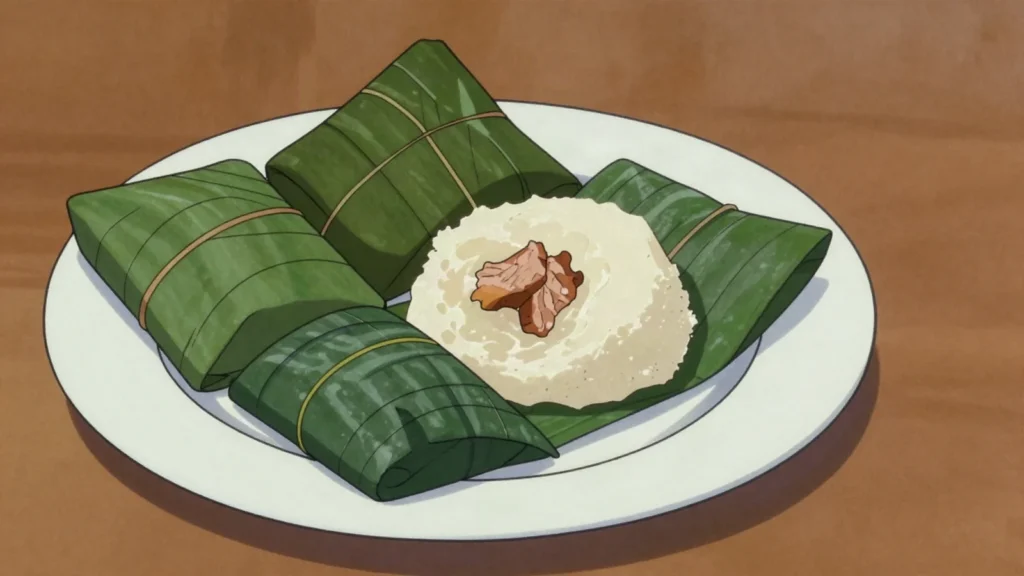
Grated manioc is wrapped around seasoned pork and boiled in leaf parcels, a portable version of laplap sold at market stalls.
Frequently asked questions
What is Tuluk?
Tuluk is a street food from Vanuatu: boiled cassava roll with a seasoned pork center, wrapped in leaves. Grated manioc is wrapped around seasoned pork and boiled in leaf parcels, a portable version of laplap sold at market stalls.
How long does Tuluk take to make?
Tuluk takes 45 minutes of preparation and 1 hour of cooking. The recipe makes makes about 8 rolls. It is rated medium to make.
What can I substitute in Tuluk?
Yes, within limits. Frozen grated cassava replaces fresh and removes the hardest part of the work. Chicken or tinned fish replaces pork, and both are used in Vanuatu. Grated taro or yam replaces some of the cassava, giving a different but related roll. Coconut cream mixed into the cassava makes a richer, softer roll and is a common addition. Foil replaces banana leaves; the leaf flavour is lost, which is a genuine loss. A vegetarian version with island cabbage and coconut cream in place of the pork is made in some households.
What is the most important thing to get right in Tuluk?
Cut the root into manageable lengths. Cut off both ends of each length. Score the thick skin lengthways. Cassava skin is thick, brown and papery. Remove both, since both must come off. Do not use a vegetable peeler for this. Use a knife and peel the root thickly. Cut out the fibrous central core. Rinse the peeled flesh thoroughly.