
Ingredients
The nuts
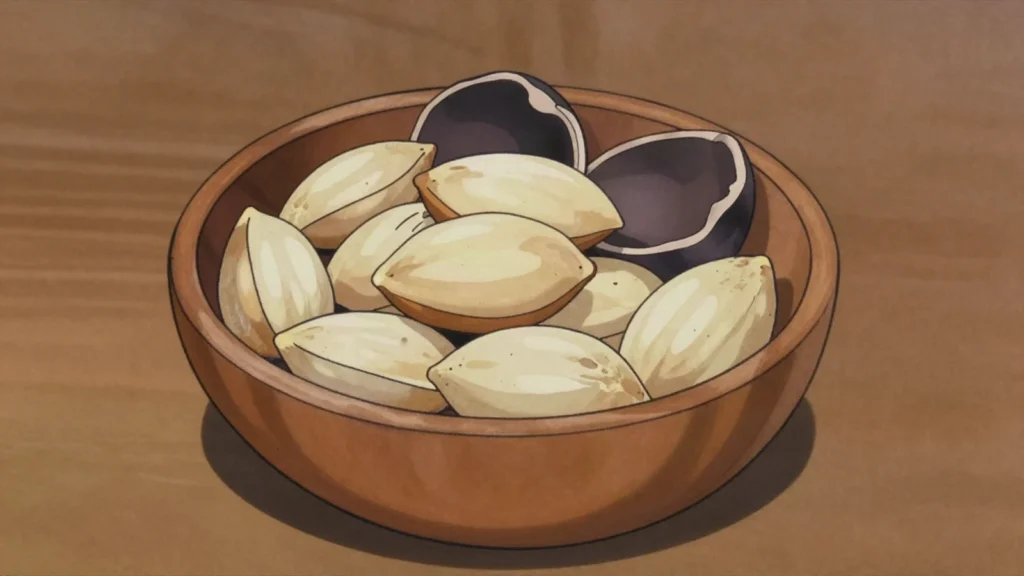
- 1 kgnangai nuts in shell
- Canarium indicum or C. harveyi
- well dried
To crack and clean
- a flat stone or hammer
- a hard surface
- boiling water, for blanching
- a cloth, for the testa
To finish, optional
- salt
- honey
- for coating
To serve
- raw, roasted or smoked
- grated over laplap
- skewered on a palm frond spine
Directions
- Keep the kernels dry, cool and airtight. Keep them in their testa until eaten. It happens in a hot humid climate.
- Discard any that smell musty or taste bitter. That was found in people who had never eaten it. Set a nut on its side on a hard surface. Too hard crushes the kernel inside. Pick the kernel out of the split shell. Discard all the shell fragments. About an eighth of the weight is food.
- Pick over the extracted kernels. Discard any that are discoloured. Discard any that smell musty or rancid. Drop the kernels into boiling water. Give them about one full minute.
- Drain them all off immediately. Rub the warm kernels in a cloth. Use a clean cloth and clean hands. It is soft, oily and fairly mild. Spread the kernels out on a tray. Roast them in a moderate oven. Give them about twelve minutes.
- Shake the tray every few minutes. Judging them takes a careful look. Take them out slightly early for that. Tip them onto a cold tray immediately.
- Spread them in a single layer. Let them cool right down completely. Sprinkle salt over them while warm. Warm honey and stir the kernels through.
- Spread them out on a tray to set. Hang the nuts above a kitchen fire. Leave them hanging there for months. The smoke and heat keep them dry. Put them out in a serving bowl. Or grate them over a hot laplap.
Technique
- Nangai shows documented IgE cross-reactivity with grass, birch and mugwort pollen: in a published study, pollen-allergic people who had never eaten it tested positive on skin prick and specific IgE. The honest limit is that sensitisation is firmly established while clinical reactivity is less so, since not every positive was confirmed on challenge. It is a genuine species-specific finding rather than generic tree-nut boilerplate, so anyone with pollen allergy should be cautious and what is being offered should be said clearly.
- The nut is depulped by letting the fruit flesh rot off, on the ground or in sacks, in a hot humid climate, and a food-safety analysis of the crop assesses aflatoxin contamination of nuts stored damp as a high risk. The control is proper drying; blanching kills surface microbes but does not destroy aflatoxin, and no home treatment removes it. Buy properly dried nuts and discard any that smell musty or taste bitter.
- The kernel is around seventy percent oil, so rancidity is the dominant spoilage mode rather than an afterthought — the oil oxidises on air contact and enzymes release free fatty acids. Keep kernels dry, cool, airtight and in their testa, which slows it.
Substitutions
- Nangai in Vanuatu covers at least Canarium indicum and C. harveyi; eating a lot of fresh C. harveyi kernels is reported to cause nausea and vomiting, though from a single source with no mechanism given.
- Roasting is at least as traditional as raw or smoked and is the dominant retail form, with roasted and honey-coated kernels sold in Port Vila.
Variations
- Smoking over a kitchen fire is a storage method keeping nuts up to about a year, not merely a flavour treatment.
- Only about an eighth of the nut in shell is kernel, so a kilogram gives little food; that is normal rather than a poor batch.
- Grated over laplap is the standard cooked use, and fresh kernels are sold skewered on palm-frond spines.
History
Harvested from village groves on Malekula and Santo, traded between islands long before Europeans arrived.
Frequently asked questions
What is Nangai Nut?
Nangai Nut is a snack from Vanuatu: rich oily canarium kernel cracked from a hard shell; eaten raw or smoked. Harvested from village groves on Malekula and Santo, traded between islands long before Europeans arrived.
How long does Nangai Nut take to make?
Nangai Nut takes 20 minutes of preparation and 20 minutes of cooking. The recipe makes serves 8. It is rated easy to make.
What can I substitute in Nangai Nut?
Yes, within limits. Nangai in Vanuatu covers at least Canarium indicum and C. harveyi; eating a lot of fresh C. harveyi kernels is reported to cause nausea and vomiting, though from a single source with no mechanism given. Roasting is at least as traditional as raw or smoked and is the dominant retail form, with roasted and honey-coated kernels sold in Port Vila.
What is the most important thing to get right in Nangai Nut?
Discard any that smell musty or taste bitter. That was found in people who had never eaten it. Set a nut on its side on a hard surface. Too hard crushes the kernel inside. Pick the kernel out of the split shell. Discard all the shell fragments. About an eighth of the weight is food.