
Ingredients
The meat
- 1.5 kggoat or pork
- cut into 3 cm cubes
- with some fat left on
- or a mixture of both
The seasoning
- 1large onion, chopped
- 8 clovesgarlic, crushed
- a large thumb of ginger, grated
- 3hot chillies, chopped
- or to taste
- 2 teaspoonssalt
- 1 teaspoonblack pepper
- juice of 2 limes
The herbs and greens
- a large bunch of local herbs
- lemon basil, coriander or similar
- roughly chopped
- 6spring onions, chopped
- a handful of papaya leaves
- or spinach, optional
- 2tomatoes, chopped
Sometimes added
- 200 mlcoconut milk
- or a little water
- a splash of tamarind water
- a little turmeric
The bamboo
- 3to 4 lengths green bamboo
- about 50 cm long
- one node closed at the base
- internal diameter about 8 cm
- banana leaf, to plug the open end
- loosely, not sealed
To serve
- boiled rice
- or boiled cassava
- or corn
- sliced raw chilli
Directions
- Steam builds inside with nowhere to escape. The tube must never be fully sealed. Take it off the fire and check it. There is a related point about the bamboo. Use only green freshly cut bamboo. Dry bamboo burns through and catches fire. Check for cracks before you use a tube. It grows in many warm countries.
- Cut the meat into cubes of about three centimetres. Leave some fat on for moisture and flavour. Pound the garlic, ginger and chilli. Add the chopped onion to the paste. Add the salt, pepper and lime juice. Capsaicin oil clings to skin for hours.
- Rub the paste thoroughly into the meat. Work it into every surface with your hands. Let it stand for at least thirty minutes. An hour gives noticeably better flavour. Add the chopped tomatoes as well. Mix everything through the seasoned meat. Add coconut milk now if you are using it. Wash the inside thoroughly with water. Use a long brush or a cloth on a stick.
- Rinse the tube and let it drain. Check the closed node for cracks. Use a long stick to pack it down. Fill it no more than three quarters full. Leave a clear space at the open end. Steam must be able to escape freely. Turn them every fifteen minutes or so. Move it if one side is charring too fast.
- Cook them for about two full hours. Goat may take a little longer. Steam should escape from the plugged end. Use tongs and stand well back. The tube and contents are extremely hot.
- Put everything in a heavy casserole. Cover the dish with a tight lid. Bake at one hundred and sixty degrees. Bake for about two and a half hours. Use a heavy knife along the length. Check the food for splinters before serving.
- Keep faces well away from the splitting. Hot steam escapes when it opens. Tip the contents onto a serving dish. Serve it with plain boiled rice. Leftovers keep three days in the fridge.
Technique
- A sealed bamboo tube over fire will explode. Steam builds with nowhere to go, the tube bursts, and fragments and scalding contents are thrown outward. Plug the open end loosely with banana leaf so steam escapes freely — you should be able to see it escaping. If no steam is coming out, take it off the fire and check it.
- Use only green freshly cut bamboo. Dry bamboo burns through and can itself explode as trapped air in the nodes expands, which is why bamboo cracks loudly in a bonfire. Check every tube for cracks first, since a cracked tube spills boiling contents onto an open fire.
- Never use decorative or treated bamboo. It may be chemically preserved and those chemicals must not go near food. Not all bamboo species suit cooking either — some are too thin-walled, some impart an unpleasant flavour. Ask locally rather than guessing.
- Fill the tube no more than three quarters. Contents expand as they cook, and an overfilled tube overflows and builds more pressure.
- Cook over steady embers, not high flames. Flames burn the bamboo through; turn the tubes every fifteen minutes so they char evenly.
- Split the tube over a board, with faces well away — hot steam escapes and bamboo splinters are sharp. Check the food for splinters before serving.
- The bamboo fragrance is genuinely part of the dish and cannot be reproduced in a casserole. The oven method gives good food and a different dish, and the atlas will not pretend otherwise.
- Tukir is cooked for weddings and village ceremonies, where animals are killed and shared according to customary rules about who receives what. Timor-Leste’s customary systems, lisan, govern marriage, land and exchange and survived both Portuguese rule and Indonesian occupation. Food at such events is part of an exchange between families.
Substitutions
- A heavy lidded casserole in a low oven replaces the bamboo, giving the same seasoning and a different dish.
- Goat and pork are both used; a mixture of the two is common.
- Chicken works and cooks in about half the time.
- Spinach replaces papaya leaves; papaya leaf is deliberately bitter and spinach is not, which changes the dish.
- Lemon basil is the characteristic herb; Thai basil or ordinary basil with extra lime is the nearest substitute.
- Coconut milk is optional and makes a richer, saucier result.
Variations
- Bamboo-tube cooking appears across Southeast Asia — in Laos, northern Thailand, Indonesia and the Philippines — with different fillings and the same principle.
- A rice version, with rice and coconut milk cooked in the tube, is made in several of those traditions.
- Some Timorese cooks add a whole chicken jointed into the tube rather than cubed meat.
- A fish version, with whole small fish and herbs, cooks in about forty minutes.
- Ai manas, the Timorese chilli sauce, is served alongside in many households.
- A version with far more coconut milk gives something closer to a curry inside the tube.
History
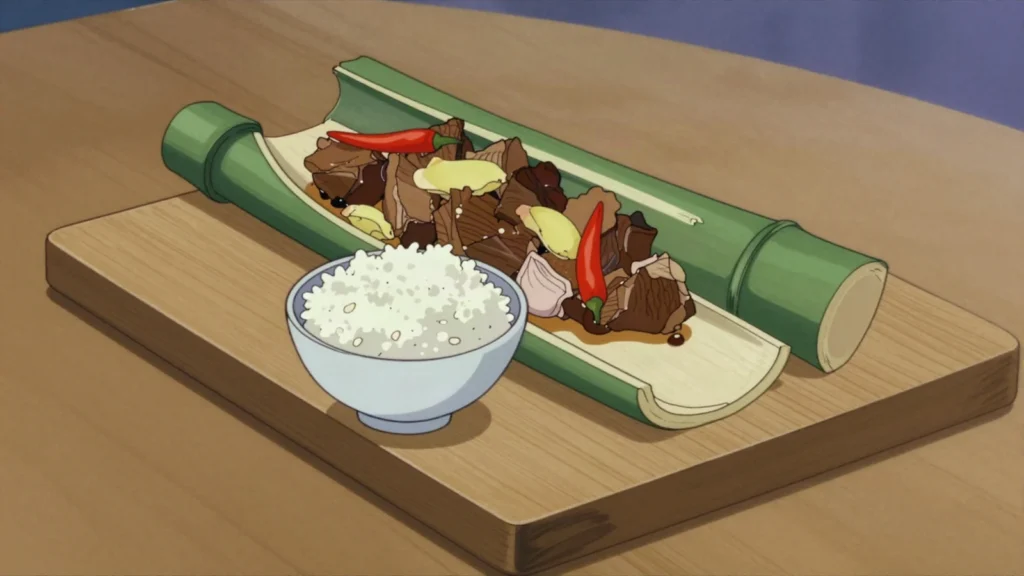
Cooked at village ceremonies and weddings, where the bamboo both cooks and seasons the meat and is split open at the table.
Frequently asked questions
What is Tukir?
Tukir is a main from Timor-Leste: goat or pork cooked with herbs inside a bamboo tube over an open fire. Cooked at village ceremonies and weddings, where the bamboo both cooks and seasons the meat and is split open at the table.
How long does Tukir take to make?
Tukir takes 40 minutes of preparation and 2 hours of cooking. The recipe makes serves 6. It is rated hard to make.
What can I substitute in Tukir?
Yes, within limits. A heavy lidded casserole in a low oven replaces the bamboo, giving the same seasoning and a different dish. Goat and pork are both used; a mixture of the two is common. Chicken works and cooks in about half the time. Spinach replaces papaya leaves; papaya leaf is deliberately bitter and spinach is not, which changes the dish. Lemon basil is the characteristic herb; Thai basil or ordinary basil with extra lime is the nearest substitute. Coconut milk is optional and makes a richer, saucier result.
What is the most important thing to get right in Tukir?
Steam builds inside with nowhere to escape. The tube must never be fully sealed. Take it off the fire and check it. There is a related point about the bamboo. Use only green freshly cut bamboo. Dry bamboo burns through and catches fire. Check for cracks before you use a tube. It grows in many warm countries.