
Ingredients
The dumplings
- 400 gplain flour
- 2 teaspoonsbaking powder
- half a teaspoon salt
- 2 tablespoonssugar
- about 250 ml water
- or coconut milk
- for a richer dumpling
The coconut sauce
- 800 mlcoconut cream
- freshly squeezed if possible
- or 2 tins coconut cream
- 150 gsugar
- or to taste
- or 150 ml kamaimai, toddy syrup
- a pinch of salt
Sometimes added
- a split vanilla pod
- or a little vanilla essence
- 2ripe bananas, mashed
- into the dumpling dough
- grated fresh coconut
- to scatter
To serve
- hot, in a shared bowl
- eaten with the fingers
- or with a spoon
Directions
- Flour arrived by ship as an imported good. It was never formally colonised. Crack a mature coconut over a bowl. Never chop at a coconut on a board. Grate the flesh out with a scraper. Put the grated coconut in a clean cloth. Add a little warm water to it. The thick first pressing is the cream.
- Add more water and squeeze for thinner milk. Shake the tin hard before opening it. Use full-fat cream, not light coconut milk. Light versions give a thin, watery sauce.
- Put the flour, baking powder and salt in a bowl. Whisk them together so the raising agent spreads. Add the sugar and stir it through. Make a well in the centre of the flour. Add the water or coconut milk gradually. Mix it with a spoon or with your hand. Add liquid a little at a time. Stop when it forms a soft dough.
- Mix only until no dry flour remains. Add mashed banana now if you are using it. Reduce the liquid slightly if you do. Let the dough rest for five minutes. Now shape the dumplings with wet hands.
- Pinch off pieces about the size of a walnut. Roll each piece into a rough ball. They do not need to be perfectly round. Keep them roughly the same size. Bring a large pot of water to the boil. Add a pinch of salt to the water.
- Drop the dumplings in gently, a few at a time. Do not crowd the pot at any point. Cook them in batches if necessary. But do not take them out at that moment. Lift them out with a slotted spoon. Do not tip the pot into a colander. Set them aside while you make the sauce. Pour the coconut cream into a wide pan. Add the sugar and the pinch of salt.
- Add the vanilla pod if you are using one. Heat it gently over a medium heat. Stir until the sugar has dissolved. Never let coconut cream boil hard. Keep it at a bare simmer only. Stir it often as it heats through. Let it thicken slightly over five minutes.
- Taste it and adjust the sweetness. It should be clearly sweet but not sickly. Turn them gently to coat them all over. Simmer them together for two or three minutes. Remove the vanilla pod if you used one. Serve it hot in a large shared bowl. People take dumplings with their fingers.
- Scatter fresh grated coconut over the top. That adds texture against the soft dumplings. Add more coconut cream when reheating. Reheat it gently and never at a boil.
Technique
- Never boil coconut cream hard. It splits and goes grainy, with the oil separating out. It still tastes fine but it looks curdled — keep the sauce at a bare simmer.
- Rising to the surface is not the same as being cooked. Give the dumplings another five minutes after they rise, and cut one open to check the centre before serving.
- Lift the dumplings out with a slotted spoon rather than tipping the pot into a colander, which breaks them apart.
- Do not overwork the dough. Mix only until no dry flour remains; worked dough gives tough, chewy dumplings.
- Use full-fat coconut cream, not light coconut milk. The sauce is most of the dish and a light version gives something thin and watery.
- Wheat flour is imported to Tonga and nothing like wheat grows there. Topai is an adaptation of an imported staple to the one thing the islands have in abundance, which is coconut — a pattern repeated right across the Pacific.
- Tonga was never formally colonised, the only Pacific nation that can say so, and kept its monarchy through a period as a British protected state.
Substitutions
- Tinned full-fat coconut cream replaces freshly squeezed; shake the tin hard before opening.
- Coconut milk replaces water in the dough for a richer dumpling.
- Kamaimai, coconut toddy syrup, replaces sugar in the sauce and is the more traditional sweetener, giving a darker caramel note.
- Mashed ripe banana worked into the dough is a very common household variation and makes softer, sweeter dumplings.
- Self-raising flour replaces plain flour plus baking powder directly.
- A split vanilla pod or a little essence in the sauce is common, though the plainest version has neither.
Variations
- A banana version, with mashed ripe banana in the dough, is probably the most common household variation.
- Faikakai topai is the name used for closely related Tongan sweets in the same family, several of which use different starchy bases.
- Some cooks add grated fresh coconut to the dough itself as well as scattering it over.
- Related boiled-dumpling-in-coconut-sauce sweets are made across Samoa, Fiji and the wider Pacific under their own names.
- A version using grated cassava or breadfruit in place of some flour is made where those are plentiful.
- A thicker sauce, reduced further before the dumplings go in, gives a richer and more caramelised result.
History
A simple Tongan sweet made from store flour, cooked for large groups and eaten with the fingers.
Frequently asked questions
What is Topai?
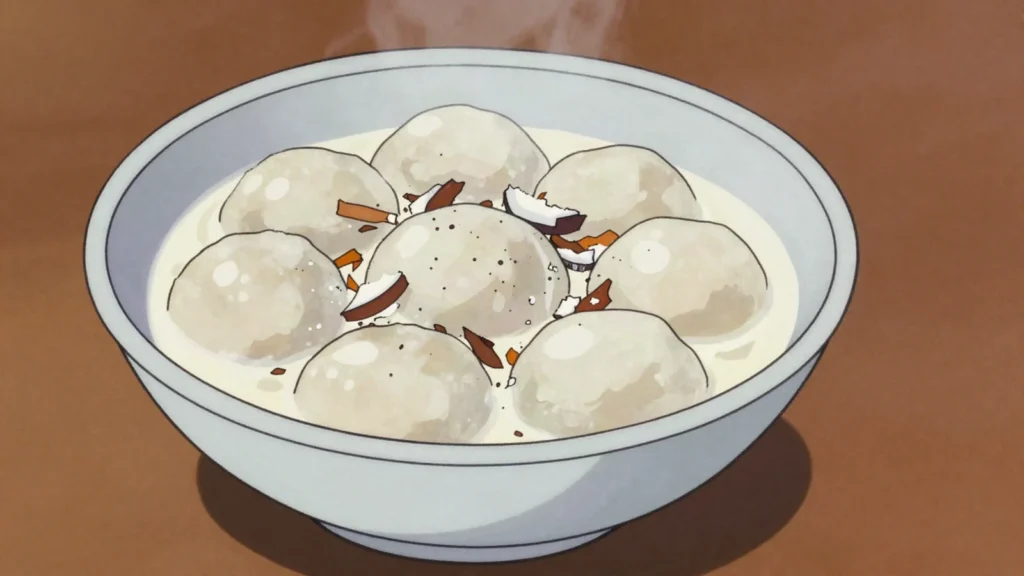
Topai is a dessert from Tonga: boiled flour dumplings served in hot sweetened coconut cream. A simple Tongan sweet made from store flour, cooked for large groups and eaten with the fingers.
How long does Topai take to make?
Topai takes 15 minutes of preparation and 25 minutes of cooking. The recipe makes serves 6. It is rated easy to make.
What can I substitute in Topai?
Yes, within limits. Tinned full-fat coconut cream replaces freshly squeezed; shake the tin hard before opening. Coconut milk replaces water in the dough for a richer dumpling. Kamaimai, coconut toddy syrup, replaces sugar in the sauce and is the more traditional sweetener, giving a darker caramel note. Mashed ripe banana worked into the dough is a very common household variation and makes softer, sweeter dumplings. Self-raising flour replaces plain flour plus baking powder directly. A split vanilla pod or a little essence in the sauce is common, though the plainest version has neither.
What is the most important thing to get right in Topai?
Flour arrived by ship as an imported good. It was never formally colonised. Crack a mature coconut over a bowl. Never chop at a coconut on a board. Grate the flesh out with a scraper. Put the grated coconut in a clean cloth. Add a little warm water to it. The thick first pressing is the cream.