
Ingredients
Hot water crust
- 500 gplain flour
- 1 tspsalt
- 150 glard
- 180 mlwater
- 1egg yolk
Filling
- 800 gcoarsely chopped pork shoulder
- 200 gpork belly, chopped
- 100 gbacon, chopped
- 2 tspsalt
- 2 tspground white pepper
- 1 tspground mace
- 1 tspdried sage
- ½ tspground nutmeg
- ½ tspanchovy essence, optional
Jelly
- 2pig’s trotters, split
- 1onion
- 2bay leaves
- 1 tsppeppercorns
- 1.5 litreswater
To glaze
- 1egg, beaten
To serve
- cold, with pickle and mustard
Directions
- Make the jelly stock first, and ideally the day before. Simmer the trotters with the onion, bay and peppercorns for 3 to 4 hours, skimming. Keep it at a bare simmer and skim it patiently, because a cloudy jelly is the mark of a boiled stock.
- Strain it and chill it, and it should set to a firm wobbling jelly. Test it on a cold plate. Keep about a fifth of the meat as fatty belly, because a lean filling comes out dry and crumbly.
- Mix in the salt, white pepper, mace, sage and nutmeg. Fry a small piece and taste it before you fill anything. Chill the filling while you make the pastry. Now the hot water crust, which must be worked warm. Bring the lard and water to a rolling boil in a pan.
- Pour the boiling liquid into the flour and salt and mix quickly with a wooden spoon, then bring it together by hand. It must be genuinely boiling. Work it while it is hot, as hot as you can bear. Cooled hot water crust cracks and will not shape, and this is the single reason most first attempts fail.
- Keep a third of the pastry warm under a cloth for the lid. Now raise the pie: flour a jam jar or a wooden dolly and mould the warm pastry up around the outside of it. Work it up evenly to about 8 mm thick, with no thin patches or cracks. Let it cool and firm for 20 minutes, then twist the jar out gently. Pack the filling in firmly, doming it slightly.
- Roll the reserved pastry into a lid, sit it on top, and crimp the edges together firmly. Cut a hole in the centre of the lid, about 1 cm across. Steam escapes through it during baking and the jelly goes in through it afterwards.
- Bake at 200°C (390°F) for 30 minutes, then reduce to 160°C (320°F) for a further hour to an hour and a quarter. Now let it cool for about an hour, until it is warm rather than hot. Warm the jelly stock until it is just liquid and pour it slowly into the hole using a funnel or a jug. Pour it in slowly, a little at a time, and wait between pours.
- Keep going until it will take no more, which is usually more than you expect. Both the pie and the jelly must be warm. Serve it cold, cut into wedges, with pickle and English mustard.
Technique
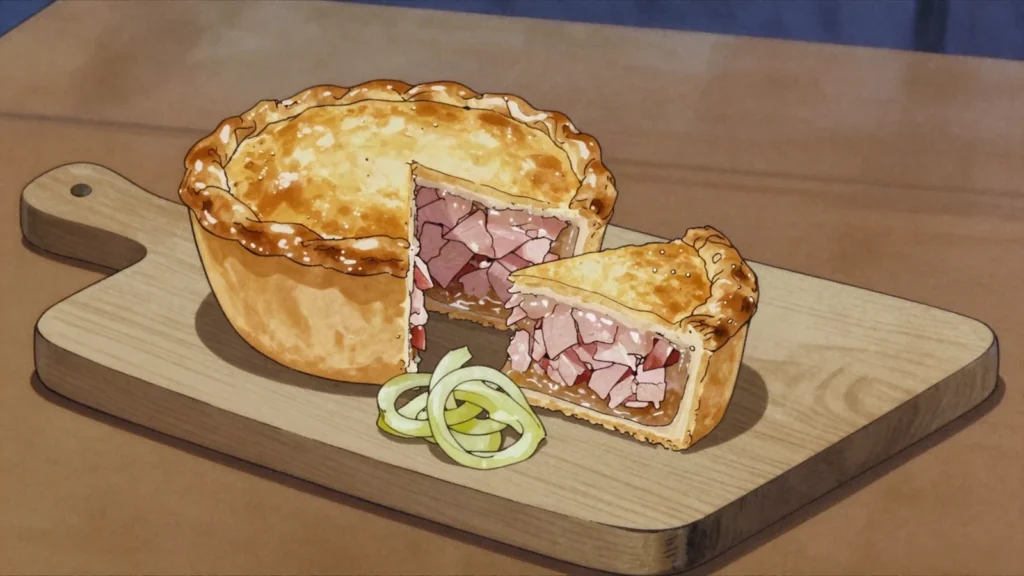
- Melton Mowbray pies use uncured pork, which is why the meat is grey rather than pink.
- The bow-sided shape comes from baking free-standing without a tin.
- It keeps four or five days refrigerated and is never served warm.
Substitutions
- A springform tin in place of hand-raising, which is much easier.
- Powdered gelatine dissolved in good pork stock, if you have no trotters.
Variations
- With a hard-boiled egg through the centre, as a gala pie.
- Made small, as individual pies.
- With apple or black pudding in the filling.
History
Melton Mowbray pork pies, sold to fox-hunting gentry from the 1830s, won PGI status in 2009 after a long legal battle.
Frequently asked questions
What is Pork pie?
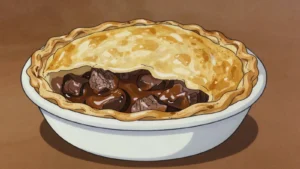
Pork pie is a snack from United Kingdom: hot-water crust pastry filled with chopped pork and set jelly, eaten cold. Melton Mowbray pork pies, sold to fox-hunting gentry from the 1830s, won PGI status in 2009 after a long legal battle.
How long does Pork pie take to make?
Pork pie takes 1 hr plus overnight setting of preparation and 2 hr of cooking. The recipe makes 1 large pie, or 6 small. It is rated hard to make.
What can I substitute in Pork pie?
Yes, within limits. A springform tin in place of hand-raising, which is much easier. Powdered gelatine dissolved in good pork stock, if you have no trotters.
What is the most important thing to get right in Pork pie?
Make the jelly stock first, and ideally the day before. Simmer the trotters with the onion, bay and peppercorns for 3 to 4 hours, skimming. Keep it at a bare simmer and skim it patiently, because a cloudy jelly is the mark of a boiled stock.