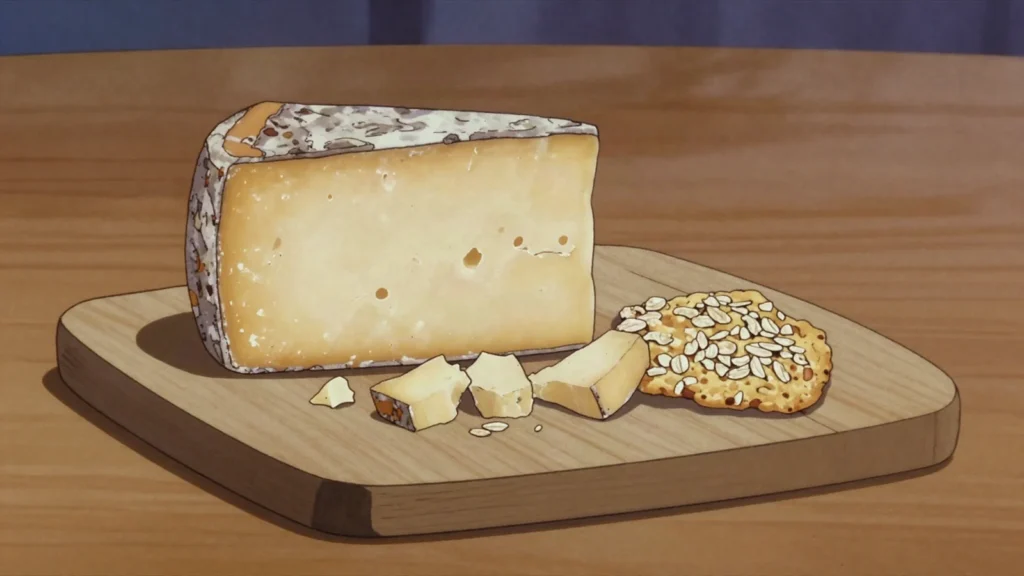

Ingredients
Milk and cultures
- 10 litreswhole cow’s milk, unhomogenised, ideally raw from a single herd
- ¼ tspmesophilic starter culture (Flora Danica or a cheddar blend)
- ½ tspvegetarian microbial rennet, diluted in 50 ml cool unchlorinated water
- ¼ tspcalcium chloride, diluted, if using shop-bought pasteurised milk
- 30 gfine dairy salt (about 2.5% of the drained curd weight)
Equipment
- 1large stainless pot with a water bath
- 1dairy thermometer, curd knife, cheesecloth
- 1hard-cheese mould and press capable of 20–25 kg pressure
- Cheese wax, or muslin plus vegetable shortening, for bandaging
Directions
- Warm the milk slowly in a water bath to 31°C (90°F), stir in the starter culture, cover and ripen 45 minutes; the milk should smell faintly yogurty and the pH drop to about 6.5.
- Stir in the diluted rennet with 20 up-and-down strokes, still the milk and leave undisturbed 45 minutes until you get a clean break, a curd that splits cleanly over a finger with clear whey in the crack.
- Cut the curd into 6 mm cubes and rest 5 minutes, then raise the temperature very slowly to 39°C (100°F) over 40 minutes, stirring gently. Rushing this traps moisture and gives a soft, acidic cheese.
- Hold at 39°C (100°F) for 30–45 minutes, stirring, until the curds shrink to the size of small beans and feel springy. Drain off the whey.
- Cheddar the curd: let it knit into a slab, cut it into blocks, and stack and turn them every 15 minutes for 1.5 hours at 38°C (100°F). The blocks stretch into a fibrous, layered texture like pulled cooked meat and the pH falls to about 5.3.
- Mill the slabs into 2 cm pieces, sprinkle over the salt in three additions and toss for 10 minutes until it is absorbed and the curds squeak.
- Pack into a cloth-lined mould and press at 5 kg for 15 minutes, redress, then press at 20 kg for 12 hours, redressing and turning once.
- Air-dry the wheel 2–3 days until the rind is dry to the touch, then either wax it or bandage it with muslin and vegetable shortening.
- Age at 10–12°C (50–55°F) and 85% humidity for a minimum of 6 months, turning weekly; a true West Country farmhouse cheddar goes 12–24 months and develops crunchy tyrosine crystals.
Technique
- Cheddaring, the stacking and turning of the drained slabs, is the step that gives the cheese its name and its dense, close, flaky body. Skip it and you have a generic pressed curd.
- Traditional West Country farmhouse cheddar uses animal rennet; the microbial rennet given here keeps the recipe vegetarian and behaves almost identically.
- Food safety: if using raw milk, the cheese must be aged at least 60 days at 10°C (50°F) or above before eating, and the make room and all equipment must be sanitised.
- Cheddar is not a protected name, but West Country Farmhouse Cheddar is PDO and must be made in Somerset, Dorset, Devon or Cornwall to this method.
Substitutions
- No press? Improvise with a mould inside a bucket and stacked weights, but you must reach roughly 20 kg or the wheel will crack and mould internally.
- Pasteurised supermarket milk works if it is not ultra-filtered; add calcium chloride or the curd will never set firm.
Variations
- Cave-aged Cheddar Gorge cheese, matured in the Somerset caves.
- Bandaged clothbound cheddar, drier and more savoury than waxed.
- Red Leicester and Cheshire, the same family with annatto or a crumblier make.
History
Named for Cheddar Gorge in Somerset, whose caves matured it; royal accounts record purchases from the twelfth century. West Country farmhouse cheddar holds PDO status.
Frequently asked questions
What is Cheddar cheese?
Cheddar cheese is a cheese & dairy from United Kingdom: firm aged cow’s milk cheese, crumbly and sharp, grated over everything from toast to pies. Named for Cheddar Gorge in Somerset, whose caves matured it; royal accounts record purchases from the twelfth century. West Country farmhouse cheddar holds PDO status.
How long does Cheddar cheese take to make?
Cheddar cheese takes 1 hr 30 min of preparation and 4 hr making, then 6–24 months ageing of cooking. The recipe makes about 1 kg cheese. It is rated hard to make.
What can I substitute in Cheddar cheese?
Yes, within limits. No press? Improvise with a mould inside a bucket and stacked weights, but you must reach roughly 20 kg or the wheel will crack and mould internally. Pasteurised supermarket milk works if it is not ultra-filtered; add calcium chloride or the curd will never set firm.
What is the most important thing to get right in Cheddar cheese?
Food safety: if using raw milk, the cheese must be aged at least 60 days at 10°C (50°F) or above before eating, and the make room and all equipment must be sanitised.