
Ingredients
Batter
- 300 gdried split mung beans, nokdu, soaked 6 hr
- about 150 ml water
- 1 tspsalt
Filling
- 200 gkimchi, squeezed and chopped
- 150 gmung bean sprouts, blanched
- 1 bunchgosari, bracken fern, optional
- 4spring onions, in lengths
- 1onion, sliced
- 150 gminced pork, optional
Seasoning
- 1 tbspsesame oil
- 2 clovesgarlic, minced
- black pepper
- salt
To fry
- plenty of vegetable oil, or a little pork fat
Dipping sauce
- 3 tbspsoy sauce
- 1 tbspvinegar
- 1 tspsugar
- 1 tspgochugaru
- 1 tspsesame seeds
- a little chopped onion
To serve
- hot, with makgeolli
Directions
- Use dried split mung beans, which are yellow and hulled, rather than whole green ones. If you can only get whole green mung beans, soak them and rub off the skins, which float and can be poured away.
- Soak them for at least six hours, or overnight. They must be soaked until completely soft, since undersoaked beans grind into a gritty batter that never cooks smooth. Drain the soaked beans thoroughly. Grind the drained beans with just enough water to let the blender turn.
- Use as little water as possible, since a thin batter spreads out into a floppy pancake that will not crisp. The batter should be thick, like a heavy porridge, and should hold a shape on a spoon.
- Grind it fairly coarse rather than perfectly smooth, leaving some texture in it. A slightly coarse grind gives the characteristic bite, and a completely smooth batter is pasty. Let the batter stand for twenty minutes if you have time. Squeeze the kimchi hard to remove its liquid before chopping it.
- Squeeze the blanched beansprouts too, and pat everything dry. Wet filling makes a soggy pancake that steams instead of frying, and this is the commonest fault. Use well-fermented, sour kimchi rather than fresh, since its acidity cuts the richness and its flavour is deeper.
- Fold the filling through the batter rather than layering it. Season it with sesame oil, garlic, salt and pepper and taste a little of the raw batter. Season it firmly, since mung bean batter is bland on its own.
- Use far more oil than for an ordinary pancake, enough to come a few millimetres up the sides. A dry pan gives a soft, pale, disappointing pancake. Heat the oil over a medium heat, not a fierce one. Keep the heat moderate throughout, since the pancake is thick and the inside needs time to cook through. Now spoon a ladleful into the pan and spread it into a thick round.
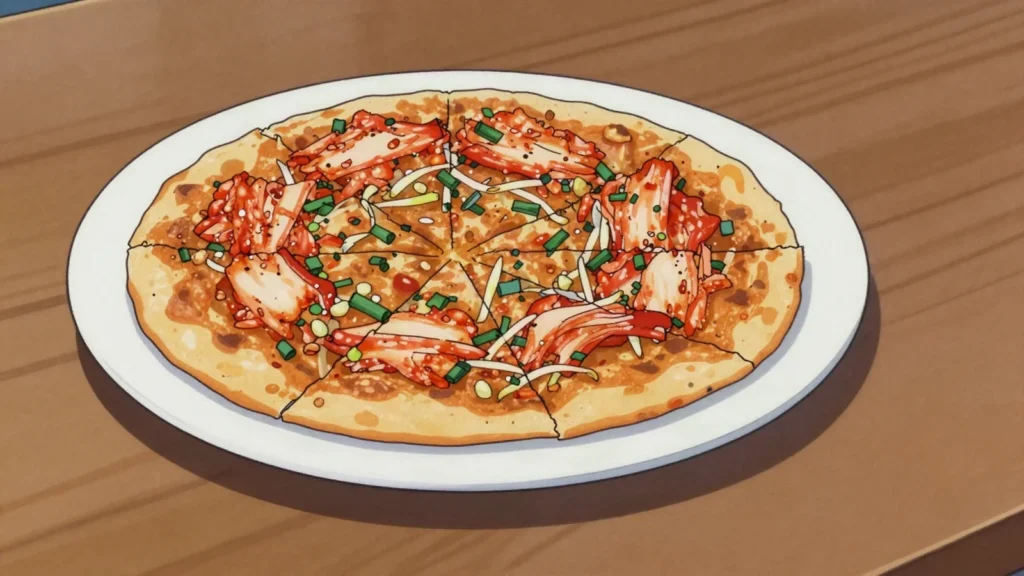
- Make them about a centimetre thick, which is much thicker than a pajeon. Do not press it flat, and let it keep its rough uneven edge, since those edges are what crisp best. Fry for four to five minutes on the first side without moving it. Leave it alone until the underside is deep golden, since moving it early tears it apart.
- Turn it once, add a little more oil at the edge, and fry the other side for three or four minutes. Press it lightly with the spatula after turning so the whole surface contacts the pan. Serve it immediately, cut into wedges with scissors or a spatula. It goes soft within minutes of cooling, which is why it is fried to order everywhere it is sold.
Technique
- There is no flour in the batter, only ground mung beans.
- Generous oil is what crisps the edges, and a dry pan gives a soft pancake.
- Well-fermented sour kimchi is better here than fresh.
Substitutions
- Whole green mung beans, soaked and hulled.
- Vegetable oil in place of pork fat.
Variations
- Made without meat, which is very common.
- With gosari, bracken fern, which is traditional.
- Made small, as individual pancakes.
Frequently asked questions
What is Nokdu-jijim?
Nokdu-jijim is a snack from North Korea: crisp-edged griddled mung-bean pancake with vegetables.
How long does Nokdu-jijim take to make?
Nokdu-jijim takes 30 min plus 6 hr soaking of preparation and 30 min of cooking. The recipe makes 6 pancakes. It is rated medium to make.
What can I substitute in Nokdu-jijim?
Yes, within limits. Whole green mung beans, soaked and hulled. Vegetable oil in place of pork fat.
What is the most important thing to get right in Nokdu-jijim?
Use dried split mung beans, which are yellow and hulled, rather than whole green ones. If you can only get whole green mung beans, soak them and rub off the skins, which float and can be poured away.