The big, juicy summer fruits of hot, dry places — the perfumed musk melons of Persia and Central Asia, the crisp honeydews, and the watermelon of Africa — eaten cold and raw, with salt, with ham, with cheese, and almost never cooked.
Where it comes from
Melons come from two lines. The sweet melons — cantaloupe, muskmelon, honeydew, Galia, charentais — are varieties of one species from Persia and Central Asia, where the melons of Turkmenistan, Uzbekistan and Afghanistan are still considered the finest in the world and are a matter of regional pride. Watermelon is a different plant from southern Africa, domesticated in Egypt and Sudan and grown across the ancient world for its water as much as its sweetness; it is in Egyptian tombs and the Bible.
In the kitchen both are eaten raw and cold, and the tradition across the Mediterranean and Middle East is to pair their sweetness with salt: melon with prosciutto in Italy, watermelon with feta in Greece and Turkey, with salty white cheese and bread in Egypt and the Levant, sprinkled with salt or chilli-lime in Mexico. Watermelon seeds are roasted and eaten; the rind is pickled in the American South and China.
Varieties
- Cantaloupe / charentais — Small, ribbed, grey-green, with deep orange, intensely perfumed flesh. The French summer melon; the American ‘cantaloupe’ is a netted muskmelon.
- Honeydew — Smooth, pale green or yellow skin, pale green sweet flesh; mild and crisp, keeps well.
- Galia — Netted, yellow-green, with sweet green flesh; an Israeli cross, widely sold.
- Piel de Sapo and Canary — Spanish ‘toad skin’ and yellow Canary melons; oval, crisp, very sweet, long-keeping.
- Watermelon — Large, striped or dark green, with red (or yellow) crisp watery flesh; seeded and seedless types.
- Central Asian melons (Uzbek, Turkmen) — Torpedo-shaped, thin-skinned, intensely sweet; little exported, legendary at home.
In the kitchen
Cold and raw. Melon with thin slices of prosciutto or jamón, with a squeeze of lime, with mint, or with a little salt and pepper; watermelon in chunks with feta, mint, olive oil and black olives, or with chilli and lime. Blended with a little water and sugar, watermelon becomes agua de sandía; melon, a soup with a little wine.
Neither cooks well — heat destroys the perfume and leaves sweet mush — though watermelon rind pickles and a quickly grilled slice of watermelon are both genuine dishes. Watermelon seeds, dried and roasted with salt, are a snack across the Middle East and China.
Choosing and keeping
A ripe muskmelon smells sweet at the stem end and gives slightly there; a ripe watermelon sounds hollow when knocked, feels heavy for its size and has a creamy yellow patch where it lay on the ground. Neither ripens further after picking, though a melon softens.
Whole melons keep a week or so at room temperature; cut, they keep two or three days wrapped in the fridge and taint everything with their scent. Serve cold but not ice-cold, which numbs the flavour.
Dishes with melon
 TizanaChopped fruit in juice or soda, served in a cup with a spoon
 Mostarda di CremonaWhole candied fruits in fiery mustard syrup, eaten with boiled meats and cheese.
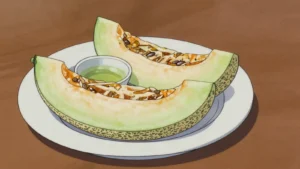 Turkmen melonintensely sweet Vaharman and Gulaby melons eaten fresh or dried
 Mets de pistacheGround squash seeds steamed in leaf parcels into a dense savoury loaf
 MelonpanSoft bun under a crisp cookie crust scored into a melon pattern.
 SalpicónChopped fruit in watermelon juice or soda, eaten with a spoon
 Kontomire stewCocoyam-leaf palava stew with egusi seeds and smoked fish
 PinakbetIlocano vegetable stew of bitter melon, okra and squash flavoured with bagoong
Melon and watermelon is tagged on 21 dishes from 22 countries in the atlas. These notes are written from general knowledge and carry no per-fact citation — see About.