
Ingredients
Parcels
- 8large banana leaves, plus 8 more for lining the pot
- 1.4 kgchicken, jointed into 8 pieces
- Strips of banana-leaf midrib or kitchen string, for tying
Sauce
- 150 gsmooth groundnut paste (unsweetened)
- 2onions, finely chopped
- 3tomatoes, chopped
- 1green capsicum, chopped
- 3garlic cloves, crushed
- 1 tbspgrated ginger
- 2 tspcurry powder
- 1 tspground black pepper
- 2 tspsalt
- 250 mlwater
- 2 tbspoil
To serve
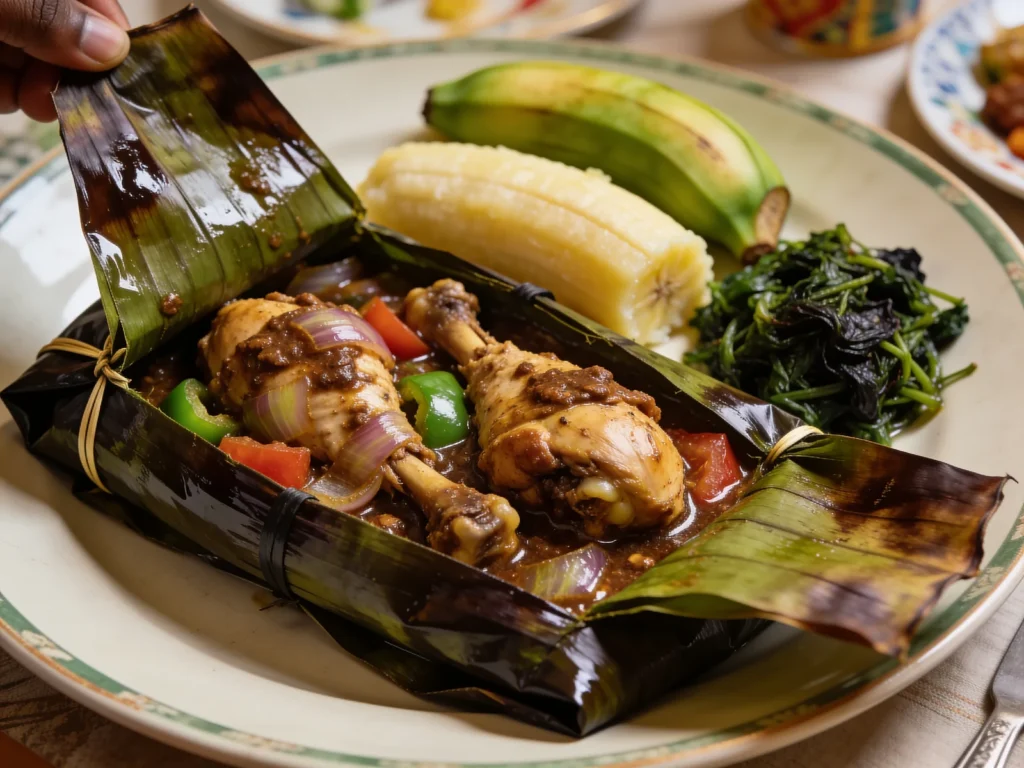
- Steamed matooke, sweet potato or rice
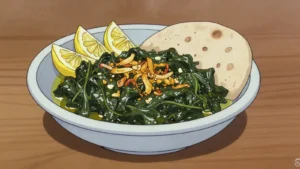
- Bugga (steamed greens)
Directions
- Pass each banana leaf briefly over an open flame or a hot plate until it darkens, glistens and turns limp. This wilting is essential – an unwilted leaf splits the moment you fold it.
- Season the chicken with salt, pepper, garlic, ginger and curry powder and leave 30 minutes.
- Fry the onions in the oil for 6 minutes, add the tomatoes and capsicum and cook 8 minutes to a soft, jammy base.
- Loosen the groundnut paste with the water to a smooth cream, stir it into the vegetables and warm gently for 3 minutes without boiling hard, so it does not split. Season well – it should taste slightly over-salted, since nothing will be added later.
- Lay two wilted leaves in a cross for each parcel. Place two pieces of chicken in the centre and spoon over a generous quarter of the sauce.
- Gather the leaf edges up over the filling and fold them down neatly to make a sealed pouch, then tie firmly around the neck with a strip of leaf midrib. The parcel must be tight enough that no sauce escapes.
- Line a heavy pot with the extra leaves and a lattice of banana stalks or a rack, add 4 cm of water, sit the parcels on top and cover with more leaves and a tight lid.
- Steam over low heat for 2 to 2.5 hours, topping up the water without letting it touch the parcels. The luwombo is ready when the leaf is dark brown and translucent, the chicken pulls from the bone and the sauce has thickened and darkened. Serve unopened, one parcel per person, to be untied at the table.
Technique
- Luwombo is a Buganda court dish, created in 1887 by Kabaka Mwanga II’s personal cook, and it is still the dish of weddings, introductions and Christmas.
- The whole point is that no steam or aroma escapes. The parcel concentrates everything, so the sauce goes in almost dry and thickens as the chicken releases its juices – do not add extra liquid.
- Wilting the leaf over flame is not for looks. It softens the fibres and releases a faint smoky-green aroma that seasons the food from the outside in.
Substitutions
- Foil or baking parchment can hold the parcel if banana leaves are unavailable, but you lose the leaf aroma entirely – add a couple of extra leaves to the pot if you can find any.
- Beef, goat, smoked fish or mushrooms are all cooked as luwombo; groundnut luwombo with no meat at all is a common fasting dish.
Variations
- Luwombo lw’ente, made with beef in the same groundnut sauce.
- Luwombo of mushrooms and smoked groundnut, the vegetarian version served at the same feasts.
History
A stew of meat, chicken, fish or vegetables, wrapped and steamed inside banana leaves rather than cooked in an open pot, developed within Buganda, the largest traditional kingdom within what is now Uganda, and generally credited to royal Buganda court cooking, with one account tracing its invention to a royal chef seeking a more refined, elegant way to serve food to the king and his household compared to ordinary open stewing. Its steaming inside sealed banana leaf parcels both concentrates and blends the dish’s flavours and reflects a distinctly Bugandan cooking technique layered onto ingredients found more broadly across the region. Luwombo carries significant ceremonial weight in Ugandan culture specifically, closely associated with weddings and other major celebrations rather than treated as routine everyday cooking.
Frequently asked questions
What is Luwombo?
Luwombo is a main from Uganda: chicken, beef or groundnuts steamed in banana leaves; royal Buganda dish. A stew of meat, chicken, fish or vegetables, wrapped and steamed inside banana leaves rather than cooked in an open pot, developed within Buganda, the largest traditional kingdom within what is now Uganda, and generally credited to royal Buganda court cooking, with one account tracing its invention to a royal chef seeking a more refined, elegant way to serve food to the king and his household compared to ordinary open stewing. Its steaming inside sealed banana leaf parcels both concentrates and blends the dish’s flavours and reflects a distinctly Bugandan cooking technique layered onto ingredients found more broadly across the region. Luwombo carries significant ceremonial weight in Ugandan culture specifically, closely associated with weddings and other major celebrations rather than treated as routine everyday cooking.
How long does Luwombo take to make?
Luwombo takes 40 min of preparation and 2 hr 30 min of cooking. The recipe makes 4 servings. It is rated medium to make.
What can I substitute in Luwombo?
Yes, within limits. Foil or baking parchment can hold the parcel if banana leaves are unavailable, but you lose the leaf aroma entirely – add a couple of extra leaves to the pot if you can find any. Beef, goat, smoked fish or mushrooms are all cooked as luwombo; groundnut luwombo with no meat at all is a common fasting dish.
What is the most important thing to get right in Luwombo?
Gather the leaf edges up over the filling and fold them down neatly to make a sealed pouch, then tie firmly around the neck with a strip of leaf midrib. The parcel must be tight enough that no sauce escapes.