
Ingredients
Broth
- 2 kgbeef bones, preferably leg and marrow
- 1 kgbeef shin, in one piece
- 5 litrescold water
- 1thumb ginger, sliced
- 1whole head of garlic
Broth spices, in a bag
- 2star anise
- 1cinnamon stick
- 1 tbspfennel seeds
- 1 tspcumin seeds
- 1 tspSichuan peppercorns
- 3bay leaves
- 4cloves
- 1 tspwhite peppercorns
- 1small piece of caoguo, black cardamom
Noodle dough
- 600 ghigh-protein wheat flour
- 1 tspsalt
- 300 mlwarm water
- 1 tsppenghui, or 1/2 tsp bicarbonate of soda
- oil, for coating
Chilli oil
- 60 gcoarse chilli flakes
- 200 mlvegetable oil
- 1star anise
- 1 tspSichuan peppercorns
- 1/2 tspsalt
To serve
- 1white radish or daikon, in thin half-moons
- a large handful of coriander, chopped
- 4garlic sprouts or spring onions, sliced
- chinkiang vinegar, at the table
Directions
- Put the bones in a large pot and cover them with cold water. Bring it to a hard boil and boil for ten minutes. Drain it all off and rinse the bones and the pot thoroughly. Return the bones and the whole piece of shin to the clean pot. Cover with the five litres of cold water. Bring it slowly to the boil and skim every trace of foam.
- Skim repeatedly over the first twenty minutes. Now the crucial rule about the heat. Add the ginger and the whole head of garlic. Tie the spices into a muslin bag and lower it in. Simmer it uncovered for four to five hours.
- Take the piece of shin out after two hours. It should be tender enough to slice but not falling apart. Let it cool, then wrap it and chill it. Chilled meat slices far more thinly than warm meat.
- Remove the spice bag after three hours, since longer makes it bitter. Strain the broth through muslin at the end. Skim the fat from the surface, leaving a thin film. It should be clear enough to see the bottom of a bowl through it.
- Season it with salt and taste it carefully. Slice the white radish into thin half-moons. Blanch them in boiling water for two minutes and drain them. Simmer them in the strained broth for ten minutes before serving. They should be translucent and soft but should hold their shape.
- Mix it into the flour and bring it to a rough dough. Knead it hard for fifteen minutes. Cover it and rest it for thirty minutes. Knead it again for ten minutes. Rest it again for another thirty minutes. Divide the dough into ropes and coat them generously in oil. Cover them and rest them for at least three hours. Dough that has not rested long enough will simply snap.
- Take a rope and hold one end in each hand. Pull it apart slowly and steadily without jerking. Fold it in half and pull again. The slapping stretches them evenly and stops them sticking.
- Repeat until you reach the thickness you want. Put the chilli flakes and salt in a heatproof bowl. Heat the oil with the star anise and Sichuan peppercorns. Bring it to about 190C, until the spices are fragrant. Strain out all of the whole spices.
- Pour the hot oil over the chilli flakes in three stages. It should sizzle hard and turn deep red. Let it cool and settle for at least an hour. Bring a large pot of water to a rolling boil. Drop the pulled noodles in and stir once.
- Cook them for sixty to ninety seconds only. Fresh hand-pulled noodles are done almost as soon as they float. Lift them out with a spider straight into warmed bowls. Slice the chilled beef shin as thinly as you can.
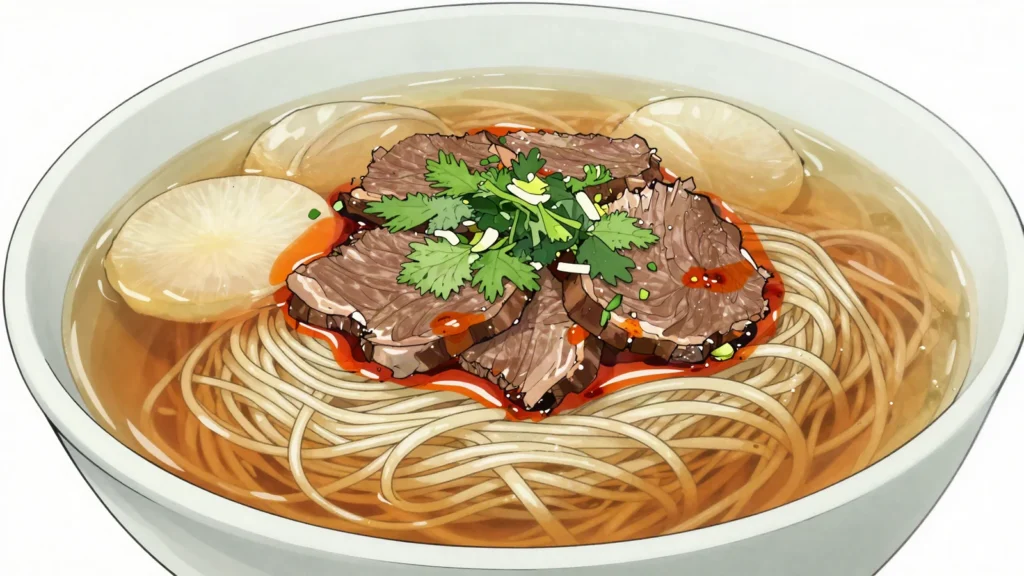
- Put noodles in each bowl and ladle the hot clear broth over. Lay the radish slices and beef over the noodles. Spoon the red chilli oil over the surface. Scatter coriander and garlic sprouts generously over the top. Serve it immediately with chinkiang vinegar at the table. The bowl should show all five colours clearly.
Technique
- Never let the broth boil after the initial skim, since it turns cloudy and cannot be recovered.
- Rest the oiled noodle dough for at least three hours or it snaps when pulled.
- Pour the hot oil over chilli flakes in three stages, since all at once scorches them.
Substitutions
- Bicarbonate of soda in place of penghui alkaline water.
- Shop-bought fresh ramen-style noodles, if hand-pulling defeats you.
Variations
- With a wider noodle, such as the flat kuan cut.
- With extra chilli oil, which is how locals order it.
- With pickled garlic served alongside.
History
Traced to Lanzhou Hui cook Ma Baozi around 1915; the standard is summed up as one clear, two white, three red, four green, five yellow.
Frequently asked questions
What is Lanzhou Beef Noodle Soup?
Lanzhou Beef Noodle Soup is a soup & stew from China: hand-pulled noodles in clear beef broth with radish, chili oil and coriander. Traced to Lanzhou Hui cook Ma Baozi around 1915; the standard is summed up as one clear, two white, three red, four green, five yellow.
How long does Lanzhou Beef Noodle Soup take to make?
Lanzhou Beef Noodle Soup takes 1 hour plus 4 hours resting of preparation and 5 hours of cooking. The recipe makes 6 servings. It is rated hard to make.
What can I substitute in Lanzhou Beef Noodle Soup?
Yes, within limits. Bicarbonate of soda in place of penghui alkaline water. Shop-bought fresh ramen-style noodles, if hand-pulling defeats you.
What is the most important thing to get right in Lanzhou Beef Noodle Soup?
Put the bones in a large pot and cover them with cold water. Bring it to a hard boil and boil for ten minutes. Drain it all off and rinse the bones and the pot thoroughly. Return the bones and the whole piece of shin to the clean pot. Cover with the five litres of cold water. Bring it slowly to the boil and skim every trace of foam.