
Ingredients
Nut
- fresh kola nuts, Cola nitida or Cola acuminata
To serve
- a shallow wooden or ceramic bowl
- a small knife
Sometimes with
- alligator pepper
- peanut butter or garden egg
Directions
- There is nothing to cook. The whole of this is presentation, sequence and who is handed what, and that is the dish.
- Buy nuts that are firm and heavy with unbroken skin, and keep them wrapped in damp leaves or cloth so they do not dry out.
- A dried kola nut goes hard and loses most of its aroma, so freshness is the only quality question.
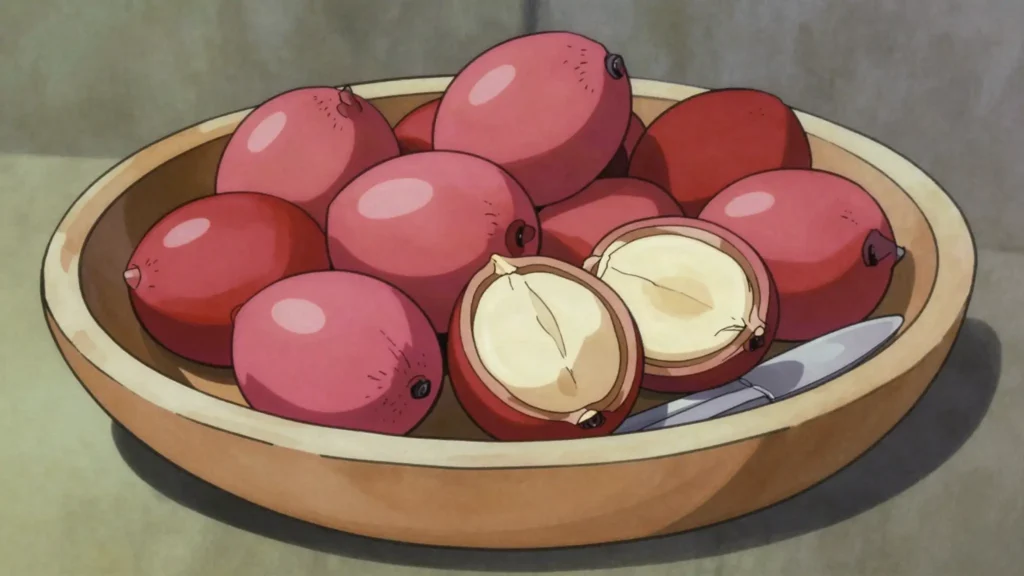
- Wash the nuts and set them whole in a shallow bowl.
- Present the bowl to the guest first, with both hands.
- Offering kola to a visitor on arrival is the opening move of hospitality across much of West and Central Africa, and refusing it is a serious thing.
- The guest touches or acknowledges the nut and returns it to the host, who then breaks it.
- Who breaks the kola is fixed by seniority, and in many communities it is the eldest man present. Getting that order wrong is the mistake outsiders make.
- Split the nut along its natural seam with a thumbnail or a small knife into its lobes.
- The number of lobes is read as a sign in some traditions, and a nut that splits into an unusual number is remarked on.
- Share the lobes around the group, starting with the most senior person.
- Chew a lobe slowly. It is hard, dense and very bitter at first, and the bitterness fades to a sweetness after a minute or two.
- Do not swallow it quickly. A lobe is chewed over several minutes and it is a social act rather than a snack.
- It is strongly stimulant, carrying roughly twice the caffeine of coffee by weight, along with theobromine, and it is chewed to stay alert on long journeys and through night ceremonies.
- Worth stating plainly: long-term heavy kola chewing has been associated in some studies with oral and digestive cancers, and it is a stimulant that affects blood pressure and sleep.
- It is offered at arrivals, at marriages, at naming ceremonies and at funerals, and the same nut carries all of those meanings depending on the occasion.
Technique
- Cola nitida has two lobes and Cola acuminata usually more, and different traditions prefer different species.
- The nut gave cola drinks their name and their original flavouring, though most now contain none of it.
- It is a major regional trade good and has been for centuries, moving north across the Sahara long before Europeans arrived.
Substitutions
- There is no substitute. The nut is the whole thing.
- Bitter kola, Garcinia kola, which is a different plant used in similar ceremonial ways.
Variations
- Eaten with alligator pepper, which is a common pairing.
- Ground and dried into a powder for drinks.
- The Mali and Manding tradition, where the nuts are exchanged rather than shared on the spot.
History
Kola is presented at welcomes, betrothals and funerals across the Gulf of Guinea, splitting the nut being an act of hospitality.
Frequently asked questions
What is Kola nut?
Kola nut is a snack from Equatorial Guinea: bitter caffeine-rich seed chewed slowly and offered to guests on arrival. Kola is presented at welcomes, betrothals and funerals across the Gulf of Guinea, splitting the nut being an act of hospitality.
How long does Kola nut take to make?
Kola nut takes 5 min of preparation and no cooking at all. The recipe makes variable. It is rated easy to make.
What can I substitute in Kola nut?
Yes, within limits. There is no substitute. The nut is the whole thing. Bitter kola, Garcinia kola, which is a different plant used in similar ceremonial ways.
What is the most important thing to get right in Kola nut?
There is nothing to cook. The whole of this is presentation, sequence and who is handed what, and that is the dish.