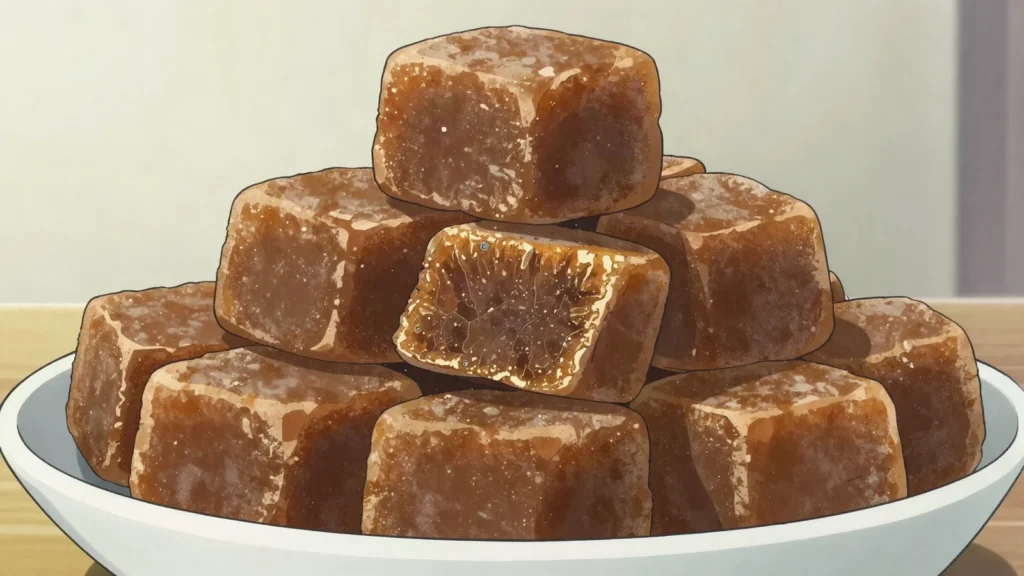

Ingredients
Cane
- 8 litresfresh sugarcane juice, garapa
- or 2 kg raw cane sugar and 1 litre water
Equipment
- a wide heavy copper or steel pan
- a sugar thermometer
- wooden moulds, or a lined tray
- a long wooden paddle
Traditionally
- an engenho, a cane mill
Used in
- pé de moleque
- paçoca
- cocada
- grated over cornmeal cakes
Directions
- Press the cane and strain the juice through cloth to remove the fibre. Strain it properly, because any fibre left in scorches and speckles the finished block. Pour the juice into a wide heavy pan and bring it to a boil.
- Use a wide shallow pan rather than a deep one, because the water has to evaporate and surface area is what does it.
- Skim the grey-green foam that rises constantly in the first half hour. Skim it patiently and thoroughly. Now boil it down steadily, stirring occasionally, for an hour or more.
- Use a long paddle and keep others away from the pan. Boil it to about 118 to 121°C (245 to 250°F), the firm ball stage. Use a thermometer. Below this the block never sets hard; above it, the rapadura turns brittle and glassy rather than firm and crumbly.
- Take it off the heat and let the bubbling subside. Now beat it with a wooden paddle for a few minutes as it cools slightly. Pour it quickly into wooden moulds or a lined tray, because it sets fast.
- Score it into blocks while it is still warm if you are using a tray. Let it cool completely and harden, which takes several hours.
- Wrap the blocks in paper and store them somewhere dry. Rapadura absorbs moisture from the air and goes sticky, so it must be kept sealed and dry.
Technique
- Rapadura with peanuts, coconut or cashew set into it is sold widely in Brazil.
- The quality varies enormously between mills and a good one is prized.
- It is grated rather than cut when used in cooking.
Substitutions
- Panela, piloncillo, jaggery or dark muscovado, which are all close.
- Raw cane sugar boiled with water, which approximates it without the cane flavour.
Variations
- With peanuts or coconut set into the block.
- Rapadura mole, a softer spreadable version.
- Dissolved in water as garapa or in cachaça.
History
Poured into wooden moulds at sugar mills since colonial times; the sertao staple that sweetened the Northeast before refined sugar arrived.
Frequently asked questions
What is Rapadura?
Rapadura is a snack from Brazil: hard block of unrefined cane sugar, chewed or shaved over dishes. Poured into wooden moulds at sugar mills since colonial times; the sertao staple that sweetened the Northeast before refined sugar arrived.
How long does Rapadura take to make?
Rapadura takes 20 min of preparation and 2 hr of cooking. The recipe makes about 1 kg. It is rated hard to make.
What can I substitute in Rapadura?
Yes, within limits. Panela, piloncillo, jaggery or dark muscovado, which are all close. Raw cane sugar boiled with water, which approximates it without the cane flavour.
What is the most important thing to get right in Rapadura?
Use a wide shallow pan rather than a deep one, because the water has to evaporate and surface area is what does it.