Ingredients
Semmelknödel
- 300 gstale white bread rolls, in small cubes
- 300 mlwarm milk
- 2eggs
- 1onion, finely chopped
- 40 gbutter
- 2 tbspchopped parsley
- 2 tbspplain flour
- salt, pepper, nutmeg
Kartoffelknödel
- 1 kgfloury potatoes
- 150 gpotato starch or plain flour
- 1egg yolk
- salt and nutmeg
- croutons fried in butter, for the centres
To cook
- a wide pan of well salted water
To serve
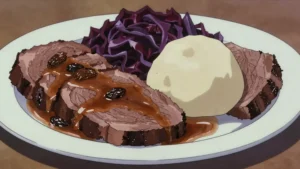
- with a roast and its gravy
- with Schweinebraten, Sauerbraten or goulash
- with mushroom sauce
Directions
- Use genuinely stale white rolls, two or three days old, cut into small cubes. If your bread is fresh, dry the cubes in a low oven for twenty minutes first. Warm the milk and pour it over the bread cubes. Use warm rather than cold milk, which soaks in far faster and more evenly.
- Let it stand for twenty to thirty minutes, turning it once or twice. Meanwhile fry the onion in butter until soft and golden, and let it cool. Add a spoonful more flour if it is sloppy, or a splash of milk if it will not cohere.
- Shape one dumpling and simmer it alone for ten minutes before committing the whole batch. If it falls apart, work another spoonful of flour into the mixture and test again. Roll them firmly so there are no cracks or loose pieces on the surface.
- Bring a wide pan of well salted water to a boil, then reduce it until it is barely trembling. Never boil dumplings hard, since the turbulence breaks them apart and they will disintegrate within a minute.
- Simmer them for fifteen to twenty minutes, uncovered. Do not stir them while they cook, and move them only with a slotted spoon if they stick to the base. Lift them out and let them drain for a moment.
- Boil floury potatoes in their skins, then peel them while still hot and pass them through a ricer. Cooking them in their skins keeps water out, which matters enormously since wet potato needs more flour and gives heavy dumplings.
- Let the riced potato cool and steam dry before adding anything. Work it as little as possible, since overworked potato dough turns elastic and heavy. Add only enough starch to make it just shapeable, and no more.
- Cook them exactly as the bread dumplings, in barely trembling salted water. Tearing them open with forks keeps them light where a knife compresses and smears them, and it is how it is done at the table. Serve them with a roast and plenty of gravy, which is their reason for existing.
Technique
- Semmelknödel are bread and Kartoffelknödel are potato, made by different methods.
- The water must barely tremble, never boil.
- Test one dumpling before committing the whole batch.
Substitutions
- Any stale white bread in place of Semmeln.
- Plain flour in place of potato starch, giving a slightly heavier result.
Variations
- Serviettenknödel, steamed in a cloth and sliced.
- Speckknödel, with bacon worked through.
- Halb und halb, made with half raw and half cooked potato.
History
Large, round dumplings, made from bread, potato or a combination of the two, boiled or steamed and served alongside meat dishes with gravy, documented across southern Germany, Austria and the wider Central European region for many centuries as an essential accompaniment to richer, sauce-based main dishes. Their dense, substantial texture, designed specifically to absorb and pair well with rich meat gravies and sauces, reflects a broader Central European culinary tradition of hearty, starch-based sides well suited to the region’s historically colder climate and correspondingly rich, warming cuisine. Knödel remain a staple side dish across southern Germany specifically, closely associated with Bavarian cuisine and traditional dishes including sauerbraten and roast pork.
Frequently asked questions
What is Knödel?
Knödel is a salad & side from Germany: boiled potato or bread dumplings mopping up roast gravy. Large, round dumplings, made from bread, potato or a combination of the two, boiled or steamed and served alongside meat dishes with gravy, documented across southern Germany, Austria and the wider Central European region for many centuries as an essential accompaniment to richer, sauce-based main dishes. Their dense, substantial texture, designed specifically to absorb and pair well with rich meat gravies and sauces, reflects a broader Central European culinary tradition of hearty, starch-based sides well suited to the region’s historically colder climate and correspondingly rich, warming cuisine. Knödel remain a staple side dish across southern Germany specifically, closely associated with Bavarian cuisine and traditional dishes including sauerbraten and roast pork.
How long does Knödel take to make?
Knödel takes 30 min plus 20 min resting of preparation and 20 min of cooking. The recipe makes 8 dumplings. It is rated medium to make.
What can I substitute in Knödel?
Yes, within limits. Any stale white bread in place of Semmeln. Plain flour in place of potato starch, giving a slightly heavier result.
What is the most important thing to get right in Knödel?
Use genuinely stale white rolls, two or three days old, cut into small cubes. If your bread is fresh, dry the cubes in a low oven for twenty minutes first. Warm the milk and pour it over the bread cubes. Use warm rather than cold milk, which soaks in far faster and more evenly.