
Ingredients
The base
- 2 kgtaro corms
- peeled
- or breadfruit
- or cassava
- or yam
The coconut
- 600 mlthick coconut cream
- freshly squeezed
The equipment
- a wooden pounding board
- a stone or wooden pestle
- clean dense volcanic stones
- never porous or river stones
- a fire to heat them
- long tongs or green sticks
Sometimes scattered over
- navele
- Barringtonia edulis nuts
- nangai kernels
- grated coconut
Directions
- Use stones that have been fired before. The cooking must be done first and fully. Peel all of the taro corms first. Oil your hands before peeling. Or wear gloves if you are sensitive. Boil or bake the corms until fully soft. Give them at least forty minutes. Cook it longer if it resists at all. Roast the whole breadfruit in the fire.
- Turn it over as the skin blackens. Give it about an hour depending on size. Cut the roasted breadfruit open. Remove the rind, core and any seeds. Keep only the cooked white flesh. Put the hot cooked base on the board.
- Pound it steadily with the pestle. Pound it while it is still hot. Cold starch will not work into a mass. Work quickly once it comes off the heat. It should become a smooth glossy mass. Flatten the pounded mass on the platter. Spread it out into a thick round.
- Press it out with your fist or a spoon. It must hold the liquid without leaking. Leave a good wall all around it. Grate the fresh coconut finely. Squeeze it to extract thick cream. Do not thin it down with water.
- Let them heat for a long time. Stones take a long time to heat through. Keep people back while they heat. Do not stand over the fire at all. Lift them with long tongs or green sticks. Pour the coconut cream into the hollow. Fill the hollow nearly up to the top. Lower a hot stone into the coconut cream.
- Stand back as each stone goes in. The escaping steam is scalding hot. Add stones until the cream boils properly. Two or three is usually enough. Lift out each one as it cools. Fold the boiled cream into the paste. Work it in from around the edges. The paste absorbs the hot cream.
- Work it until it is evenly combined. Judging it takes a careful look. Scatter navele or nangai nuts over it. Serving it is done from the platter. Bring the whole platter to the group. Everyone takes from the same board.
Technique
- The atlas describes roasted coconut cream, which no source supports. The roasting belongs to the breadfruit, roasted whole in the fire before the rind, core and seeds are removed; the coconut milk is poured into a hollow opened in the pounded paste and boiled in place by dropping fire-heated stones into it. Nothing goes on a stove at any point. Taro is also the most frequent and important base rather than breadfruit, with cassava, yam and fe’i banana also standard, and this is a northern Vanuatu dish of the Banks and Torres Islands, Northwest Santo, Malo and Maewo rather than a national one.
- Porous or waterlogged stones explode when heated, because trapped water flashes to steam with nowhere to escape. This is recognised in ni-Vanuatu practice: cooks use dense black volcanic stone and reject stones that fragment, since coral and limestone shatter almost at once. It matters especially here because the stones are lowered into the dish at the table with people seated around it.
- The base must be cooked through before pounding, since pounding is not a detoxification step. Taro carries calcium oxalate raphides that sting the mouth if undercooked; giant taro, used as a base in the Torres Islands, carries far more and needs lengthy baking and repeated boiling — cooks there use about twice the normal firewood for it. Cassava nalot must be grated and thoroughly heated before pounding, since raw cassava carries cyanogenic glucosides.
Substitutions
- Roasted breadfruit is soft enough to be pounded with a young coconut or a green pawpaw rather than a wooden pestle, which taro, cassava and yam need.
- Navele, the edible Barringtonia edulis nut, has a saponin-rich coastal relative in Barringtonia asiatica which is used to stun fish; the two grow on the same beaches, so buy the nuts rather than gathering unfamiliar ones.
Variations
- Coconut cream on top of a giant-taro nalot reduces the mouth stinging, which is one reason it is applied.
- Nalot was formerly prepared only by men, is eaten at ceremonies and festivals, and is obligatory at formal feasts in Northwest Santo.
- It is inseparable from its carved wooden platter, board and pestle, which are made and kept for the purpose.
History
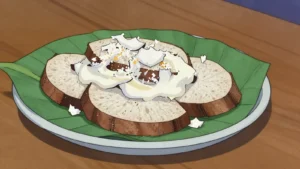
Breadfruit or taro is pounded on a wooden board with a stone pestle, then worked with roasted coconut cream into a smooth glossy mass.
Frequently asked questions
What is Nalot?
Nalot is a salad & side from Vanuatu: pounded breadfruit or taro blended with roasted coconut cream. Breadfruit or taro is pounded on a wooden board with a stone pestle, then worked with roasted coconut cream into a smooth glossy mass.
How long does Nalot take to make?
Nalot takes 1 hour of preparation and 1 hour 30 minutes of cooking. The recipe makes serves 10. It is rated hard to make.
What can I substitute in Nalot?
Yes, within limits. Roasted breadfruit is soft enough to be pounded with a young coconut or a green pawpaw rather than a wooden pestle, which taro, cassava and yam need. Navele, the edible Barringtonia edulis nut, has a saponin-rich coastal relative in Barringtonia asiatica which is used to stun fish; the two grow on the same beaches, so buy the nuts rather than gathering unfamiliar ones.
What is the most important thing to get right in Nalot?
Use stones that have been fired before. The cooking must be done first and fully. Peel all of the taro corms first. Oil your hands before peeling. Or wear gloves if you are sensitive. Boil or bake the corms until fully soft. Give them at least forty minutes. Cook it longer if it resists at all. Roast the whole breadfruit in the fire.