
Ingredients
The vegetables
- half a white cabbage
- about 600 g, shredded
- 3carrots, cut into batons
- 3potatoes, cut into chunks
- 2onions, sliced
The base
- 4 tablespoonsoil
- or niter kibbeh
- the spiced clarified butter
- 4 clovesgarlic, crushed
- a thumb of ginger, grated
- 1 tablespoonground turmeric
- half a teaspoon ground cardamom
- optional
- 2green chillies, slit
- optional
- salt and black pepper
- about 200 ml water
To serve
- injera, the sour flatbread
- alongside other dishes
- with a hot wat for contrast
- ayib, fresh curd cheese
Directions
- Use a full tablespoon, not a pinch. Wear gloves if it concerns you. Put the sliced onions in a dry pot first. Use no fat at all at this stage. Cook them over a medium heat, stirring.
- Continue until that liquid has gone. That takes about twelve minutes. Add the oil or niter kibbeh. Stir it through the softened onions.
- Cook them five minutes more. Add the garlic and ginger. Add the turmeric and cardamom.
- Cook them for two minutes. Lower the heat if the pot is running hot. Add a splash of water if it threatens to catch.
- Add them in order of how long they need. They take about twenty minutes. Add a little water with the root vegetables. Cover the pot. Use very little water.
- Cover it and cook it gently. Stir it occasionally. Add water only if it threatens to catch. The vegetables should be genuinely soft. Cook off any excess liquid at the end. Uncover the pot to do that.
- Mash one or two potatoes against the pot side. Season with salt and taste it. Grind over black pepper. Serve it on injera. Eating is done with the right hand.
Technique
- Stage the vegetables. Potato and carrot need about twenty minutes and cabbage about fifteen — everything added at once gives collapsed cabbage and hard potato.
- Cook the onions dry first, with no fat at all, until the liquid they release has gone. That takes about twelve minutes and is a genuine technique of this cooking, deepening them in a way frying from the start does not.
- Use very little water. The cabbage releases a great deal, and this is a braise rather than a stew — uncover the pot at the end to cook off any excess.
- Use a full tablespoon of turmeric, and buy it fresh. It fades within months into something dusty that gives a dull colour, and it stains hands, boards and cloth for days.
- Do not let the turmeric burn when it goes into the fat. It turns bitter quickly — lower the heat and add a splash of water if it threatens to catch.
- The vegetables should be genuinely soft, with the cabbage collapsed and the potatoes breaking. That softness is characteristic, and it surprises cooks used to keeping vegetables bright and crisp.
- Mash one or two potatoes against the side of the pot to thicken it naturally.
- Slit the chillies rather than chopping them, or leave them out. An alicha is meant to be the mild dish on the platter — heat is what the accompanying wat is for.
- Made with oil rather than niter kibbeh this is a fasting dish and entirely standard. Orthodox fasting excludes all animal products on most Wednesdays and Fridays plus long periods before feasts, which is why so much of this cooking is naturally vegan — an old religious practice rather than a modern choice.
- Niter kibbeh carries much of the flavour of this cooking and keeps for months unrefrigerated because it is clarified. Buy it from an Ethiopian grocer; ghee with a little cardamom is the nearest substitute and is not the same.
- Tikil gomen is essentially an alicha — the cabbage, carrot and potato version — and is also called atakilt wat or atkilt alicha. Those names overlap considerably and the atlas records that rather than inventing distinctions.
- This is never the whole meal. It sits on the communal injera among several dishes, with a hot red wat providing the contrast — that structure of mild alongside hot is how the meal is built.
Substitutions
- Oil replaces niter kibbeh for a fasting or vegan version, which is entirely traditional.
- Ghee with a pinch of cardamom is the nearest substitute for niter kibbeh if you cannot buy it.
- Green beans, courgette or squash join or replace the listed vegetables.
- The chillies can be left out entirely.
- Cardamom is optional; turmeric is not.
- Bread or rice replaces injera where teff flatbread is unavailable.
Variations
- Atakilt wat is the same dish under another name.
- Kik alicha, made with yellow split peas, is the pulse version of the same principle.
- Gomen, collard greens cooked soft, is the green dish on the same platter.
- Misir wat, the red lentil stew with berbere, is the hot counterpart.
- Shiro, made from ground chickpea or broad bean flour, is the everyday stew.
- Doro wat, the hot chicken stew, is the festive red dish alongside.
History
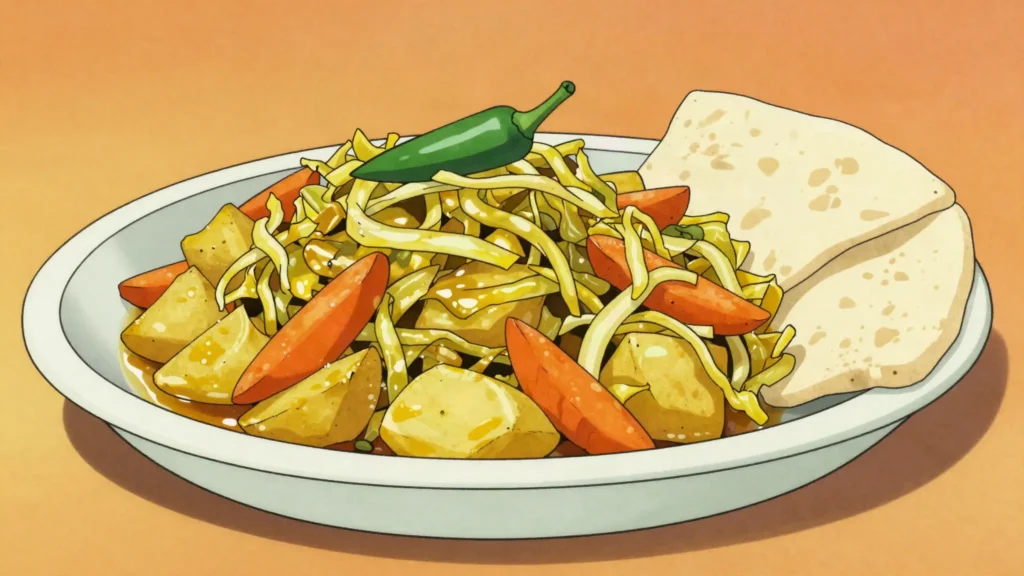
A mild stew of cabbage, carrot and potato, cooked with turmeric and a light touch of ginger and garlic rather than the fiery berbere spice central to many other Ethiopian dishes, developed as one of the gentler, less spicy options within the broader landscape of Ethiopian cooking, often included specifically to balance a meal otherwise dominated by spicier wats and stews. Its mild flavour made tikil gomen a practical dish for a wider range of eaters, including children or others preferring less intense spicing, without requiring an entirely separate style of cooking from the rest of an Ethiopian meal. It remains a common component of a beyaynetu, the mixed platter of several different stews and dishes typically served together on injera in Ethiopian dining.
Frequently asked questions
What is Tikil gomen?
Tikil gomen is a salad & side from Ethiopia: turmeric-braised cabbage, carrots and potatoes. A mild stew of cabbage, carrot and potato, cooked with turmeric and a light touch of ginger and garlic rather than the fiery berbere spice central to many other Ethiopian dishes, developed as one of the gentler, less spicy options within the broader landscape of Ethiopian cooking, often included specifically to balance a meal otherwise dominated by spicier wats and stews. Its mild flavour made tikil gomen a practical dish for a wider range of eaters, including children or others preferring less intense spicing, without requiring an entirely separate style of cooking from the rest of an Ethiopian meal. It remains a common component of a beyaynetu, the mixed platter of several different stews and dishes typically served together on injera in Ethiopian dining.
How long does Tikil gomen take to make?
Tikil gomen takes 20 minutes of preparation and 45 minutes of cooking. The recipe makes serves 6 as a side. It is rated easy to make.
What can I substitute in Tikil gomen?
Yes, within limits. Oil replaces niter kibbeh for a fasting or vegan version, which is entirely traditional. Ghee with a pinch of cardamom is the nearest substitute for niter kibbeh if you cannot buy it. Green beans, courgette or squash join or replace the listed vegetables. The chillies can be left out entirely. Cardamom is optional; turmeric is not. Bread or rice replaces injera where teff flatbread is unavailable.
What is the most important thing to get right in Tikil gomen?
Use very little water. The cabbage releases a great deal, and this is a braise rather than a stew — uncover the pot at the end to cook off any excess.