
Ingredients
Brining
- 2large napa cabbages, about 3 kg, quartered lengthways through the core
- 400 gcoarse sea salt (non-iodised)
- 3 litreswater
Rice paste
- 2 tbspglutinous rice flour
- 300 mlwater
- 1 tbspsugar
Seasoning paste
- 150 ggochugaru (Korean coarse chilli flakes)
- 12garlic cloves, minced
- 30 gginger, grated
- 1onion, blitzed to a purée
- 60 mlKorean fish sauce (myeolchi aekjeot)
- 40 gsalted fermented shrimp (saeujeot), chopped
- 1 tbspsugar or 2 tbsp grated Korean pear
Vegetables
- 400 gKorean radish (mu), cut into fine matchsticks
- 6spring onions, cut into 4 cm lengths
- 1small bunch garlic chives, cut into 4 cm lengths (optional)
- 1carrot, julienned (optional)
Directions
- Dissolve half the salt in the water and submerge the cabbage quarters, then sprinkle the rest of the salt between the leaves, concentrating on the thick white stems.
- Brine 5–6 hours, turning the quarters every 2 hours. They are ready when a thick stem bends double without snapping.
- Rinse the cabbage three times in cold water to remove surface salt and drain cut-side down for at least 30 minutes. Skimp on the draining and the kimchi will be watery.
- Whisk the rice flour into the water and cook over medium heat, stirring, for 5 minutes until it thickens to a translucent glue, then stir in the sugar and cool completely. This paste feeds the lactic bacteria and makes the seasoning cling.
- Mix the cooled paste with the gochugaru and leave 10 minutes for the chilli to bloom and the colour to deepen, then stir in the garlic, ginger, onion, fish sauce, saeujeot and sugar.
- Fold the radish, spring onion, chives and carrot through the paste until evenly coated and slightly wet-looking.
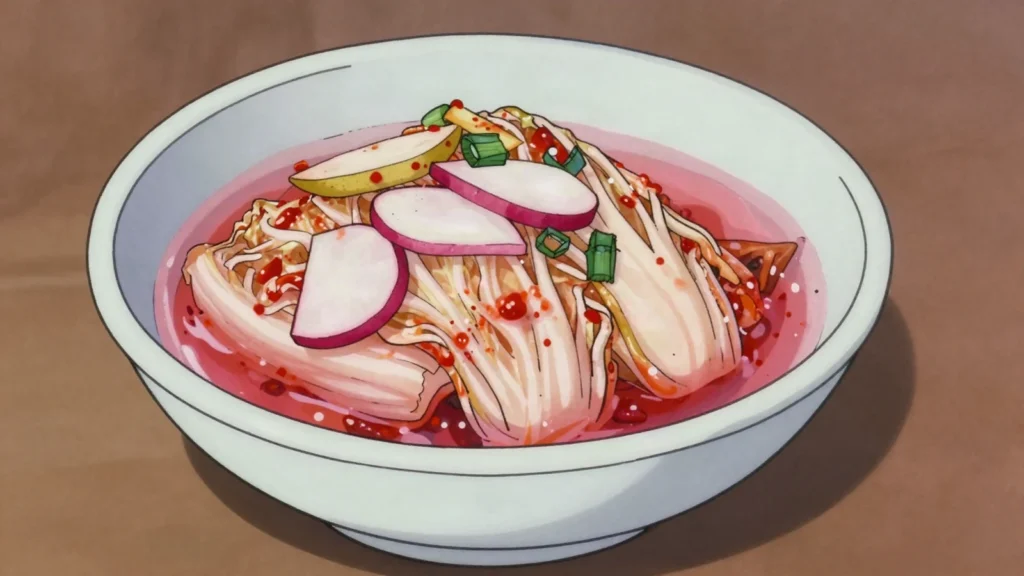
- Wearing gloves, open each cabbage quarter leaf by leaf and smear the paste over every leaf, using more on the stems than the tips. Fold each quarter over on itself and wrap it in its own outer leaf.
- Pack tightly into a jar, pressing down hard to expel air until the brine rises over the top, leaving 5 cm of headroom. Ferment at 18–20°C (65–70°F) for 2–3 days until it smells sour and bubbles rise when pressed, then refrigerate. It is good from day three and keeps fermenting for months.
Technique
- Kimjang, the communal late-autumn kimchi-making that supplies a household for the winter, is on the UNESCO intangible heritage list. This is the baechu kimchi made at that time.
- Use Korean gochugaru, not generic chilli powder or cayenne. It is sun-dried, mildly hot and fruity, and it is what gives kimchi its red colour without brutal heat.
- Pressing the air out matters. Kimchi ferments anaerobically under its own brine; exposed leaves at the top go soft, brown and mouldy.
- The jar will overflow as it ferments. Stand it on a plate or use a container with room, and burp it daily.
Substitutions
- For a vegan kimchi, replace the fish sauce and saeujeot with 3 tbsp soy sauce plus 20 g of dried shiitake and kombu steeped in hot water; the ferment is cleaner and less deep.
- No Korean radish: use daikon, which is milder and slightly more watery.
- Glutinous rice flour can be swapped for 3 tbsp of cooked, blended white rice or plain flour.
Variations
- Kkakdugi, cubed radish kimchi, crunchier and faster to ferment.
- Baek kimchi, the white non-spicy version brined with pear, jujube and pine nuts.
- Mul kimchi, a cold, soupy summer kimchi eaten with its brine as a drink.
History
A fermentation practice going back well over a thousand years across the Korean peninsula, long before the red kimchi eaten today existed: early versions were salted, fermented vegetables with no chili at all, since chili peppers are a New World crop that only reached Korea via Portuguese and Japanese trade routes in the 1500s–1600s. The now-familiar red, chili-heavy style developed from the 1700s onward, once pepper cultivation was established locally, and spread across the whole peninsula before its 1945 division. Kimjang, the communal autumn ritual of making enough kimchi to last a household through winter, remained central enough to Korean identity, north and south alike, that UNESCO inscribed it on its Intangible Cultural Heritage list in 2013.
Frequently asked questions
What is Kimchi?
Kimchi is a fermented & pickled from North Korea: northern-style fermented cabbage, milder and juicier than southern versions. A fermentation practice going back well over a thousand years across the Korean peninsula, long before the red kimchi eaten today existed: early versions were salted, fermented vegetables with no chili at all, since chili peppers are a New World crop that only reached Korea via Portuguese and Japanese trade routes in the 1500s–1600s. The now-familiar red, chili-heavy style developed from the 1700s onward, once pepper cultivation was established locally, and spread across the whole peninsula before its 1945 division. Kimjang, the communal autumn ritual of making enough kimchi to last a household through winter, remained central enough to Korean identity, north and south alike, that UNESCO inscribed it on its Intangible Cultural Heritage list in 2013.
How long does Kimchi take to make?
Kimchi takes 1 hr of preparation and 6 hr brining plus 2 to 5 days fermenting of cooking. The recipe makes about 3 kg (fills a 4 litre jar). It is rated medium to make.
What can I substitute in Kimchi?
Yes, within limits. For a vegan kimchi, replace the fish sauce and saeujeot with 3 tbsp soy sauce plus 20 g of dried shiitake and kombu steeped in hot water; the ferment is cleaner and less deep. No Korean radish: use daikon, which is milder and slightly more watery. Glutinous rice flour can be swapped for 3 tbsp of cooked, blended white rice or plain flour.