
Ingredients
Pudding
- 1 litrewhole milk
- 150 gsugar
- 60 gcornflour
- 30 grice flour
- 1 tbspbutter
- 1 tspvanilla or mastic
For the pan
- 3 tbspcaster sugar
- butter, for greasing
To serve
- ground cinnamon
- kaymak
Directions
- Kazandibi means the bottom of the cauldron, and the burnt layer is the dish rather than an accident.
- Grease a wide heavy pan and dust the base evenly with the caster sugar.
- Whisk the cornflour and rice flour into a little of the cold milk until smooth, then stir in the rest of the milk and the sugar.
- Cook it over a medium heat, stirring constantly, for about 15 minutes until it thickens to a heavy, glossy pudding.
- Stir without stopping and scrape the corners. Milk pudding catches in seconds and a scorched batch at this stage is ruined rather than improved.
- Beat in the butter and vanilla and take it off the heat.
- Pour the pudding onto the sugared pan and spread it to an even layer about 2 cm thick.
- Now the burning, which is the whole technique. Put the pan over a low to medium direct heat.
- Leave it there for 10 to 15 minutes without moving it at all.
- Do not stir, shake or lift it. The sugar underneath caramelises and then chars into a dark, bitter-sweet skin, and that skin only forms if it is left completely alone.
- Listen and smell rather than looking. You want a strong caramel smell tipping just towards burnt, and if it smells acrid it has gone too far.
- Lift a corner with a palette knife to check. The base should be deep brown to nearly black in patches, not merely golden.
- Take it off the heat and let it cool completely, then chill for at least 4 hours until firmly set.
- Cut it into rectangles and lift each one out with a palette knife.
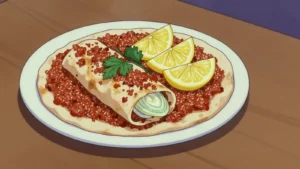
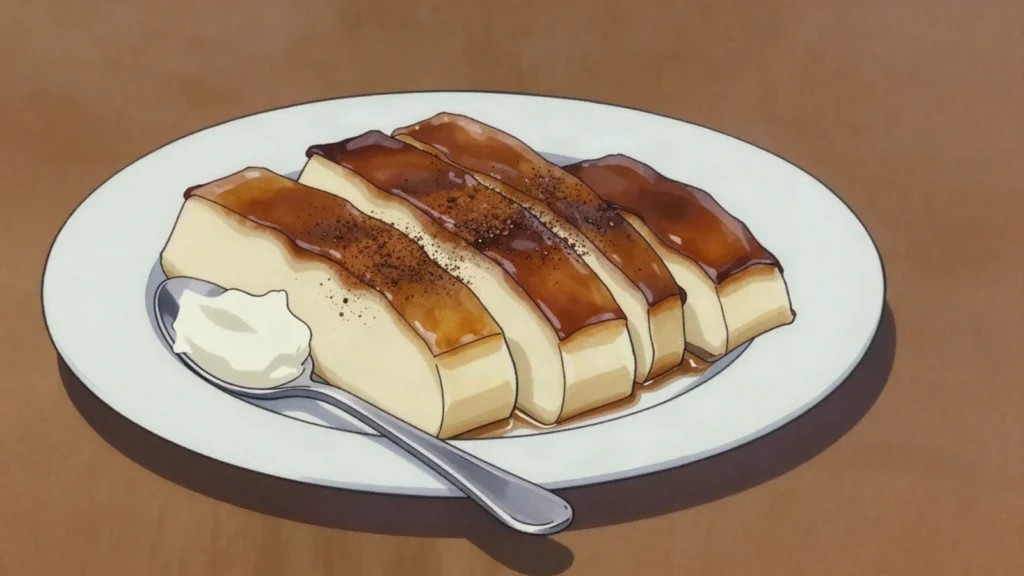
- Roll each rectangle up with the burnt side outward.
- Burnt side out, always. The whole point is that the dark caramelised layer is what you see and taste first, against the pale pudding inside.
- Serve cold, dusted with cinnamon, with kaymak alongside.
- It is Ottoman palace cooking, and it is traditionally made alongside tavuk göğsü, the milk pudding made with shredded chicken breast.
Technique
- The burnt layer should taste of caramel with a bitter edge, not of carbon.
- Mastic gives it the authentic Turkish resinous note and is worth finding.
- It is served very cold, straight from the fridge.
Substitutions
- All cornflour if you have no rice flour, accepting a slightly softer set.
- Clotted cream in place of kaymak.
Variations
- Tavuk göğsü kazandibi, made with shredded chicken breast.
- With a scoop of ice cream, which is how many Turkish shops serve it now.
- Made in individual pans as single portions.
History
Its name means bottom of the cauldron; it developed from tavuk gogsu, the Ottoman chicken-breast pudding.
Frequently asked questions
What is Kazandibi?
Kazandibi is a dessert from Turkey: milk pudding deliberately scorched on the pan base, rolled and served in caramelised slices. Its name means bottom of the cauldron; it developed from tavuk gogsu, the Ottoman chicken-breast pudding.
How long does Kazandibi take to make?
Kazandibi takes 20 min plus 4 hr chilling of preparation and 40 min of cooking. The recipe makes 8 servings. It is rated hard to make.
What can I substitute in Kazandibi?
Yes, within limits. All cornflour if you have no rice flour, accepting a slightly softer set. Clotted cream in place of kaymak.
What is the most important thing to get right in Kazandibi?
Kazandibi means the bottom of the cauldron, and the burnt layer is the dish rather than an accident.