
Ingredients
Cream
- 1 litredouble cream, at least 48% fat, not ultra-pasteurised
To serve
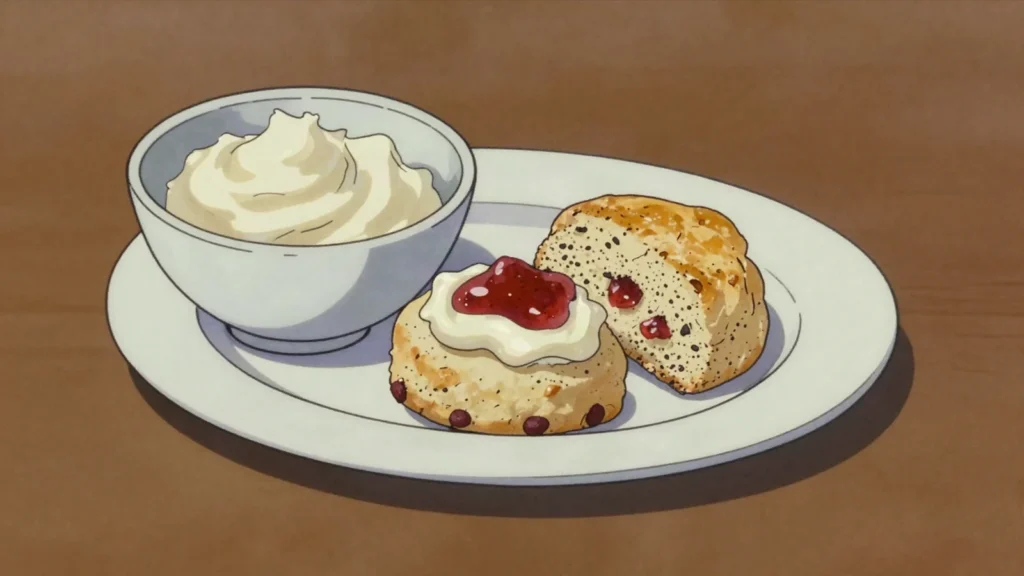
- warm scones
- strawberry jam
- tea
Directions
- The cream must not be ultra-pasteurised. UHT cream has been heated so far already that it will never form a crust, and this is the single reason most attempts fail.
- Pour it into a wide shallow ovenproof dish so it is no more than 5 cm deep. Depth is the enemy here — the crust forms at the surface, and a deep dish gives a thin skin over a lot of liquid cream.
- Bake, uncovered, at 80°C (175°F) for 12 hours. Overnight is the usual way.
- It must never bubble or simmer. Anything above about 90°C (195°F) and you get scorched cream rather than clotted cream, and the taste of it does not come out.
- After 12 hours the surface will be a thick, wrinkled, buttery-yellow crust. Take it out without shaking the dish.
- Cool at room temperature for an hour, then refrigerate the whole dish for 12 hours without disturbing it.
- The overnight chill is not optional. Warm, the crust is soft and tears; properly cold, it lifts away in solid slabs.
- Scoop the clotted layer off into a pot, leaving the thin liquid beneath. That liquid is excellent in scones, so keep it.
- Stir the clotted cream lightly to a spoonable, grainy thickness. It keeps four days in the fridge.
- Serve on scones with jam. Cornwall puts jam first and cream on top; Devon puts cream first and jam on top, and each considers the other wrong.
Technique
- Not ultra-pasteurised, shallow dish, 80°C (175°F), 12 hours, then chilled 12 hours.
- Never let it bubble.
- Keep the thin cream underneath for baking.
Substitutions
- A slow cooker on the lowest setting with the lid ajar, which holds the temperature well.
- Jersey or Guernsey cream, which is what gives the deep yellow colour of the real thing.
- Bought Cornish clotted cream, which carries PDO protection.
Variations
- Thunder and lightning — clotted cream and golden syrup on bread, a Cornish tea.
- Stirred into fudge, or served with hot apple pie.
History
Devon and Cornwall have scalded cream for centuries; Cornish clotted cream won PDO protection in 1998, and the jam-first order still divides the counties.
Frequently asked questions
What is Clotted cream?
Clotted cream is a cheese & dairy from United Kingdom: thick scalded cream with a golden crust, spread on scones beneath jam. Devon and Cornwall have scalded cream for centuries; Cornish clotted cream won PDO protection in 1998, and the jam-first order still divides the counties.
How long does Clotted cream take to make?
Clotted cream takes 10 min plus 12 hours chilling of preparation and 12 hours of cooking. The recipe makes makes about 400 g. It is rated easy to make.
What can I substitute in Clotted cream?
Yes, within limits. A slow cooker on the lowest setting with the lid ajar, which holds the temperature well. Jersey or Guernsey cream, which is what gives the deep yellow colour of the real thing. Bought Cornish clotted cream, which carries PDO protection.
What is the most important thing to get right in Clotted cream?
The cream must not be ultra-pasteurised. UHT cream has been heated so far already that it will never form a crust, and this is the single reason most attempts fail.