
Ingredients
Dough
- 500 gplain flour
- 7 ginstant yeast
- 300 mlwarm water
- 2 tspsalt
- 1 tspsugar
- 2 tbspolive oil
Topping
- 400 gminced lamb, quite fatty
- 2onions
- 1sweet red pepper
- 3tomatoes
- 1 bunchflat parsley
- 4 clovesgarlic
- 2 tbspred pepper paste
- 1 tbsptomato paste
- 1 tspcumin
- 1 tsppul biber
- 1 tspsalt
- black pepper
To serve
- lemon wedges
- flat parsley
- sliced onion with sumac
- ayran
Directions
- Make a soft dough with the flour, yeast, warm water, salt, sugar and oil, knead it 10 minutes, and prove for 1 hour 30 minutes.
- Now the topping, and the critical thing is that it must be wet, not dry.
- Grate or process the onions, pepper and tomatoes to a coarse pulp rather than chopping them.
- That vegetable pulp is what makes lahmacun work. It cooks down into the meat and keeps it moist over a very hot oven, and a dry chopped topping burns to gravel.
- Squeeze out some of the excess liquid, but keep the mixture noticeably wet.
- Mix the pulp with the mince, chopped parsley, garlic, both pastes and the spices, and work it thoroughly with your hands.
- Use minced lamb with real fat in it. Lean meat dries out completely in the time it takes the base to crisp.
- Heat the oven as hot as it will go, ideally 275°C (525°F) or more, with a stone or heavy tray inside.
- Divide the dough into eight and roll each out extremely thin, to about 25 cm and barely 2 mm thick.
- Roll it thinner than feels sensible. A lahmacun base should be a cracker-thin sheet, and any thickness turns it into a pizza, which it is not.
- Spread a thin layer of the meat mixture over the whole surface, right to the edges.
- Spread it thin and even, no more than a few millimetres. A thick layer steams instead of roasting and the base underneath stays pale.
- Slide it onto the hot stone and bake for 4 to 6 minutes.
- It is done when the edges are crisp and the meat is cooked and slightly caught at the edges, while the centre is still soft enough to roll.
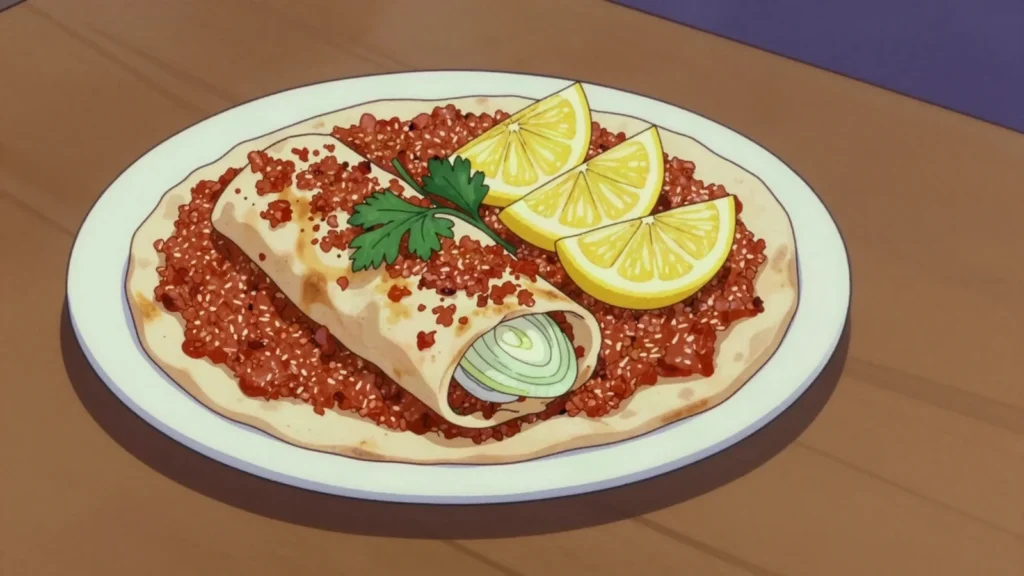
- Squeeze lemon over, pile on parsley and sumac onion, then roll it up tightly and eat it in the hand.
- The lemon and the raw parsley are not garnish. They cut the fat and the spice, and a lahmacun eaten without them is only half the dish.
- It is southeastern in origin, from Şanlıurfa, Gaziantep and Adana, and it is sold from wood-fired ovens by the piece.
Technique
- It is not Turkish pizza, whatever the menu says, and the base is not meant to be bready.
- Şanlıurfa versions run hotter with more pepper; Gaziantep leans on garlic.
- They freeze well part-baked and finish in a hot oven in two minutes.
Substitutions
- Minced beef, or a beef and lamb mix.
- A cast iron pan preheated under the grill, if you have no stone.
Variations
- With more chilli, as made in Adana.
- With pomegranate molasses drizzled over.
- Made small, as a meze-sized round.
History
A thin, crisp flatbread topped with a mixture of minced meat, tomato, pepper, onion and herbs, then baked at very high heat, documented across Turkey and the wider Levant for many generations, often described as Turkish pizza due to its round, flat, topped shape despite representing a genuinely separate and considerably older culinary tradition. Its very thin, crackerlike base, distinct from the thicker doughs used in many other flatbread traditions, reflects a specific regional baking technique requiring extremely high oven heat to achieve the correct texture within a short baking time. Lahmacun is traditionally eaten rolled up around fresh vegetables and herbs rather than cut into slices, and it remains one of Turkey’s most widely eaten street foods.
Frequently asked questions
What is Lahmacun?
Lahmacun is a street food from Turkey: thin crisp flatbread topped with spiced minced meat; rolled with parsley and lemon. A thin, crisp flatbread topped with a mixture of minced meat, tomato, pepper, onion and herbs, then baked at very high heat, documented across Turkey and the wider Levant for many generations, often described as Turkish pizza due to its round, flat, topped shape despite representing a genuinely separate and considerably older culinary tradition. Its very thin, crackerlike base, distinct from the thicker doughs used in many other flatbread traditions, reflects a specific regional baking technique requiring extremely high oven heat to achieve the correct texture within a short baking time. Lahmacun is traditionally eaten rolled up around fresh vegetables and herbs rather than cut into slices, and it remains one of Turkey’s most widely eaten street foods.
How long does Lahmacun take to make?
Lahmacun takes 40 min plus 1 hr 30 min rising of preparation and 25 min of cooking. The recipe makes 8 lahmacun. It is rated medium to make.
What can I substitute in Lahmacun?
Yes, within limits. Minced beef, or a beef and lamb mix. A cast iron pan preheated under the grill, if you have no stone.
What is the most important thing to get right in Lahmacun?
Now the topping, and the critical thing is that it must be wet, not dry.