
Ingredients
Dough
- 500 gplain flour
- 250 gghee (samna baladi), softened but not melted
- 2 tbspmilk powder
- 1 tbspsesame seeds, toasted
- 2 tspkahk essence (rihet el kahk), or 1 tsp ground mahleb plus half tsp ground cinnamon and a pinch of ground clove
- half tsp salt
- 7 ginstant yeast
- 1 tspsugar
- 120–150 mlwarm water
Agameya filling
- 100 ghoney
- 60 gghee
- 80 gplain flour
- 40 gsesame seeds
- 60 gwalnuts or pistachios, chopped
- half tsp ground cinnamon
To finish
- 100 gicing sugar, for dusting
Directions
- Make the agameya first. Melt the ghee, stir in the flour and cook over low heat 3–4 minutes to a pale roux, then add the honey, sesame, nuts and cinnamon and cook 2 minutes until it comes together as a thick, glossy caramel-coloured paste. Cool, then roll into pea-sized balls and chill until firm.
- For the dough, rub the ghee into the flour, milk powder, kahk essence, toasted sesame and salt with your fingertips. Keep rubbing for a full 10 minutes, well past the point where it looks done, until the mixture is the texture of damp sand and smells strongly of the spices. This step, called fark, is what makes kahk crumble rather than snap.
- Rest the rubbed mixture, covered, at room temperature overnight. The ghee soaks fully into the flour and the perfume develops.
- The next day, dissolve the yeast and sugar in the warm water, leave 10 minutes until frothy, and work it into the flour mixture just until it forms a soft, pliable dough. Stop as soon as it comes together: kneading develops gluten and makes kahk tough.
- Cover and prove 1 hour in a warm place. The dough will not double, only soften and puff a little.
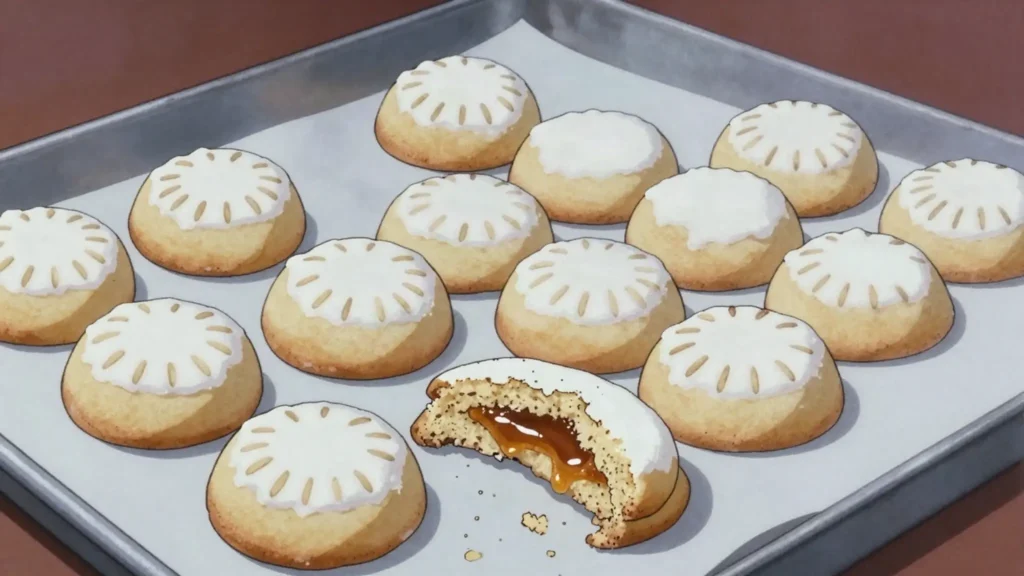
- Take walnut-sized pieces, flatten each in your palm, sit a ball of agameya in the middle, and close the dough over it, rolling smooth so there is no seam and no filling showing.
- Press the top with a molgat kahk, the traditional patterned tweezers, or mark it with a fork. Sit them on lined trays with space between.
- Bake at 180°C (350°F) for 20–25 minutes. They must stay pale, barely blond, with only the base lightly coloured. A browned kahk is an overbaked kahk.
- Cool completely on the tray, then bury them in icing sugar. They keep for weeks in a tin and improve after two or three days.
Technique
- Kahk is baked for Eid al-Fitr, and the tradition runs back to the Tulunid and Fatimid periods in Cairo, where the caliph’s kitchens turned out thousands of moulded kahk to distribute.
- Rihet el kahk is a proprietary aromatic blend sold by Egyptian spice merchants, usually built on mahleb with cinnamon, clove, orris root and sometimes rose. It is the single most identifiable smell of the Eid.
- The overnight rest and the long hand-rubbing are not optional flourishes. Together they are what create the sandy, dissolving texture Egyptians judge kahk by.
Substitutions
- No ghee: clarified butter is the closest, though samna baladi has a stronger, slightly cheesy aroma that defines the flavour. Do not use ordinary butter, whose water content ruins the crumb.
Variations
- Kahk bil-malban, filled with Turkish delight cubes instead of agameya.
- Kahk sada, plain and unfilled, simply dusted with icing sugar.
- Ghorayeba, the related melting shortbread of pure ghee, sugar and flour, baked alongside kahk for the same holiday.
History
Kahk moulds and offering scenes appear in pharaonic tomb art, and Fatimid caliphs had the biscuits distributed from the state kitchens at Eid.
Frequently asked questions
What is Kahk?
Kahk is a dessert from Egypt: crumbly sugar-dusted biscuits filled with nut paste, baked for Eid al-Fitr. Kahk moulds and offering scenes appear in pharaonic tomb art, and Fatimid caliphs had the biscuits distributed from the state kitchens at Eid.
How long does Kahk take to make?
Kahk takes 1 hr plus overnight resting of preparation and 25 min of cooking. The recipe makes about 40 biscuits. It is rated medium to make.
What can I substitute in Kahk?
Yes, within limits. No ghee: clarified butter is the closest, though samna baladi has a stronger, slightly cheesy aroma that defines the flavour. Do not use ordinary butter, whose water content ruins the crumb.
What is the most important thing to get right in Kahk?
For the dough, rub the ghee into the flour, milk powder, kahk essence, toasted sesame and salt with your fingertips. Keep rubbing for a full 10 minutes, well past the point where it looks done, until the mixture is the texture of damp sand and smells strongly of the spices. This step, called fark, is what makes kahk crumble rather than snap.