
Ingredients
The rice
- 150 gshort grain rice
- Egyptian or pudding rice
- or arborio
- rinsed once, lightly
- 300 mlwater
The milk
- 1.2 litreswhole milk
- 150 gsugar
- or to taste
- a pinch of salt
The flavouring
- 1 teaspoonvanilla extract
- or 2 or 3 grains of mastic
- mastiha, ground with sugar
- see the note
- or 1 tablespoon rose water
- or orange blossom water
To thicken, if needed
- 2 tablespoonscornflour
- slaked in a little cold milk
- optional
To finish
- ground cinnamon
- chopped pistachios
- or almonds, or raisins
- a drizzle of cream, optional
Directions
- Use short grain rice. It gives a thin pudding with separate grains. Rinse it once, lightly. So do not rinse it until the water runs clear.
- Cook the rice in water first. Add the water and bring it to a simmer. Cook it until the water is absorbed. That takes about ten minutes. Add the milk to the softened rice. Bring it to a bare simmer. Stir it constantly. Rinse the pan with cold water first. Do not dry it.
- Use a heavy pan. Thin pans catch far more readily. Simmer it for about thirty minutes. Stir it and scrape the base throughout. Do not let it boil hard. Keep it at a bare simmer.
- Add the sugar after about twenty minutes. So add it once the rice is nearly soft. Add a pinch of salt. The rice should be completely soft. Take it off looser than you want it. A pudding that looks right hot sets solid cold. Stir it in during the last five minutes. Simmer it to cook out the starch.
- Grind two or three grains with a little sugar. It also stops it clumping. Stir it in at the end. A tablespoon is enough for this quantity. Add them off the heat. Pour it into individual dishes. Cover the surface with cling film to prevent it.
- Cool it to room temperature first. Then refrigerate it for at least four hours. Cool it reasonably quickly and refrigerate it. Do not leave it standing warm for hours.
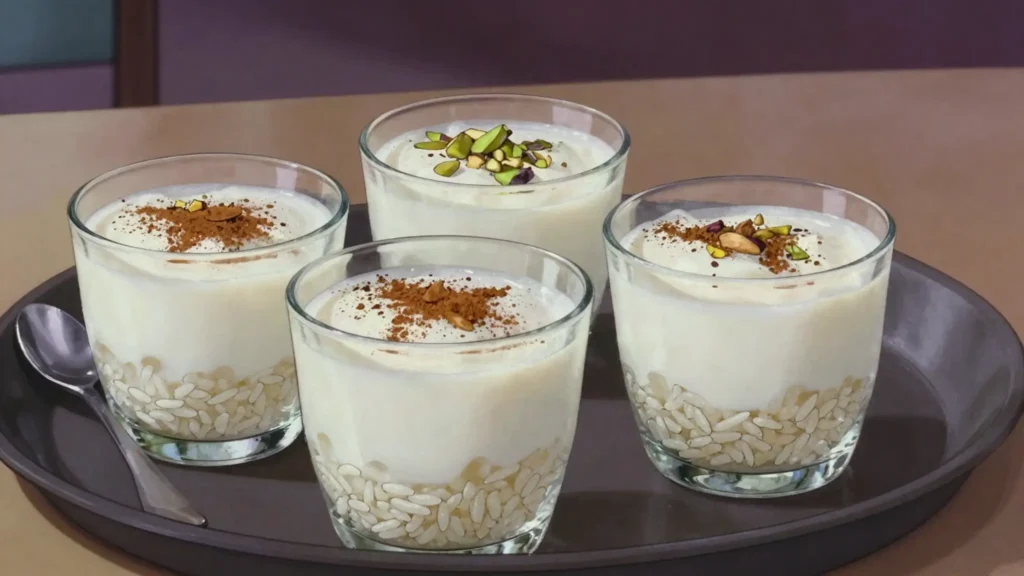
- Serve it cold from the refrigerator. Sprinkle cinnamon over. Scatter chopped pistachios or almonds. Add raisins if you like. It is cold, sweet and gentle after a long fast. Keep it covered.
Technique
- Take it off the heat looser than you want it — it should pour easily off a spoon and look almost too thin. Rice pudding thickens enormously as it cools, and one that looks right hot sets solid cold. That is the commonest failure with this dish.
- Stir constantly and scrape the base. Milk and rice starch catch easily, and a caught pan tastes burnt throughout with no way to rescue it. Rinse the pan with cold water first and do not dry it — that thin film reduces sticking considerably.
- Rinse the rice once and lightly, not until the water runs clear. The surface starch is what thickens the pudding, which is the opposite of what you want with plain rice.
- Use short grain rice. It releases far more starch than long grain, which gives a thin pudding with separate grains.
- Cook the rice in water first, then add the milk. Rice softens faster in water than in milk, so this shortens the process and reduces the risk of scorching.
- Add the sugar late, once the rice is nearly soft. Sugar in the pan makes it catch faster and slows the rice softening.
- The pinch of salt is not a mistake. It makes both the sweetness and the milk taste more.
- Never let it boil hard. Milk boils over without warning and scorches at the edges.
- Grind mastic with a little sugar, which acts as an abrasive and stops it gumming up the mortar. Two or three small grains is enough — it is very strong and too much tastes medicinal and bitter. Add it at the end, since the aroma is volatile.
- Rose water and orange blossom water are equally strong. A tablespoon for this quantity, added off the heat; more tastes of soap.
- Cornflour slaked in cold milk and stirred in during the last five minutes gives a smoother, glossier, more custard-like set and is common in Egyptian versions. Rice starch alone gives a more rustic result, and both are made.
- Chill at least four hours and preferably overnight. It sets as it chills and must be served genuinely cold — that is what makes this dish what it is rather than a warm rice pudding.
- Cover the surface with cling film if you do not want a skin, or stir it in when it forms. Keep it covered in the refrigerator too, since milk puddings take on other smells readily.
Substitutions
- Arborio or any pudding rice replaces Egyptian short grain.
- Vanilla replaces mastic and is the commonest flavouring.
- Rose water or orange blossom water give the other traditional scents.
- Cornflour guarantees the set and gives a smoother texture.
- Evaporated or condensed milk replaces some of the milk for a richer pudding; reduce the sugar if using condensed.
- Plant milks work, though they thicken differently and often need cornflour.
Variations
- Mahalabia is the Egyptian milk pudding set with cornflour and no rice.
- Om Ali, the bread and milk pudding, is the other great Egyptian milk dessert.
- Riz bi haleeb across the Levant is the same dish under another name.
- Sütlaç in Turkey is often baked until the top browns.
- Kheer and phirni in South Asia use cardamom and reduce the milk far further.
- A version layered with cream and nuts is sold in Egyptian dessert shops.
History
Rice pudding, made by slowly cooking rice in milk and sugar until thick and creamy, typically flavoured with vanilla and topped with cinnamon or crushed nuts, documented across Egypt for many generations as a beloved traditional dessert, closely related to rice pudding traditions found across the wider Middle East and Mediterranean region. Its simple, comforting preparation, requiring just rice, milk and sugar slowly simmered together, reflects a broadly shared regional dessert tradition adapted with Egypt’s own particular flavouring preferences and serving customs. Roz bel laban remains a common, everyday dessert across Egyptian households, valued for both its simplicity and its comforting, familiar flavour.
Frequently asked questions
What is Roz bel laban?
Roz bel laban is a dessert from Egypt: chilled creamy rice pudding scented with vanilla or mastic. Rice pudding, made by slowly cooking rice in milk and sugar until thick and creamy, typically flavoured with vanilla and topped with cinnamon or crushed nuts, documented across Egypt for many generations as a beloved traditional dessert, closely related to rice pudding traditions found across the wider Middle East and Mediterranean region. Its simple, comforting preparation, requiring just rice, milk and sugar slowly simmered together, reflects a broadly shared regional dessert tradition adapted with Egypt’s own particular flavouring preferences and serving customs. Roz bel laban remains a common, everyday dessert across Egyptian households, valued for both its simplicity and its comforting, familiar flavour.
How long does Roz bel laban take to make?
Roz bel laban takes 10 minutes of preparation and 45 minutes, plus chilling of cooking. The recipe makes serves 6. It is rated easy to make.
What can I substitute in Roz bel laban?
Yes, within limits. Arborio or any pudding rice replaces Egyptian short grain. Vanilla replaces mastic and is the commonest flavouring. Rose water or orange blossom water give the other traditional scents. Cornflour guarantees the set and gives a smoother texture. Evaporated or condensed milk replaces some of the milk for a richer pudding; reduce the sugar if using condensed. Plant milks work, though they thicken differently and often need cornflour.
What is the most important thing to get right in Roz bel laban?
Use short grain rice. It gives a thin pudding with separate grains. Rinse it once, lightly. So do not rinse it until the water runs clear.