
Ingredients
Molho, makes about 700 ml
- 500 mllager beer
- 200 mlpassata
- 300 mlbeef stock
- 1onion, finely chopped
- 2garlic cloves, crushed
- 2 tbsptomato purée
- 1bay leaf
- 1small piri-piri chilli, chopped
- 50 mltawny port or brandy
- 1 tspsweet paprika
- 30 gbutter
- 1 tbspcornflour slaked in 2 tbsp water
- salt and white pepper
Sandwich, per person
- 2thick slices of white pão de forma, lightly toasted
- 1thin beef steak, 100 g, beaten flat
- 1fresh sausage (linguiça or salsicha fresca), split lengthwise
- 2 slicessmoked ham (fiambre)
- 1 slicemortadela or chouriço
- 5 slicesqueijo flamengo or another flat melting cheese
- 1egg, fried, to top
To serve
- 400 ghand-cut chips, double-fried
- cold beer
Directions
- Sweat the onion and garlic in the butter for 8 minutes, then add the tomato purée and paprika and cook 2 minutes more.
- Pour in the beer, passata, stock, port, bay and chilli and simmer uncovered for 25–30 minutes, until reduced by a third and no longer tasting of raw beer.
- Blend smooth, pass through a sieve, return to the pan and thicken with the cornflour slurry to the consistency of thin gravy. It must pour freely. Season hard: savoury, faintly bitter, warm with chilli.
- Fry the steak fast in a very hot pan, 1 minute a side, and fry the split sausage until browned. Keep both hot.
- Build on a heatproof plate in this order: bread, ham, sausage, mortadela, steak, second slice of bread.
- Drape the cheese over the top and down all four sides so the sandwich is completely sealed in it.
- Grill under a hot grill or in a 220°C (425°F) oven for 5–6 minutes, until the cheese has melted over the edges and just started to blister.
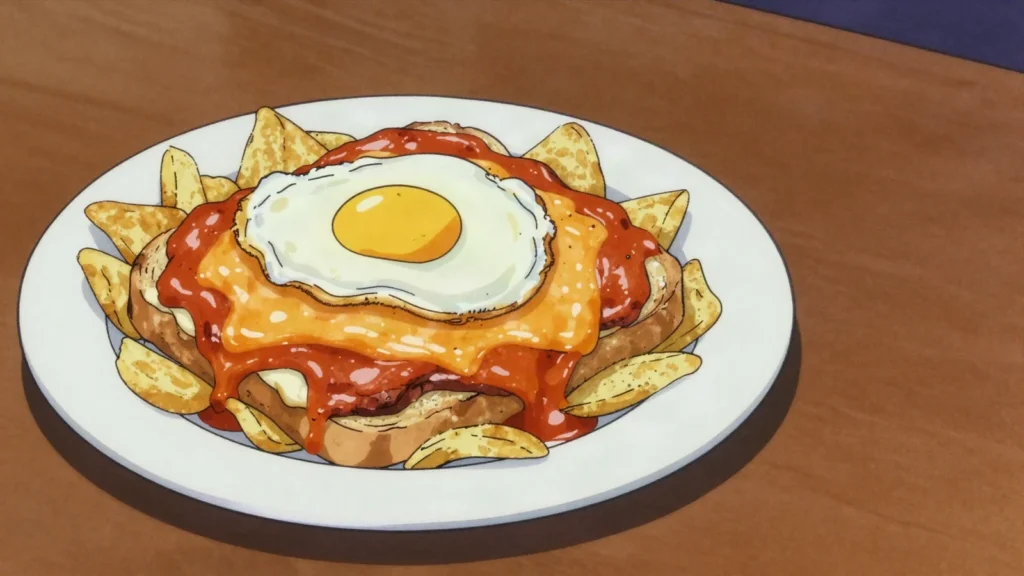
- Ladle 250–300 ml of hot sauce over each francesinha, slide the fried egg on top, surround with chips and serve with a knife, a fork and a beer.
Technique
- It was invented in Porto in the 1950s by Daniel David da Silva, a returned emigrant from France, as a heavier northern answer to the croque-monsieur. The name means little French girl.
- The sauce is the dish. Every house in Porto guards its own version and the only constants are beer, tomato and chilli. Judge a francesinha on its sauce alone.
- It has to arrive swimming. A dry francesinha, with the sauce merely spooned over, is a failed one.
- The cheese must seal the sides, not just the top, so the sauce sets against it rather than soaking the bread to mush.
Substitutions
- No queijo flamengo: mild Edam or a young Gouda, which is essentially what flamengo is.
- No piri-piri: any hot chilli sauce. The heat should be clearly present but never dominant.
- No port: a splash of brandy, or leave it out and add a teaspoon of sugar.
Variations
- Francesinha especial, with a second steak layered in.
- Some houses add a slice of chouriço or swap the steak for roast pork.
- A version served without the fried egg, which several older Porto cafés still consider correct.
History
A heavily layered sandwich of bread, multiple cured and fresh meats, melted cheese and a fried egg, drowned in a thick, spiced tomato-and-beer sauce, invented in Porto in the 1960s by Daniel da Silva, a Portuguese emigrant returning from France, who adapted the French croque-monsieur into a heartier, spicier, distinctly Portuguese version. Its name means ‘little Frenchwoman’ in Portuguese, a nod to its French inspiration, and da Silva is said to have deliberately made the dish spicier and richer than its French ancestor to better suit Portuguese tastes of the period. It remains most strongly associated with Porto specifically rather than Portugal broadly, and different Porto restaurants closely guard their own particular versions of the defining sauce, treating the exact recipe as a competitive secret.
Frequently asked questions
What is Francesinha?
Francesinha is a main from Portugal: porto sandwich layered with meats, melted cheese, spicy beer sauce. A heavily layered sandwich of bread, multiple cured and fresh meats, melted cheese and a fried egg, drowned in a thick, spiced tomato-and-beer sauce, invented in Porto in the 1960s by Daniel da Silva, a Portuguese emigrant returning from France, who adapted the French croque-monsieur into a heartier, spicier, distinctly Portuguese version. Its name means ‘little Frenchwoman’ in Portuguese, a nod to its French inspiration, and da Silva is said to have deliberately made the dish spicier and richer than its French ancestor to better suit Portuguese tastes of the period. It remains most strongly associated with Porto specifically rather than Portugal broadly, and different Porto restaurants closely guard their own particular versions of the defining sauce, treating the exact recipe as a competitive secret.
How long does Francesinha take to make?
Francesinha takes 30 min of preparation and 40 min of cooking. The recipe makes 2 servings, and they are enormous. It is rated medium to make.
What can I substitute in Francesinha?
Yes, within limits. No queijo flamengo: mild Edam or a young Gouda, which is essentially what flamengo is. No piri-piri: any hot chilli sauce. The heat should be clearly present but never dominant. No port: a splash of brandy, or leave it out and add a teaspoon of sugar.
What is the most important thing to get right in Francesinha?
Blend smooth, pass through a sieve, return to the pan and thicken with the cornflour slurry to the consistency of thin gravy. It must pour freely. Season hard: savoury, faintly bitter, warm with chilli.