
Ingredients
Semolina layer
- 500 gcoarse semolina
- 200 gcaster sugar
- 200 gbutter, melted
- 250 mlplain yoghurt
- 1 teaspoonbaking powder
- 1/2 teaspoonsalt
- 1 teaspoonvanilla
Date filling
- 500 gsoft dates, pitted
- 80 gbutter
- 1 teaspoonground cinnamon
- 1/2 teaspoonground cardamom
- a splash of orange blossom water
To finish
- 80 gblanched almonds, whole
- 3 tablespoonstahini, for the tin
- 150 mllight syrup, optional
Directions
- Put the semolina, sugar, baking powder and salt in a bowl. Stir them together thoroughly. Pour in the melted butter and rub it through. Work it with your fingers until evenly combined. Add the yoghurt and the vanilla. Mix it into a thick even paste. It should hold together and be spreadable. Add a spoonful of milk if it is too stiff.
- Cover it and rest it for thirty minutes. Making the date filling takes a few minutes. Check the dates carefully for any stones. If the dates are dry, soak them in hot water first. Melt the butter in a pan over a low heat. Add the dates and mash them with a wooden spoon.
- Work them until they form a thick smooth paste. Add the cinnamon, cardamom and orange blossom water. Keep working it for about five minutes. Let it cool until it is warm rather than hot.
- Brush a baking tray with tahini rather than butter. Tahini is traditional and stops it sticking well. Press half the semolina mixture into the base. Use wet hands or the back of a spoon. Press it flat and even right to the corners.
- Warm paste spreads far more easily than cold. Take it right to the edges of the tray. Press the remaining semolina mixture over the top. Lay those pieces over the dates and press them together. Smooth the whole surface flat with a wet hand.
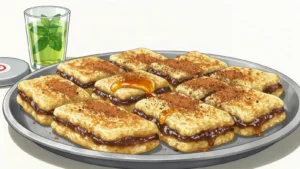
- Cut the tray into diamonds with a sharp knife. Cut right down through to the bottom. Press one whole almond into the centre of each diamond. Baking it takes about forty-five minutes. Heat the oven to 180C with a shelf in the middle. Bake it until the top is deep golden brown. The edges should be a shade darker still.
- Make it with equal sugar and water plus lemon juice. Let the syrup cool completely first. Pour the cold syrup over the hot cake. Use far less than for a plain basbousa. Let the tray cool completely on a rack. The layers firm up as it cools. Lift the diamonds out along the cut lines. Serve it with mint tea or with Arabic coffee. It keeps five days in a tin at room temperature.
Technique
- Basbousa is made across the Arab world under several names, including harissa in the Levant and namoura elsewhere.
- The Libyan date-layered version uses local dates for sweetness rather than relying entirely on syrup.
Substitutions
- Fine semolina can be used for a denser cake, though coarse gives the traditional texture.
- Any soft date works, and medjool gives a particularly rich filling.
Variations
- Plain basbousa has no filling and is soaked heavily in syrup.
- Some Libyan bakers add ground nuts to the date paste.
- A version with coconut worked into the semolina is also made.
History
A Libyan take on semolina cake that uses the country’s dates rather than plain syrup for sweetness.
Frequently asked questions
What is Basbousa bil tamr?
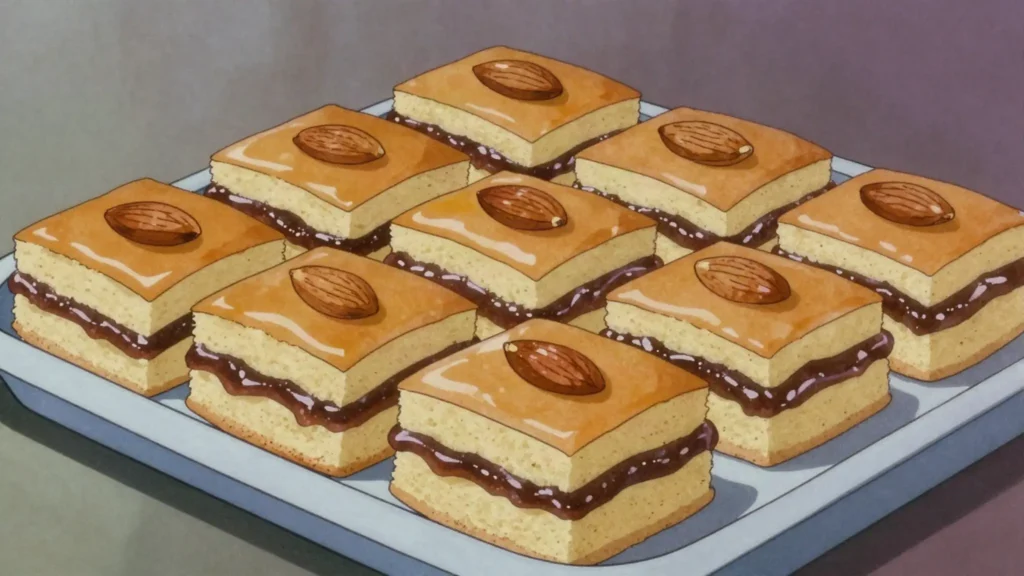
Basbousa bil tamr is a dessert from Libya: semolina cake layered with date paste and almonds, cut into diamonds. A Libyan take on semolina cake that uses the country’s dates rather than plain syrup for sweetness.
How long does Basbousa bil tamr take to make?
Basbousa bil tamr takes 40 minutes of preparation and 45 minutes of cooking. The recipe makes one tray, 20 diamonds. It is rated medium to make.
What can I substitute in Basbousa bil tamr?
Yes, within limits. Fine semolina can be used for a denser cake, though coarse gives the traditional texture. Any soft date works, and medjool gives a particularly rich filling.
What is the most important thing to get right in Basbousa bil tamr?
Work them until they form a thick smooth paste. Add the cinnamon, cardamom and orange blossom water. Keep working it for about five minutes. Let it cool until it is warm rather than hot.