
Ingredients
The duck
- 1whole duck, jointed
- or 6 duck legs
- about 1.8 kg in total
- skin left on
- salt and pepper, to season
The coriander base
- a very large bunch of coriander
- leaves and soft stems
- about 150 g
- blended with a little water
- 2onions, finely chopped
- 6 clovesgarlic, crushed
- 3 tablespoonsají amarillo paste
- or 2 fresh ají amarillo, blended
- 1 tablespoonají panca paste
- optional
The liquid
- 330 mldark beer
- a stout or a dark lager
- or chicha de jora, traditionally
- about 600 ml duck or chicken stock
- juice of 1 lime
The rice and vegetables
- 500 glong grain rice
- rinsed until the water runs clear
- 150 gpeas
- fresh or frozen
- 1red pepper, cut into strips
- 1carrot, diced, optional
- 200 gloche squash, grated
- if you can find it
To serve
- salsa criolla
- sliced red onion with lime
- extra ají sauce
- lime wedges
Directions
- Use the soft stems as well as the leaves. Only the thick woody ends are discarded. Put the coriander in a blender with a little water. Blend it to a smooth bright green purée.
- Use as little water as the machine will allow. Too much water thins the flavour. Cut it into eight or ten pieces. Keep the back and neck for making stock. Season the pieces well with salt and pepper. Pat them dry with kitchen paper first. Put them skin side down in a cold heavy pot. Starting cold is deliberate here. Turn the heat to medium and let them render. That takes ten to fifteen minutes.
- Turn them and brown all the sides. Lift them out and set them aside. Pour off most of the rendered fat. Leave about four tablespoons in the pot. Keep the rest, which is excellent for cooking. Duck fat sets solid and keeps for months refrigerated.
- Roast potatoes cooked in it are genuinely good. Add the chopped onions to the duck fat. Cook them slowly for about ten minutes. They should be soft and lightly golden.
- Add the crushed garlic and cook two minutes more. Add the ají amarillo paste and the ají panca. Fry them in the fat for two or three minutes. Do not rush it, since everything rests on it. Return the duck pieces to the pot. Add the dark beer and let it bubble for a minute. Add the stock and bring it to a simmer.
- Cover it and simmer gently for about forty-five minutes. The duck should become properly tender. Keep it warm and covered while the rice cooks. You need roughly twice as much liquid as rice. Add stock or water to reach that. Reduce it if you have far too much. It should taste strongly seasoned already.
- Stir it into the measured liquid. Hold back a few spoonfuls for the end. Add the lime juice as well. Rinse it until the water runs clear first. Stir it into the liquid once. Add the peas, pepper and carrot.
- Add the grated loche if you have it. Bring it back to a boil. Cover the pot with a tight fitting lid. Cook it for about eighteen minutes. Do not lift the lid during that time. Turn the heat off and leave it covered. Rest it for ten minutes. Stir through the reserved coriander purée.
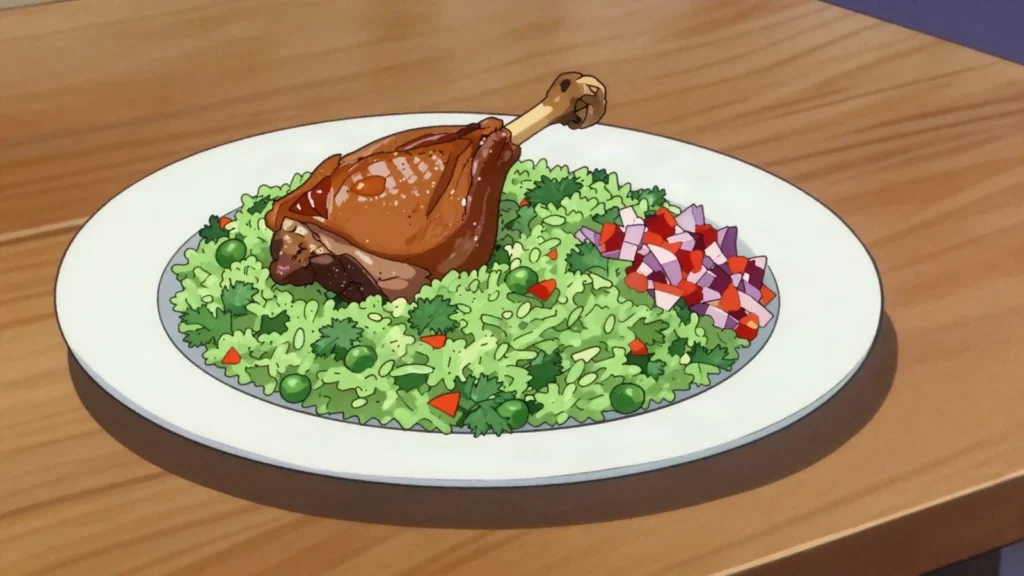
- Taste and correct the seasoning. Spread the rice on a large platter. Lay the duck pieces over the top. Serve salsa criolla alongside, which is essential. That is red onion sliced very thin.
- Serve extra ají sauce for those who want heat. Serve lime wedges on the table. It keeps three days in the refrigerator. Cool cooked rice quickly and refrigerate it. Rice left warm can grow harmful bacteria. Add a splash of stock when reheating.
Technique
- The quantity of coriander should look excessive. A hundred and fifty grams blended into a purée is what colours and flavours the whole dish, and without enough of it the rice is simply brown. Use the soft stems as well as the leaves.
- Hold back a few spoonfuls of the coriander purée and stir it through at the very end. Coriander loses its bright green to long cooking and turns dull olive; the late addition restores the colour.
- Taste and season the braising liquid before the rice goes in, and make it almost too strong. The rice dilutes it considerably, and under-seasoned liquid gives bland rice — the commonest failure in this dish.
- Measure the liquid: roughly twice as much as the rice by volume. Top it up or reduce it to reach that before the rice goes in.
- Start the duck skin side down in a cold pot and bring the heat up slowly. That renders the fat out gradually before the skin browns, and gives both a better skin and a great deal of usable duck fat.
- Lift the duck out before the rice stage and return it at the end. It stops the meat overcooking and makes the rice far easier to handle.
- Use duck legs rather than breast if you are choosing. Legs have more flavour and stand up to a long braise; breast overcooks and dries.
- Keep the rendered duck fat. It sets solid, keeps for months refrigerated and is excellent for roasting potatoes.
- Chicha de jora, a fermented maize drink that predates the Spanish arrival and was central to Andean life, is the traditional liquid. Dark beer became the common substitute and is now standard rather than a compromise. Both are legitimate.
- Ají amarillo is fruity and aromatic rather than fiercely hot, and it is one of the defining flavours of Peruvian cooking. The jarred paste is the practical route outside Peru.
- Loche squash is used as an aromatic in small grated quantities rather than as a bulk vegetable, and it holds a protected designation in Lambayeque. It is genuinely hard to find abroad and the dish works without it.
- Cool leftover rice within an hour and refrigerate it. Bacillus cereus spores survive cooking and produce a toxin that reheating does not destroy.
Substitutions
- Duck legs replace a whole jointed duck and are easier to handle; they also stand up to the braise better than breast.
- Chicken makes arroz con pollo, the far more everyday version of the same dish, and cooks in about half the time.
- Dark beer replaces chicha de jora, which is traditional and harder to buy.
- Jarred ají amarillo paste replaces fresh chillies and is what most cooks outside Peru use.
- Ají panca is optional and adds a mild smoky depth.
- Loche squash can simply be left out; there is no real substitute and the dish works without it.
Variations
- Arroz con pollo is the chicken version and is eaten across Peru constantly.
- Arroz con mariscos uses seafood in the same green rice.
- A version cooked with chicha de jora rather than beer is the older form and is still made in the north.
- Some cooks add a spoonful of huacatay, Andean black mint, alongside the coriander.
- Seco de pato is the related northern duck stew, served with rice separately rather than cooked together.
- Some households serve it with a fried plantain alongside.
Frequently asked questions
What is Arroz con pato?
Arroz con pato is a main from Peru: duck rice tinted green with coriander and dark beer, northern classic.
How long does Arroz con pato take to make?
Arroz con pato takes 40 minutes of preparation and 1 hour 30 minutes of cooking. The recipe makes serves 6. It is rated medium to make.
What can I substitute in Arroz con pato?
Yes, within limits. Duck legs replace a whole jointed duck and are easier to handle; they also stand up to the braise better than breast. Chicken makes arroz con pollo, the far more everyday version of the same dish, and cooks in about half the time. Dark beer replaces chicha de jora, which is traditional and harder to buy. Jarred ají amarillo paste replaces fresh chillies and is what most cooks outside Peru use. Ají panca is optional and adds a mild smoky depth. Loche squash can simply be left out; there is no real substitute and the dish works without it.
What is the most important thing to get right in Arroz con pato?
Add the crushed garlic and cook two minutes more. Add the ají amarillo paste and the ají panca. Fry them in the fat for two or three minutes. Do not rush it, since everything rests on it. Return the duck pieces to the pot. Add the dark beer and let it bubble for a minute. Add the stock and bring it to a simmer.