
Ingredients
Dough
- 500 gstrong white flour
- 20 gfresh yeast, or 7 g instant dried
- 200 mlwhole milk, warmed to 35°C (95°F)
- 80 gcaster sugar
- 3egg yolks
- 80 gsoftened butter
- 1 tspfine salt
- zest of 1 lemon
- 1 tbspdark rum
Walnut filling
- 400 gwalnuts, freshly ground
- 200 mlhot single cream
- 120 ghoney
- 80 gcaster sugar
- 50 gbutter, melted
- 1 tspground cinnamon
- 2egg whites, whipped to soft peaks
- 2 tbsprum
- 50 graisins, soaked in the rum (optional)
To finish
- 1egg yolk beaten with 1 tbsp milk
- 1 tbspicing sugar, for dusting
- butter and flour, for the mould
Directions
- Whisk the yeast into the warm milk with 1 tsp of the sugar and let it froth for 10 minutes. Mix into the flour with the remaining sugar, yolks, salt, zest and rum, then work the soft butter in and knead 12 minutes to a smooth, satiny dough that pulls cleanly from the bowl.
- Prove, covered, at 24–26°C (75–80°F) for 1 to 1.5 hours until doubled and domed.
- Pour the hot cream over the ground walnuts and stir; the heat releases the oils and stops the filling drying out. Beat in the honey, sugar, melted butter, cinnamon and rum, then fold in the whipped whites for lightness. It should be thickly spreadable, not stiff.
- Roll the dough on a floured cloth into a rectangle about 50 by 40 cm and no more than 5 mm thick, thin enough that the filling dominates every slice.
- Spread the filling to within 2 cm of the edges, using an offset spatula so the dough is not torn.
- Use the cloth to roll the dough up tightly along the long edge into an even log, pinching the seam and the ends closed.
- Lift the log into a buttered and floured fluted potica ring mould, joining the ends into a circle, seam down. Prick right through in a dozen places with a skewer to release trapped steam.
- Prove a further 45 minutes, brush with egg wash and bake at 175°C (350°F) for 55–65 minutes, covering with foil if it browns early; it is done when a skewer comes out clean and the loaf sounds hollow. Cool 15 minutes in the tin, turn out and dust with icing sugar. Slice thinly, always.
Technique
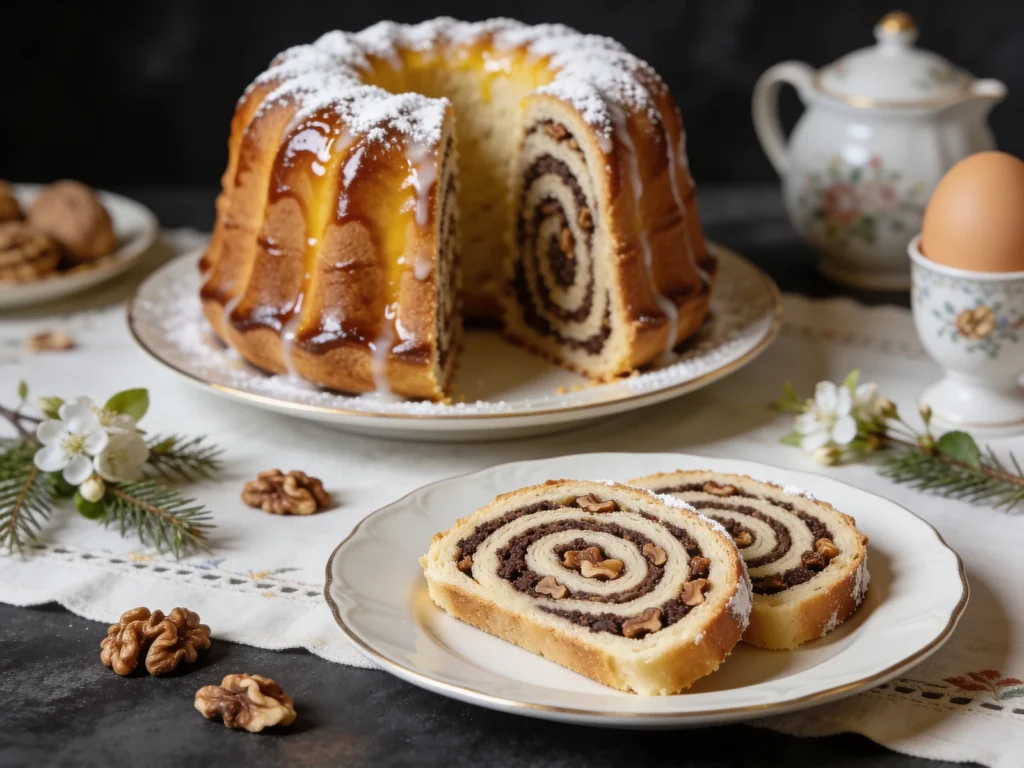
- Potica is judged on the spiral: the layers should be thin and numerous, so roll the dough thinner than feels comfortable and spread the filling generously.
- Pricking the rolled loaf is a genuine Slovenian step. Without it the filling steams, lifts the dough away and leaves a hollow ring under the crust.
- Grind the walnuts fresh. Pre-ground nuts have usually gone rancid, and there is nowhere for that flavour to hide in this cake.
Substitutions
- No potica mould: use a 26 cm bundt tin or shape the log into a ring on a lined tray, which bakes slightly drier.
- Walnuts can be replaced by ground hazelnuts, though the classic Slovenian nut is the walnut from the household tree.
Variations
- Pehtranova potica, filled with soured cream, sugar and a heavy hand of fresh tarragon, the most distinctively Slovenian version.
- Makova potica, with a poppy seed filling scalded in milk and honey.
- Skutna potica, filled with sweetened curd cheese and raisins.
History
A rolled pastry filled most traditionally with ground walnuts, though poppy seed, tarragon and other fillings exist regionally, documented in Slovenian cooking since at least the 1500s and strongly tied to major holidays and family celebrations, particularly Christmas and Easter, when a whole potica is often the centerpiece of the table. Its distinctive spiral shape, formed by rolling the filling into a thin sheet of yeasted dough before coiling it into a round pan, is considered essential enough to the dish’s identity that Slovenia has pursued formal recognition of potica as a protected traditional specialty, distinguishing it from superficially similar rolled pastries in neighboring countries. Regional variation in filling and exact dough recipe remains significant across Slovenia’s different historical regions.
Frequently asked questions
What is Potica?
Potica is a bread & pastry from Slovenia: rolled festive bread with walnut, tarragon or poppy filling. A rolled pastry filled most traditionally with ground walnuts, though poppy seed, tarragon and other fillings exist regionally, documented in Slovenian cooking since at least the 1500s and strongly tied to major holidays and family celebrations, particularly Christmas and Easter, when a whole potica is often the centerpiece of the table. Its distinctive spiral shape, formed by rolling the filling into a thin sheet of yeasted dough before coiling it into a round pan, is considered essential enough to the dish’s identity that Slovenia has pursued formal recognition of potica as a protected traditional specialty, distinguishing it from superficially similar rolled pastries in neighboring countries. Regional variation in filling and exact dough recipe remains significant across Slovenia’s different historical regions.
How long does Potica take to make?
Potica takes 50 min of preparation and 3 hr proving and baking of cooking. The recipe makes 10 servings (one 26 cm ring). It is rated hard to make.
What can I substitute in Potica?
Yes, within limits. No potica mould: use a 26 cm bundt tin or shape the log into a ring on a lined tray, which bakes slightly drier. Walnuts can be replaced by ground hazelnuts, though the classic Slovenian nut is the walnut from the household tree.
What is the most important thing to get right in Potica?
Roll the dough on a floured cloth into a rectangle about 50 by 40 cm and no more than 5 mm thick, thin enough that the filling dominates every slice.