
Ingredients
The beans
- 400 gdried red kidney beans
- or black beans
- soaked overnight
- picked over for stones
- 2 litreswater
The seasoning
- 1onion, chopped
- 6garlic cloves, crushed
- 3spring onions, sliced
- a sprig of thyme
- 2whole cloves
- 1scotch bonnet, whole
- or to taste
- salt and black pepper
To finish
- 3 tablespoonsoil
- or a little butter
- 1 teaspoonepis, optional
- the Haitian seasoning base
To serve
- white rice
- or mayi moulen, cornmeal
- poured over generously
- with avocado, optional
Directions
- Use the back of a ladle to press them through. Work in batches rather than all at once. Households keep a jar of it in the refrigerator.
- Lift it out before it splits in the pot. A burst bonnet makes the sauce fiercely hot. Wash your hands thoroughly after touching them. Never rub your eyes while handling them. Pick the dried beans over for stones and grit. Spread them on a tray and look them over. Discard anything that is not a sound bean.
- Cover the beans with cold water overnight. Use far more water than seems necessary. Cover them by ten centimetres at least. Boil the drained beans hard in fresh water. Bring them to a full rolling boil first. Hold that hard boil for ten full minutes.
- Add the onion, garlic, thyme and cloves. Add the whole scotch bonnet at the same time. Add the spring onion along with everything else. Simmer the beans until they are entirely soft. Give them about ninety minutes at a simmer. Cook them longer if there is any resistance. Check the water every half hour or so.
- Top it up with hot water as it reduces. The beans must stay covered throughout. Lift it out before its skin splits open. Check it every twenty minutes or so. Lift out the thyme sprig, cloves and chilli. Blend the beans with their cooking liquid. Blend them until they are as smooth as possible.
- Add liquid as needed to let the blender work. It should be a thick smooth purée at that point. Steam expands and can force the lid off. Let it cool a little and fill the jug half full.
- Hold the lid down with a folded cloth. Press the purée through a fine sieve. Set the sieve over a clean pot or bowl. Work the purée through with the back of a ladle. Press firmly in a circular motion. Work in small batches rather than all at once. Discard those skins once they stop giving liquid. The skins are all that should remain in the sieve.
- Press until only dry skins are left there. Everything else should have gone through. Add hot water if you run out of bean liquid. Make it slightly thinner than you want it. It should run over rice rather than sitting on it.
- Heat oil in a pan and pour the sauce in. Simmer it gently for about ten minutes. Stir it constantly, since it catches easily. Stir a spoon of epis into the sauce. Add it near the end rather than at the start. Some households use it and some do not. Season the sauce well with salt and pepper. Taste it carefully and add until it lifts. It should be clearly savoury rather than gentle.
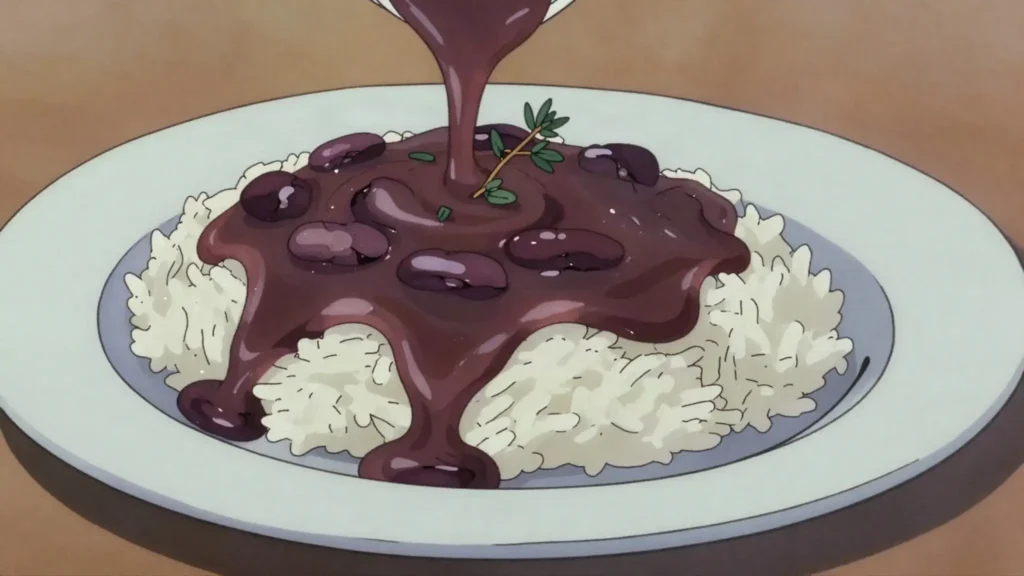
- Taste it against a spoonful of plain rice. It should be seasoned strongly enough for both. Pour the hot sauce generously over rice. It should pool around and soak into the rice.
Technique
- Dried kidney beans must be boiled hard for ten full minutes before any slow cooking. Raw kidney beans contain phytohaemagglutinin, a lectin causing severe vomiting and stomach pain, and slow cooking without a hard boil can concentrate rather than destroy it. Black beans, equally traditional here, do not carry that toxin.
- The beans must be cooked completely soft — crushing to nothing between the fingers, with no firmness at all — since half-cooked beans will not sieve properly. Test several rather than one, and cook them longer if there is any resistance.
- The scotch bonnet goes in whole and must be lifted out before its skin splits, since a burst one releases all its heat at once. Check it every twenty minutes, and wash your hands thoroughly after handling it — the oils burn eyes badly.
Substitutions
- Black beans replace kidney beans and are equally traditional, giving a darker sauce. A spoon of epis, the Haitian green seasoning base of blended peppers, garlic, herbs and onion that households keep in the refrigerator, lifts the finished sauce — it is optional here, since the individual aromatics do the same job, and both routes are used.
- Mayi moulen, the Haitian cornmeal porridge, replaces the rice and is an equally common partner; sliced avocado alongside is a standard accompaniment. This is often the whole meal in itself, with meat or fish added when available.
Variations
- Sieving is the step that makes this a sauce rather than a purée: bean skins do not break down in a blender and stay as tough flecks, so press the blended beans through a fine sieve with the back of a ladle, working in small batches since a crowded sieve blocks up. Press until only dry skins remain, then discard them.
- It should pour easily like a thin gravy and run over the rice rather than sitting on it — that flow is the whole point. Make it slightly thinner than you want, since it thickens noticeably as it stands.
- Beans absorb a very great deal of salt and plain rice dilutes the seasoning further, so taste the sauce against a spoonful of rice, which is how it will actually be eaten, and season strongly enough for both. Pour it generously so every grain is coated — a thin drizzle is not what this dish is.
History
The everyday Haitian sauce that turns plain rice or mayi moulen into a meal, made from red or black beans.
Frequently asked questions
What is Sos pwa?
Sos pwa is a soup & stew from Haiti: beans cooked soft and puréed into a thin sauce poured over rice or cornmeal. The everyday Haitian sauce that turns plain rice or mayi moulen into a meal, made from red or black beans.
How long does Sos pwa take to make?
Sos pwa takes 15 minutes plus soaking of preparation and 1 hour 45 minutes of cooking. The recipe makes serves 6. It is rated easy to make.
What can I substitute in Sos pwa?
Yes, within limits. Black beans replace kidney beans and are equally traditional, giving a darker sauce. A spoon of epis, the Haitian green seasoning base of blended peppers, garlic, herbs and onion that households keep in the refrigerator, lifts the finished sauce — it is optional here, since the individual aromatics do the same job, and both routes are used. Mayi moulen, the Haitian cornmeal porridge, replaces the rice and is an equally common partner; sliced avocado alongside is a standard accompaniment. This is often the whole meal in itself, with meat or fish added when available.
What is the most important thing to get right in Sos pwa?
Use the back of a ladle to press them through. Work in batches rather than all at once. Households keep a jar of it in the refrigerator.