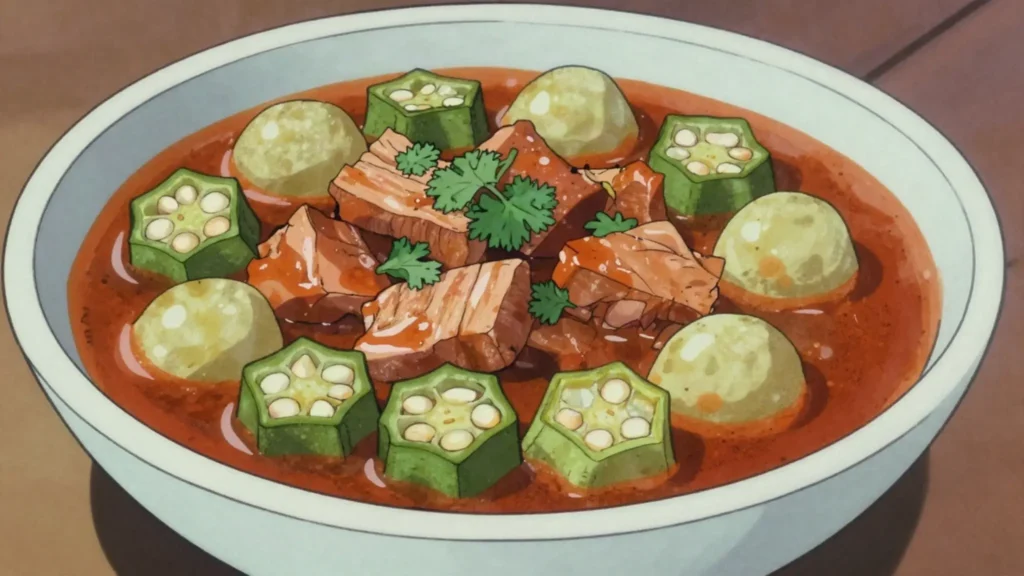

Ingredients
The meat
- 700 gpork shoulder
- cut into chunks
- 200 gsmoked pork or bacon
- chopped
- salt and black pepper
The okra
- 700 gokra
- trimmed and sliced
- juice of 2 limes
- or 3 tablespoons vinegar
The sofrito
- 2onions, chopped
- 1green pepper, chopped
- 6garlic cloves, crushed
- 2 teaspoonsground cumin
- 1 teaspoondried oregano
- 2bay leaves
- 400 gtomatoes, chopped
- 3 tablespoonsoil or lard
The dumplings
- 2green plantains
- grated
- 1egg
- 2garlic cloves, crushed
- salt
The rest
- about 1 litre stock
- or water
- white rice, to serve
Directions
- Drain and rinse it before cooking. High dry heat breaks the mucilage down. Cut the ends off and score the skin. Oil your hands and the knife first. Wash the okra and dry it thoroughly. Wet okra releases far more mucilage.
- Cut the stem end off each pod. Cut only the tough stem cap off. Trim it as shallowly as you can. Slice the pods into thick rounds. Thick rounds release less than thin ones. Put the sliced okra in a bowl. Pour the lime juice over all of it. Let it stand for about twenty minutes. Twenty minutes is enough to work.
- Drain and rinse it thoroughly after. Pat it all dry before it goes in. Heat the oil in a heavy deep pot. Brown all of the pork in batches. Do not crowd the pot at any point. Take the time to do it in batches. Add the smoked pork or the bacon. Add the onion and pepper to the pot.
- Cook them for about ten minutes. They should soften and turn golden. Add the crushed garlic to the pot. Give it about one full minute. Add the cumin, oregano and bay leaves.
- Heat releases their aromatic oils. Give them about thirty seconds only. Stir them constantly so they do not burn. Add the chopped tomatoes to the pot. Cook them down for five minutes. Pour all of the stock into the pot. Bring it up to a gentle simmer. It should just cover the meat.
- Let it simmer for about an hour. Pork shoulder needs real time to soften. Peel and grate the green plantains. Grate them on the fine side only. Fine grating gives a smooth dumpling.
- Work quickly as it discolours fast. Grated plantain browns within minutes. Mix the grated plantain with the egg. Add the crushed garlic and salt. Work it all through thoroughly. It should hold together when squeezed. Roll the mixture into small balls.
- Make them all about walnut sized. Wet your hands so they do not stick. Add the drained okra to the stew. It goes in for the last half hour. Leave them alone for five minutes. Let it simmer for another half hour. Judging it takes a careful look. Cut a dumpling open to check it. It should be cooked right through.
- Simmer it for longer if there is. It should be a thick heavy stew. Cook it down further if it is thin. Taste it and then adjust the salt. Taste it before adding any more. Add plenty of black pepper to it. Serving it is always done hot. Ladle it over plain white rice. It soaks up all the thick sauce.
Technique
- Okra releases a slippery mucilage when cut, which thickens the stew and is traditional here rather than a fault — West African okra stews rely on it. To reduce it, dry the pods thoroughly before cutting, trim only the tough stem cap without cutting into the pod, slice thick rounds rather than thin, and soak the slices in lime juice or vinegar for twenty minutes before draining and rinsing. That reduces rather than removes it, and some slipperiness is expected.
- Add the okra only for the last half hour: it cooks far faster than the pork and turns to mush if it goes in early. Lower the plantain dumplings in gently one at a time and do not stir for five minutes, since they are fragile until the outside firms up.
- Green plantain releases a sticky sap that stains hands and clothes badly and is very hard to wash out — oil your hands and the knife first. The peel clings tightly and does not come away like a banana: cut the ends off, score the skin and prise it off in sections.
Substitutions
- Vinegar stands in for lime juice in the okra soak; frying the okra in high dry heat first is the other traditional way to break the mucilage down, and both are genuinely done.
- Smoked pork or bacon is not really optional, since it renders its fat into the pot and that fat carries the depth of the stew.
Variations
- Okra is a West African plant that crossed the Atlantic on slave ships, carried by enslaved people along with its name — quimbombó comes from a West African word appearing as kingombo and similar forms, and the English okra shares that origin. The atlas records that history directly rather than softening it, and the stew is still identified with Afro-Cuban heritage.
- Grate the plantain finely and work quickly, since it browns within minutes — harmless but it darkens the dumplings, and lime juice slows it. Bind it with egg, without which the dumplings fall apart in the stew.
- Cook the sofrito down properly for a good fifteen minutes, since rushing it gives a raw sharp base and it is the foundation of the whole flavour.
History
Okra came to Cuba with enslaved West Africans, who kept the name quingombo; the stew remains a marker of Afro-Cuban home cooking.
Frequently asked questions
What is Quimbombó?
Quimbombó is a soup & stew from Cuba: okra stewed with pork, plantain dumplings and sofrito. Okra came to Cuba with enslaved West Africans, who kept the name quingombo; the stew remains a marker of Afro-Cuban home cooking.
How long does Quimbombó take to make?
Quimbombó takes 40 minutes of preparation and 1 hour 30 minutes of cooking. The recipe makes serves 6. It is rated medium to make.
What can I substitute in Quimbombó?
Yes, within limits. Vinegar stands in for lime juice in the okra soak; frying the okra in high dry heat first is the other traditional way to break the mucilage down, and both are genuinely done. Smoked pork or bacon is not really optional, since it renders its fat into the pot and that fat carries the depth of the stew.
What is the most important thing to get right in Quimbombó?
Drain and rinse it thoroughly after. Pat it all dry before it goes in. Heat the oil in a heavy deep pot. Brown all of the pork in batches. Do not crowd the pot at any point. Take the time to do it in batches. Add the smoked pork or the bacon. Add the onion and pepper to the pot.