
Ingredients
Fish
- 600 gfirm white fish fillet
- cut into chunks
- or a whole fish, filleted
The paste
- 3lemongrass stalks
- tender part only, finely sliced
- 6shallots, chopped
- 6garlic cloves
- 4bird’s eye chillies
- or to taste
- 1 teaspoonsalt
- 2 tablespoonspadaek
- Lao fermented fish sauce
- or 2 tablespoons fish sauce
To bind and flavour
- a large bunch of dill
- roughly chopped
- 4spring onions, chopped
- a handful of Thai basil
- 2 tablespoonssticky rice flour
- or 1 egg, beaten
- 2kaffir lime leaves, shredded
To wrap and steam
- banana leaves
- softened over a flame
- cocktail sticks or string
- water, for the steamer
To serve
- sticky rice
- fresh herbs and raw vegetables
Directions
- Cut out the thick central rib. The central rib is stiff and will not fold. Discard all of the rib itself. That takes only a few seconds. Slice the tender part of the lemongrass. Only the pale lower part is tender enough. Peel off the tough outer layers as well. Slice it as finely as you can. Put the lemongrass in a mortar.
- Add the shallots, garlic and chillies. Add all of the measured salt to them. Pound them into a rough paste. It should be a rough paste rather than smooth. Wash hands and the mortar thoroughly. Cut the fish into bite-sized chunks. Check it very carefully for bones. About three centimetres is right.
- Put the fish into a large bowl. Add the pounded paste in to it. Add the padaek or the fish sauce. Start with less and taste later. Add the chopped dill generously. Add the spring onions and basil.
- Add all the shredded lime leaves. They are tough and fibrous otherwise. Roll them up and slice them into threads. Add the sticky rice flour to it. Mix it all together thoroughly. Work it through with your hands. Coat every piece of fish in the paste. But do not break up the fish at all.
- Fry a small spoonful in a pan. Taste it and adjust the seasoning. Lay a softened leaf flat on the board. Put a portion of the mixture in the middle. Do not overfill any of them at all.
- Fold the sides of the leaf over the filling. It should be a flat rectangular parcel. Keep all of the parcels fairly flat. Steam pressure pushes the folds apart. Put water in the bottom of a large pot. Set a rack or a basket above it. The parcels must sit above the water. Cover the pot tightly with a lid. Bring the water to a steady boil.
- Let them steam for about thirty minutes. The fish itself cooks in ten minutes. Check it every fifteen minutes or so. Add boiling water if it runs low. A dry pot burns very quickly indeed. Steam it longer if it is still wet.
- Let it stand a moment before opening. Serving it is done hot in the leaf. Bring the parcels to the table closed. Serve hot sticky rice alongside. Add fresh herbs and raw vegetables. It keeps two days refrigerated. Steam it again briefly to reheat.
Technique
- The parcel sits on top of the rice steamer and cooks in the same steam, using no extra fuel at all; firewood and charcoal cost money and labour, and cooking two things on one fire is a real consideration that shaped the technique rather than an incidental detail.
- Liver fluke is endemic in the Mekong basin, carried by raw freshwater fish, and long-term infection is linked to bile duct cancer. The risk concerns raw and fermented preparations rather than well cooked fish: this dish is thoroughly steamed, and the padaek goes into the parcel and cooks rather than being used raw.
- Fry one small spoonful and taste it before wrapping, since raw fish mixture cannot be judged for salt and padaek strength varies enormously between jars. Keep the parcels flat rather than thick, since a flat one steams through while a thick one leaves a raw centre.
Substitutions
- Bottled fish sauce stands in for padaek, though it is thinner and less complex.
- Foil, ideally with baking paper inside it, stands in where banana leaves are unavailable, though it adds no flavour.
Variations
- Mok means wrapped and steamed in a leaf; ping means grilled over coals, and the same fillings are cooked both ways.
- Dill is used generously as a main ingredient rather than a garnish, and is a defining flavour of the dish.
- It is brought to the table closed for each person to open, since the aroma rising from the leaf is part of the point.
History
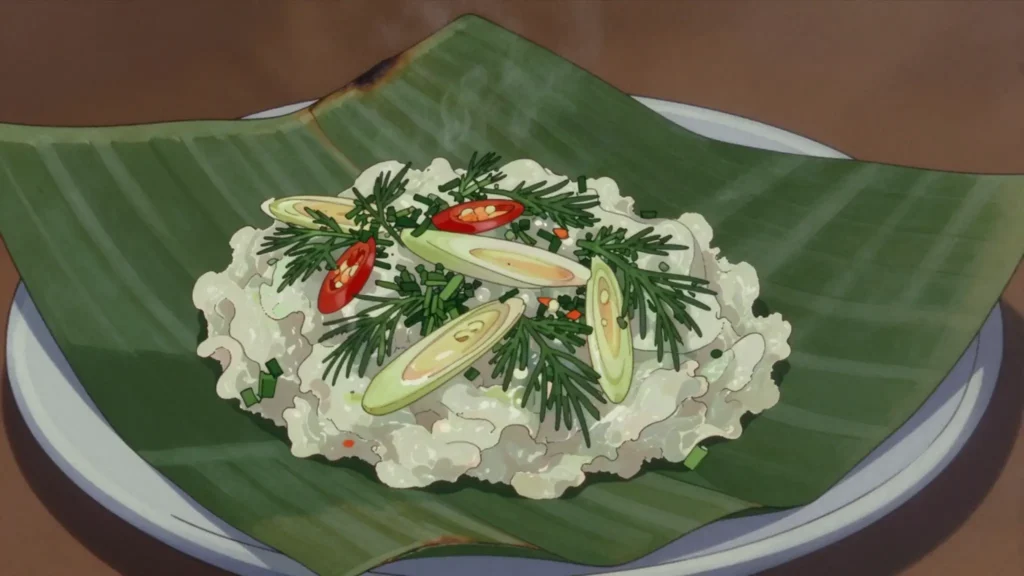
Fish with dill, chilli and padaek wrapped in banana leaf and steamed over the rice pot, a fuel-saving household technique.
Frequently asked questions
What is Mok Pa?
Mok Pa is a main from Laos: fish steamed in banana leaf with dill, lemongrass and chili. Fish with dill, chilli and padaek wrapped in banana leaf and steamed over the rice pot, a fuel-saving household technique.
How long does Mok Pa take to make?
Mok Pa takes 40 minutes of preparation and 35 minutes of cooking. The recipe makes serves 4. It is rated medium to make.
What can I substitute in Mok Pa?
Yes, within limits. Bottled fish sauce stands in for padaek, though it is thinner and less complex. Foil, ideally with baking paper inside it, stands in where banana leaves are unavailable, though it adds no flavour.
What is the most important thing to get right in Mok Pa?
Add the shallots, garlic and chillies. Add all of the measured salt to them. Pound them into a rough paste. It should be a rough paste rather than smooth. Wash hands and the mortar thoroughly. Cut the fish into bite-sized chunks. Check it very carefully for bones. About three centimetres is right.