
Ingredients
Dough
- 500 gstrong white flour
- 20 gfresh yeast
- 200 mlwarm milk
- 60 gsugar
- 4egg yolks
- 60 gbutter, melted
- 1 tspsalt
- zest of 1 lemon
- 2 tbsprum
Filling
- 300 gapricot jam, thick
To fry
- oil or lard, for deep frying
To finish
- icing sugar
Directions
- Activate the yeast in the warm milk with a spoonful of the sugar and leave it 10 minutes until foaming.
- Mix with the flour, remaining sugar, yolks, salt, zest and rum, then work in the melted butter.
- The rum is traditional and it does more than flavour: alcohol reduces how much fat the dough absorbs, which is why so many fried doughs across Central Europe contain a splash.
- Knead for 10 minutes to a soft, smooth, slightly sticky dough.
- Prove in a warm place for 1 hour 30 minutes until doubled.
- Roll the dough out to about 1.5 cm thick and cut rounds of about 7 cm.
- Prove the cut rounds on a floured cloth for a further 30 minutes, covered.
- Prove them on cloth rather than a tray, and do not move them afterwards. Knocking a proved krof deflates it and it will not recover.
- Heat the oil to 170°C (340°F) and check it with a scrap of dough.
- Fry them a few at a time, laying them in top side down, and cover the pan for the first 90 seconds.
- Covering the pan for the first side is the trick that gives the pale band around the middle. The trapped steam makes the dough rise upward while only the submerged part browns.
- Turn them once and fry the second side uncovered for another 90 seconds.
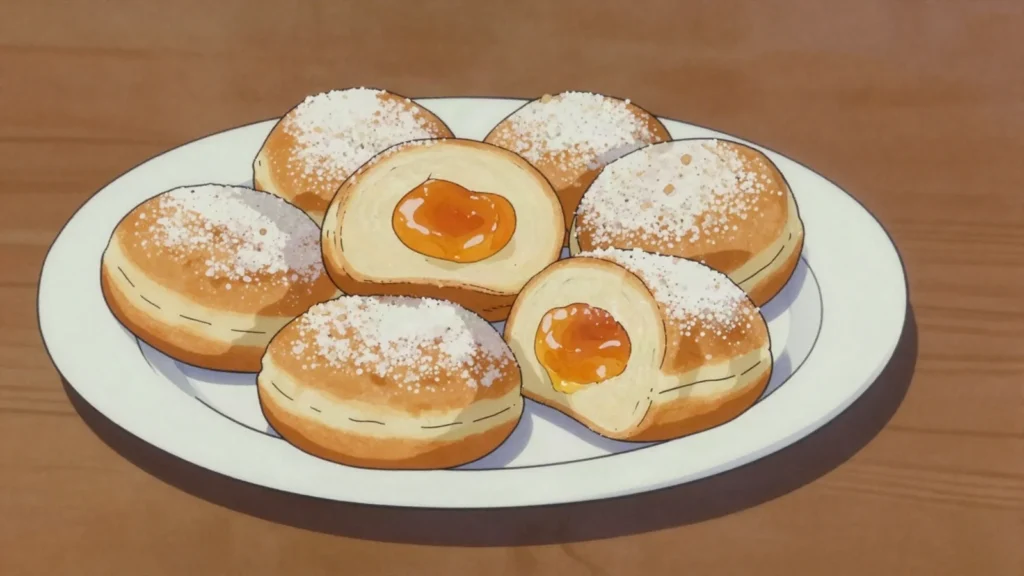
- That pale ring around the equator is the mark of a properly fried krof, and its absence means the oil was too hot or the dough underproved.
- Lift them out onto a rack and cool slightly.
- Warm the jam and pipe it into the side of each one with a long nozzle, filling generously.
- Fill them warm but not hot, and fill them from the side rather than the base so the pale ring stays visible.
- Dust with icing sugar and eat the same day.
- They are Carnival food, eaten in the run-up to Lent, and Trojane on the old road between Ljubljana and Celje is the place most associated with them.
Technique
- The Trojane krofi are famous enough that the roadside stop exists largely to sell them.
- Apricot is the traditional filling, and other jams are a modern variation.
- They are best within hours and stale quickly.
Substitutions
- Any thick jam that will not run.
- Vodka or brandy in place of rum.
Variations
- Filled with vanilla custard or chocolate.
- Baked rather than fried, which is lighter and quite different.
- Krapfen and pączki, the Austrian and Polish relatives.
History
Trojane on the old Vienna road made them famous; Slovenes eat them by the thousand during pust.
Frequently asked questions
What is Krofi?
Krofi is a dessert from Slovenia: round jam-filled doughnuts, fluffy and sugar-dusted, eaten at Carnival. Trojane on the old Vienna road made them famous; Slovenes eat them by the thousand during pust.
How long does Krofi take to make?
Krofi takes 30 min plus 2 hr rising of preparation and 25 min of cooking. The recipe makes about 16. It is rated medium to make.
What can I substitute in Krofi?
Yes, within limits. Any thick jam that will not run. Vodka or brandy in place of rum.
What is the most important thing to get right in Krofi?
The rum is traditional and it does more than flavour: alcohol reduces how much fat the dough absorbs, which is why so many fried doughs across Central Europe contain a splash.