The small, velvety, golden stone fruit of Central Asia — fragrant and tart-sweet fresh for a few weeks in summer, and dried, one of the great cooking fruits of the Middle East, North Africa and Central Europe.
Where it comes from
The apricot was domesticated in Central Asia and China, and the Silk Road carried it west: the Persians and Armenians grew it, the Romans called it the Armenian plum, and the Arabs planted it around the Mediterranean and in Spain. It remains a fruit of the dry, cold-wintered regions — Turkey’s Malatya grows most of the world’s dried apricots, Hunza in Pakistan lives on them, Armenia and Iran claim it as their own, and California grows the fresh crop for America.
Fresh apricots are fragile and their season is short, and much of the crop has always been dried, which concentrates their sweetness and acidity into something that cooks superbly. Dried apricots go into Moroccan and Persian lamb tagines and khoresh, Central European strudels and dumplings, the Middle Eastern amardine sheets, and the jam that glazes a French tart. The kernel inside the stone is the source of the almond-flavoured Italian amaretto and the Middle Eastern mahlab-like flavourings, and is bitter and mildly toxic raw.
Varieties
- Fresh apricot (Blenheim, Moorpark, Bergeron) — Small, golden-orange, velvety, with a free stone; sweet-tart and perfumed when tree-ripened, insipid when picked early.
- Turkish dried apricot — Whole, pitted, pale orange, sulphured to keep the colour; soft and sweet. The standard dried apricot.
- Hunza dried apricot — Small, brown, unsulphured, dried with the stone in; intense, honeyed, chewy.
- Californian dried apricot — Halved, dried, deep orange, tarter than Turkish.
- Amardine — Middle Eastern apricot paste dried in sheets; dissolved for a Ramadan drink or eaten as a sweet.
- Apricot kernel — The bitter kernel inside the stone; used in tiny amounts for its almond flavour, and in amaretti.
In the kitchen
Fresh apricots are best raw when perfectly ripe and best cooked when not quite — halved and roasted or baked cut side up with a little sugar and honey until they collapse, or poached in syrup. They make a sharp, bright jam that sets easily and is the classic glaze for tarts and Sachertorte.
Dried apricots soaked in warm water, tea or orange juice plump up for baking; unsoaked they go into a long braise with lamb, where they soften and sweeten the sauce — with almonds and cinnamon in Morocco, with saffron in Iran. Chopped into a stuffing for pork or a pilaf, or simmered into a compote with cardamom.
Choosing and keeping
Fresh apricots should be plump, golden, slightly soft and fragrant; hard, pale ones will never ripen well. Eat within a day or two of ripening; they bruise and spoil fast. Halved and stoned they freeze well.
Dried apricots keep a year in a sealed container; sulphured ones stay orange, unsulphured turn brown and taste deeper. Very soft, moist dried apricots are meant for eating; firmer ones for cooking.
Dishes with apricot
 Shah plovcrown of rice, dried fruit and meat baked inside a lavash crust
 Mrs Ball’s ChutneySweet-sour fruit chutney spooned onto curry, bobotie and cheese sandwiches
 Malva puddingsticky apricot sponge drenched in warm cream sauce
 HertzoggieJam-filled tartlet under a coconut meringue cap
 LeivasuppSweet purée of dark rye bread with apple, cinnamon and whipped cream.
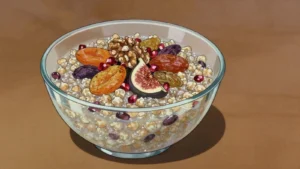 Asurepudding of grains, pulses, dried fruit and nuts, shared with neighbours
 AnushaburSweet porridge of hulled wheat with dried fruit, nuts and cinnamon.
 Zhentroasted millet pressed with butter, sugar and raisins
Apricot is tagged on 56 dishes from 38 countries in the atlas. These notes are written from general knowledge and carry no per-fact citation — see About.