
Ingredients
Sauce
- 150 gchunjang black bean paste
- 100 mloil
- 400 gpork belly, diced
- 2onions, diced
- 1courgette, diced
- 1potato, diced
- 1 tbspsugar
- 1 tbspoyster sauce
- 400 mlstock or water
Thickener
- 2 tbspcornflour slaked in 4 tbsp water
Noodles
- 600 gfresh thick wheat noodles
To serve
- 1cucumber, julienned
- danmuji pickled radish
- raw onion with chunjang
Directions
- Fry the chunjang first, on its own, in the oil over a low heat for 3 to 4 minutes.
- Frying the paste is not optional and it is the step people skip. Raw chunjang is harshly bitter, and a few minutes in hot oil turns it glossy, sweet and deep black.
- Use plenty of oil, more than seems reasonable, because the paste has to be suspended in it.
- Tip the fried paste into a bowl and set it aside, leaving the pan.
- Fry the diced pork belly until the fat renders and the edges brown.
- Add the onion and cook it hard until it softens and starts to sweeten, about 8 minutes.
- The onion is the sweetness of the whole dish, so give it time and do not rush it.
- Add the potato and courgette and cook for 5 minutes more.
- Return the fried chunjang, stir it through everything, then pour in the stock and the sugar and oyster sauce.
- Simmer for 10 minutes, until the potato is tender.
- Stir in the slaked cornflour and cook for a minute until the sauce turns thick and glossy.
- It should coat the back of a spoon heavily. A thin jjajang sauce slides off the noodles and pools at the bottom of the bowl.
- Boil the noodles, drain them, and do not rinse them.
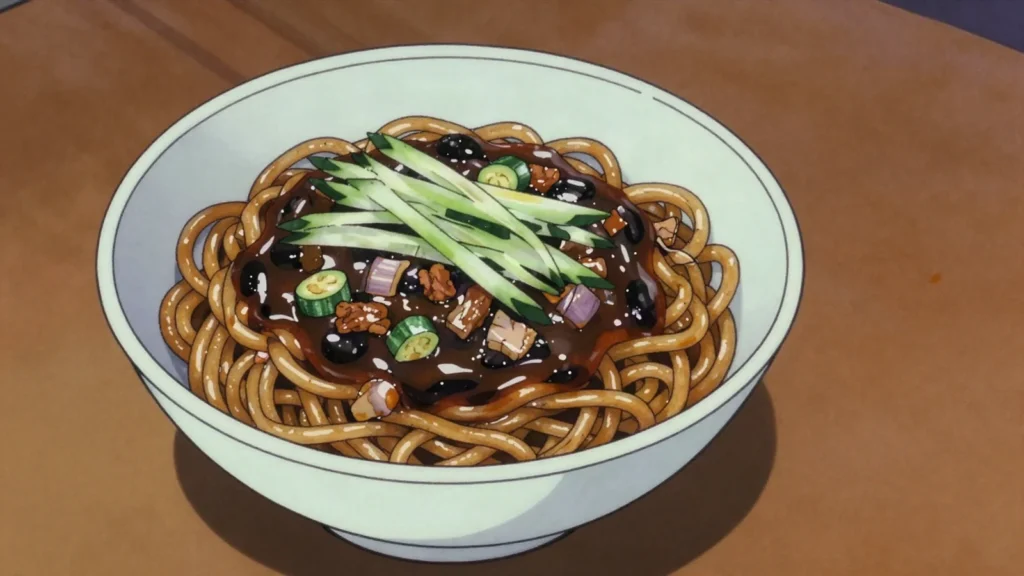
- Pile the noodles in a bowl, ladle the sauce over one half, and lay the cucumber on top.
- Serve it unmixed, with the sauce sitting on the noodles, and mix it thoroughly at the table before eating.
- Danmuji and raw onion with a dish of chunjang go alongside without exception.
- It was created by Chinese immigrants in Incheon’s Chinatown around the turn of the twentieth century and became Korean food entirely.
Technique
- Chunjang is Korean black bean paste and is not the same as Chinese doubanjiang or tianmianjiang.
- Ready-fried chunjang is sold and saves the first step.
- It is the standard order on Black Day, 14 April, when single people eat it together.
Substitutions
- Any thick wheat noodle, including udon at a pinch.
- Seafood in place of pork, which makes it samseon jjajang.
Variations
- Ganjjajang, with the sauce served separately and unthickened.
- Samseon jjajangmyeon, with prawn and squid.
- Jjajangbap, served over rice instead of noodles.
History
Wheat noodles topped with a thick, dark sauce made from black bean paste, pork and vegetables, developed by Chinese immigrants, particularly from Shandong province, who settled in the Korean port city of Incheon beginning in the late 1800s following the opening of Korean ports to foreign trade. Korean cooks and Chinese-Korean restaurant owners adapted the original Chinese black bean noodle dish, zhajiangmian, substantially over the following decades, using a sweeter, darker caramelised bean paste distinct from the saltier Chinese original, producing a dish now considered thoroughly Korean-Chinese rather than authentically representative of mainland Chinese cooking. It became one of the most popular and commonly delivered noodle dishes across South Korea through the 1900s, closely associated specifically with Chinese-Korean restaurants rather than either purely Chinese or purely traditional Korean cooking.
Frequently asked questions
What is Jjajangmyeon?
Jjajangmyeon is a main from South Korea: korean-Chinese noodles in glossy black-bean sauce with pork and onion. Wheat noodles topped with a thick, dark sauce made from black bean paste, pork and vegetables, developed by Chinese immigrants, particularly from Shandong province, who settled in the Korean port city of Incheon beginning in the late 1800s following the opening of Korean ports to foreign trade. Korean cooks and Chinese-Korean restaurant owners adapted the original Chinese black bean noodle dish, zhajiangmian, substantially over the following decades, using a sweeter, darker caramelised bean paste distinct from the saltier Chinese original, producing a dish now considered thoroughly Korean-Chinese rather than authentically representative of mainland Chinese cooking. It became one of the most popular and commonly delivered noodle dishes across South Korea through the 1900s, closely associated specifically with Chinese-Korean restaurants rather than either purely Chinese or purely traditional Korean cooking.
How long does Jjajangmyeon take to make?
Jjajangmyeon takes 20 min of preparation and 30 min of cooking. The recipe makes 4 servings. It is rated medium to make.
What can I substitute in Jjajangmyeon?
Yes, within limits. Any thick wheat noodle, including udon at a pinch. Seafood in place of pork, which makes it samseon jjajang.
What is the most important thing to get right in Jjajangmyeon?
Frying the paste is not optional and it is the step people skip. Raw chunjang is harshly bitter, and a few minutes in hot oil turns it glossy, sweet and deep black.