
Ingredients
The yakhni
- 1 kglamb or mutton on the bone
- shoulder or leg, in large pieces
- or bone-in chicken
- 2 litreswater
- 1onion, halved
- 1 headgarlic, halved crossways
- a large piece of ginger, sliced
The whole spices for the stock
- 2 tablespoonscoriander seeds
- 1 tablespoonfennel seeds
- 1 tablespooncumin seeds
- 2black cardamom pods
- 6green cardamom pods
- 8cloves
- 2 stickscinnamon
- 2bay leaves
- 1 teaspoonblack peppercorns
- tied in a muslin bag
The rice
- 600 gbasmati rice
- aged basmati if possible
- rinsed and soaked 30 minutes
The pulao
- 3large onions, sliced thinly
- 100 gghee
- or 100 ml oil
- 2 tablespoonsginger and garlic paste
- 2green chillies, slit
- 150 gplain yoghurt
- whisked smooth
- salt, to taste
To serve
- raita, yoghurt with cucumber
- kachumber salad
- sliced onion with lemon
- a mint chutney
Directions
- Put the meat into a large heavy pot. Add cold water to cover it well. Bring the pot slowly up to a boil. Skim it off carefully and repeatedly. Keep skimming until no more appears. Add the halved onion and garlic. Add the sliced fresh ginger too. Tie them in a muslin bag or a cloth.
- Toast the seeds briefly first if you like. The pulao should stay pale, not yellow. Simmer it for about an hour and a quarter. The meat should be nearly tender. Lift the meat out and set it aside. Strain the liquid through a fine sieve.
- Discard the spice bag and aromatics. You should have clear fragrant stock. Reduce it if you have too much. Add water if you have too little. The rice takes all its flavour from here. Use good basmati and use aged basmati. Rinse it until the water runs clear. Then soak it for thirty minutes. Drain it thoroughly before cooking. Heat the ghee in a large heavy pot. Add the thinly sliced onions to it.
- Fry them slowly until deep golden. That takes fifteen to twenty minutes. Stir them regularly so they colour evenly. They must be golden brown, not black. Take them off just before you think they are ready. Lift out half the onions for garnish. Drain them on kitchen paper to crisp. Add the ginger and garlic paste.
- Fry it for two minutes until fragrant. Add the slit green chillies now. Return the cooked meat to the pot. Fry it with the onions for five minutes. Now add the whisked smooth yoghurt.
- Whisk it smooth before adding it. Add it off the heat or on a very low heat. Stir it in constantly as you add it. Yoghurt splits if added to a hot pot. Cook it until the yoghurt is absorbed. The oil should separate and rise. Bring the pot to a full rolling boil.
- Stir it through once, very gently. Bring the whole pot back to a boil. Cook it uncovered for a few minutes. Wait until the liquid drops to the rice level. You should see the surface of the rice.
- Cover the pot with a tight lid. Seal the edges if the lid is loose. Cook it for fifteen to twenty minutes. Do not lift the lid at any point. Turn the heat off under it completely. Leave it covered for ten minutes. It also lets the grains firm up.
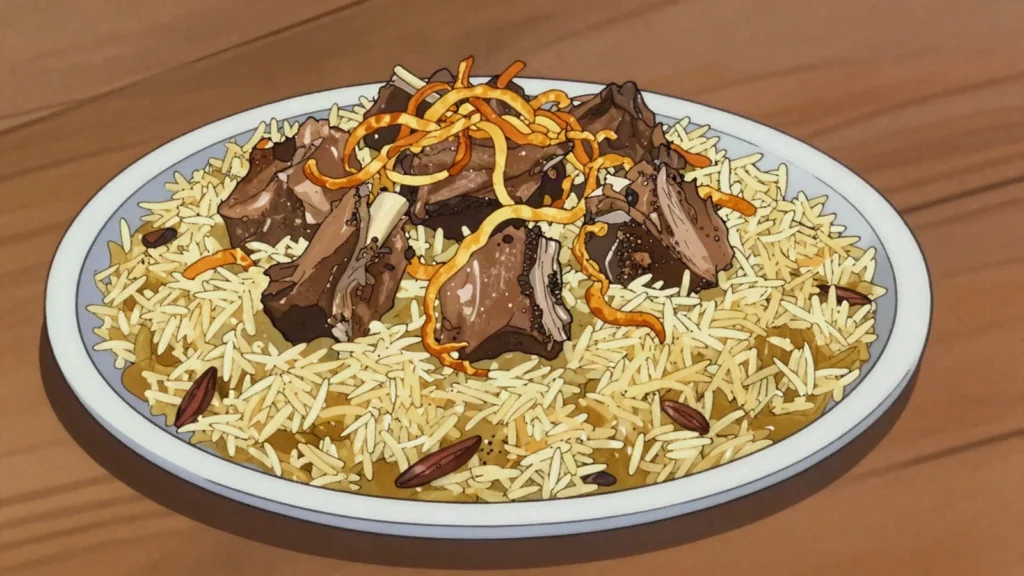
- Lift and separate rather than stirring. Now serve it out while it is hot. Pile the rice onto a large platter. Scatter the reserved fried onions over. Arrange the meat pieces on top. Serve a bowl of raita alongside. Serve kachumber salad as well. Leftovers keep three days refrigerated. Cool cooked rice quickly and chill it. Rice left warm can grow harmful bacteria.
Technique
- Taste and season the strained stock before the rice goes in. It should taste almost too salty on its own, because the rice dilutes it considerably. Under-seasoned stock gives bland pulao, and that is the commonest failure by far.
- Measure the stock. For soaked basmati, one and a half parts stock to one part rice by volume. Reduce excess stock rather than discarding it — reducing concentrates the flavour.
- A pulao is not a biryani. In a pulao the rice cooks in the stock and everything is one even colour and flavour; in a biryani, part-cooked rice is layered over separately cooked meat and finished under a seal, giving layers, uneven colour and much more heat. Pulao’s mildness is the point, not a shortcoming.
- No turmeric and no chilli in the stock. The pulao should stay pale and fragrant rather than yellow and hot; that restraint is what distinguishes it.
- Tie the whole spices in a muslin bag, a potli. Loose whole spices end up in the finished rice, and biting a clove is unpleasant.
- Whisk the yoghurt smooth and add it off the heat or on a very low flame, stirring constantly. Yoghurt added to a hot pot splits into grainy curds — the second commonest failure in this dish.
- Take the fried onions off just before they look ready. They keep browning in the residual heat, and burnt onions taste bitter throughout and darken the whole pot.
- Cover the pot when the liquid drops to the level of the rice, then do not lift the lid at all. Rest it ten minutes off the heat before fluffing with a fork.
- Use aged basmati if you can. Aged rice absorbs more and stays separate; new rice turns sticky and breaks up.
- Yakhni pulao is the usual wedding dish in Punjab and Kashmir for practical reasons: it is mild enough for everyone including children and elderly guests, it scales to enormous degs, and it is less prone to going wrong in bulk than a biryani.
- Cool leftover rice within an hour and refrigerate it. Bacillus cereus spores survive cooking and multiply in rice left warm, producing a toxin that reheating does not destroy.
Substitutions
- Bone-in chicken replaces lamb and cooks in about forty minutes rather than an hour and a quarter.
- Beef works, though it needs longer simmering and is less traditional here.
- Oil replaces ghee, though ghee gives the characteristic richness.
- A vegetable stock version with chickpeas and potatoes is genuinely made and follows the same method.
- Ground spices can replace whole ones in the stock at a real cost, since the point is a clear fragrant broth rather than a thick one.
- Long grain rice replaces basmati, though the separate elongated grains are much of the appeal.
Variations
- Kashmiri yakhni is a distinct dish — a yoghurt-based mutton curry with fennel — rather than a rice dish, and shares only the word.
- Chicken yakhni pulao is common and quicker, and is a weekday version.
- Matar pulao adds green peas and is a household everyday rice.
- Biryani is the more heavily spiced layered relative, and the distinction is real.
- Afghan Kabuli pulao uses the same principle with carrot, raisin and lamb.
- Some Kashmiri cooks add a little saffron or fried nuts, which is a festive touch.
History
Rice cooked in a fragrant broth made by simmering meat with whole spices, onion and yoghurt, developed across Pakistan and the wider South Asian subcontinent with roots tracing to Persian pilaf tradition brought to the region through historic trade and Mughal-era influence. Its comparatively mild seasoning, relying on whole spices infused into the cooking broth rather than the heavier use of ground spice and chili found in biryani, distinguishes yakhni pulao as a somewhat more delicate dish within the broader family of South Asian rice preparations, often considered easier on the stomach and suitable for those recovering from illness. Yakhni pulao remains a widely eaten dish across Pakistani households, valued for its comforting, aromatic simplicity.
Frequently asked questions
What is Yakhni Pulao?
Yakhni Pulao is a main from Pakistan: rice cooked in seasoned meat broth with whole spices. Rice cooked in a fragrant broth made by simmering meat with whole spices, onion and yoghurt, developed across Pakistan and the wider South Asian subcontinent with roots tracing to Persian pilaf tradition brought to the region through historic trade and Mughal-era influence. Its comparatively mild seasoning, relying on whole spices infused into the cooking broth rather than the heavier use of ground spice and chili found in biryani, distinguishes yakhni pulao as a somewhat more delicate dish within the broader family of South Asian rice preparations, often considered easier on the stomach and suitable for those recovering from illness. Yakhni pulao remains a widely eaten dish across Pakistani households, valued for its comforting, aromatic simplicity.
How long does Yakhni Pulao take to make?
Yakhni Pulao takes 30 minutes plus soaking of preparation and 1 hour 45 minutes of cooking. The recipe makes serves 6. It is rated medium to make.
What can I substitute in Yakhni Pulao?
Yes, within limits. Bone-in chicken replaces lamb and cooks in about forty minutes rather than an hour and a quarter. Beef works, though it needs longer simmering and is less traditional here. Oil replaces ghee, though ghee gives the characteristic richness. A vegetable stock version with chickpeas and potatoes is genuinely made and follows the same method. Ground spices can replace whole ones in the stock at a real cost, since the point is a clear fragrant broth rather than a thick one. Long grain rice replaces basmati, though the separate elongated grains are much of the appeal.
What is the most important thing to get right in Yakhni Pulao?
Fry them slowly until deep golden. That takes fifteen to twenty minutes. Stir them regularly so they colour evenly. They must be golden brown, not black. Take them off just before you think they are ready. Lift out half the onions for garnish. Drain them on kitchen paper to crisp. Add the ginger and garlic paste.