
Ingredients
Milk
- 2 litresfull-fat milk, the creamiest you can find
Sweetening
- 100 gsugar, or to taste
Flavour
- ½ tspground cardamom
- a good pinch of saffron
- 1 tsprose water or kewra, optional
To finish
- 30 gpistachios, slivered
- 30 galmonds, slivered
- edible silver leaf, optional
To serve
- chilled, in small bowls
- or poured over jalebi or malpua
Equipment
- a wide heavy pan, the widest you own
Directions
- Use the widest, heaviest pan you own. A heavy base is essential, since milk catches and scorches on a thin one and a scorched batch is unusable. Use the fullest-fat milk you can get, and buffalo milk is what is traditionally used in the subcontinent. Two litres reduces to roughly a quarter of its volume, so do not start with less than you need.
- Bring the milk to a boil, then reduce it to the lowest heat that keeps it at a bare simmer. Keep it low for the full two hours, since high heat scorches the base and gives a burnt taste through everything. It should barely move, with the occasional bubble at the edges.
- Let a skin form on the surface, which takes a few minutes once the milk is hot. Do not stir it back in, which is exactly what you would do for any other milk dish and is wrong here.
- Let the next skin form and push it aside as well, onto the same wall of the pan. Repeat this every five to seven minutes for the whole two hours. The layers build up around the sides of the pan into a thick pale collar, which is what you are making.
- Add the sugar only in the last fifteen minutes. Add the saffron now too, steeped in a spoonful of warm milk. Stir them through gently so they break into ribbons and flakes rather than dissolving. That texture of soft chewy strands through thick milk is what people are looking for.
- Add the cardamom and rose water off the heat, since heat drives off their aroma. It thickens considerably as it cools, so take it off slightly looser than you want it.
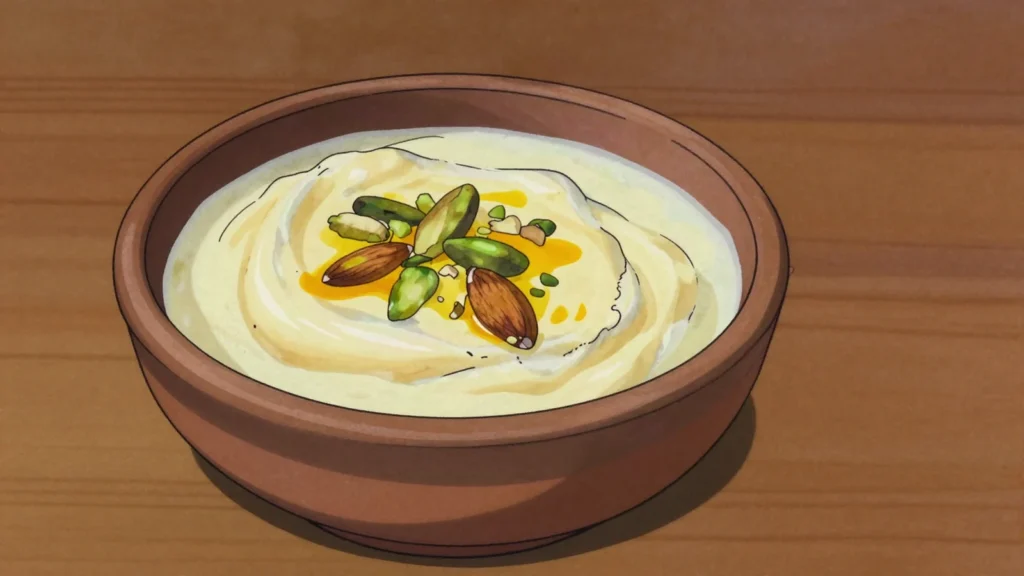
- Chill it for at least four hours, and it is served cold. Scatter slivered pistachios and almonds over before serving. It keeps three days refrigerated and it is often made a day ahead.
Technique
- The skins are pushed aside rather than stirred in, which is what makes it rabri.
- A wide heavy pan is essential for both evaporation and skin formation.
- Sugar goes in only at the end, since it makes the milk catch.
Substitutions
- Full-fat cow’s milk in place of buffalo milk.
- Kewra water in place of rose water.
Variations
- Poured over hot jalebi, which is a classic pairing.
- Made with a little condensed milk to shorten the cooking, which is a compromise.
- Set with soaked bread, as shahi tukda.
Frequently asked questions
What is Rabri?
Rabri is a dessert from Pakistan: milk reduced for hours until thick with layers of clotted skin, scented with cardamom.
How long does Rabri take to make?
Rabri takes 10 min of preparation and 2 hr of cooking. The recipe makes 6 servings. It is rated medium to make.
What can I substitute in Rabri?
Yes, within limits. Full-fat cow’s milk in place of buffalo milk. Kewra water in place of rose water.
What is the most important thing to get right in Rabri?
Use the widest, heaviest pan you own. A heavy base is essential, since milk catches and scorches on a thin one and a scorched batch is unusable. Use the fullest-fat milk you can get, and buffalo milk is what is traditionally used in the subcontinent. Two litres reduces to roughly a quarter of its volume, so do not start with less than you need.