
Ingredients
The fish
- 4whole rainbow trout
- about 300 g each
- gutted and scaled
- or 4 trout fillets
- very fresh
The seasoning
- juice of 3 limes
- 4 clovesgarlic, crushed
- 1 teaspoonground cumin
- 1 teaspoonsalt
- half a teaspoon black pepper
- a little chopped huacatay
- Andean black mint, optional
- or fresh oregano
For frying
- 150 gplain flour
- or fine maize flour
- seasoned with salt and pepper
- 150 mlvegetable oil
- for shallow frying
To serve
- chuño, freeze-dried potatoes
- soaked and boiled
- mote, boiled hominy
- boiled potatoes
- llajua or ají sauce
- sliced onion and tomato salad
- lime wedges
Directions
- Scale it by scraping from tail to head. Scales fly a very long way otherwise. Rinse the cavity thoroughly under cold water.
- Remove the dark line along the backbone. Pat the fish completely dry inside and out. Cut two or three diagonal slashes in each side. Cut through the skin into the flesh. Those slashes help it cook evenly.
- Mix the lime juice, garlic and cumin. Add the salt, pepper and chopped herbs. Rub the mixture over and inside the fish. Let it sit for fifteen to thirty minutes. Do not marinate it in lime for longer. Put the seasoned flour on a wide plate. Pat the fish dry again before coating. Coat each fish thoroughly in the flour.
- Shake off all of the excess flour. A thick coating goes soggy rather than crisp. Heat the oil in a wide heavy pan. One centimetre of depth is enough. Cool oil makes the fish absorb it and go greasy.
- Lay the fish in away from you. Never leave hot oil unattended at all. Keep a lid within reach of the pan. If oil catches fire, turn off the heat. Fry for about five minutes on the first side. Do not move the fish while it cooks. Let a crust form before you turn it. Turn it once with a wide spatula.
- Fry the second side for about four minutes. Whole trout of this size take nine or ten minutes. Lift it out and drain it briefly. Squeeze lime over it immediately. The result keeps for years without spoiling.
- Soak chuño overnight before cooking it. Then boil it until tender, about half an hour. Serve it all together on one plate. Leftover cooked trout keeps a day chilled.
Technique
- Rainbow trout is not native to Lake Titicaca. It was introduced from North America in the 1930s to build a fishery, and in that aim it succeeded — trout is the lake’s main commercial catch and supports many lakeside families. It is also widely implicated in the sharp decline of the lake’s native Orestias killifish, which exist nowhere else on earth; at least one species, the Titicaca orestias, has not been recorded for decades and is considered extinct. Both facts belong on the page.
- Lake Titicaca faces serious pollution from untreated sewage and mining runoff, and studies have found heavy metals in lake fish. The atlas quotes no figures — the studies vary, are revised, and differ by part of the lake. Buy farmed trout from a reputable source, which is what most lakeside restaurants serve, and ask locally if you are concerned.
- The Titicaca water frog is critically endangered and is sometimes sold in juices in the region. The atlas records no recipe using it and will not encourage that trade.
- Do not marinate the fish in lime for more than about thirty minutes. The acid begins to cure the flesh, turning it opaque and firm — that is ceviche, a different dish.
- Pat the fish dry before flouring, even after marinating, and shake off all excess flour. Wet fish steams and thick coating goes soggy.
- Do not move the fish once it is in the pan. Let a crust form before turning, or the skin tears away and stays behind.
- Err on the side of undercooking. Trout is delicate, carries on cooking as it rests, and overcooked trout is dry and disappointing.
- Chuño is freeze-dried potato, made by freezing potatoes overnight on the altiplano, treading out the water, and sun-drying over weeks. It keeps for years and it predates the Inca by a long way — one of the oldest preservation methods known. Its chewy, earthy texture is nothing like fresh potato and is an acquired taste.
Substitutions
- Any fresh trout replaces Titicaca trout; the technique is what matters and the atlas does not pretend the origin is reproducible.
- Fillets replace whole fish and cook in about six minutes, though whole fish stays moister.
- Fine maize flour replaces wheat flour and gives a crisper crust; it is common in the Andes.
- Fresh oregano replaces huacatay, which is genuinely distinctive and sold as a paste in Andean shops.
- Plain boiled potatoes replace chuño if you cannot find it, though the earthy chewiness is the point of chuño.
- Tinned hominy replaces home-cooked mote and needs only warming.
- Any fresh chilli and tomato sauce stands in for llajua.
Variations
- Grilled rather than fried trout is equally common at lakeside restaurants and is lighter.
- Trucha a la plancha, cooked on a flat griddle with little oil, is the simplest version.
- Some restaurants stuff the cavity with herbs, garlic and lime slices before grilling.
- Peruvian lakeside towns on the other shore serve the same fish with their own accompaniments.
- Ispi, a small native lake fish, is fried whole and eaten by the handful, and is the older lake dish.
- A trout ceviche, cured in lime with onion and chilli, is made in some lakeside restaurants.
History
Rainbow trout were introduced to Lake Titicaca in the 1930s and became the lake’s main commercial fishery.
Frequently asked questions
What is Trucha del Titicaca?
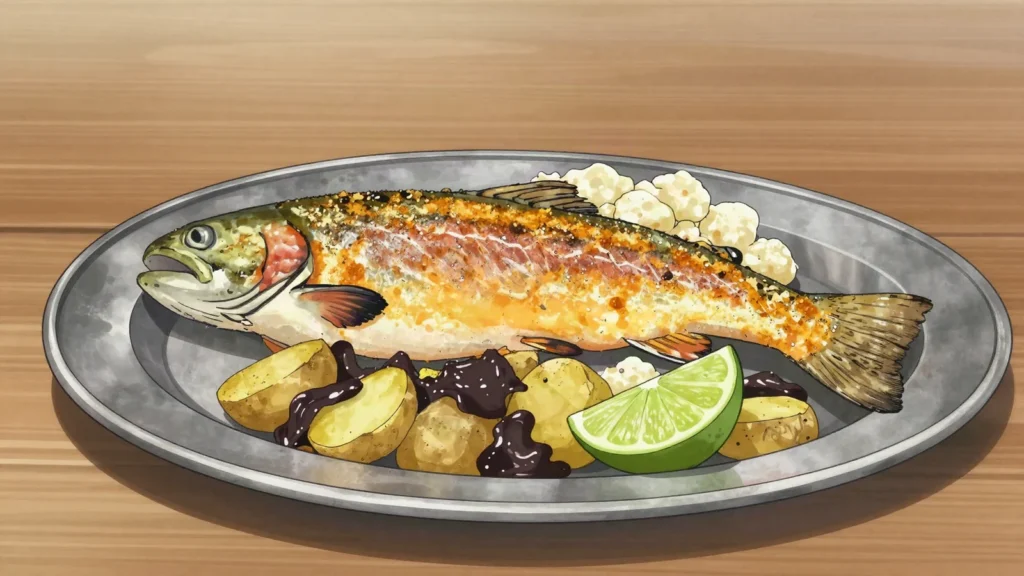
Trucha del Titicaca is a main from Bolivia: lake trout fried or grilled, served with chuño and mote at the shore. Rainbow trout were introduced to Lake Titicaca in the 1930s and became the lake’s main commercial fishery.
How long does Trucha del Titicaca take to make?
Trucha del Titicaca takes 20 minutes of preparation and 20 minutes of cooking. The recipe makes serves 4. It is rated easy to make.
What can I substitute in Trucha del Titicaca?
Yes, within limits. Any fresh trout replaces Titicaca trout; the technique is what matters and the atlas does not pretend the origin is reproducible. Fillets replace whole fish and cook in about six minutes, though whole fish stays moister. Fine maize flour replaces wheat flour and gives a crisper crust; it is common in the Andes. Fresh oregano replaces huacatay, which is genuinely distinctive and sold as a paste in Andean shops. Plain boiled potatoes replace chuño if you cannot find it, though the earthy chewiness is the point of chuño. Tinned hominy replaces home-cooked mote and needs only warming. Any fresh chilli and tomato sauce stands in for llajua.
What is the most important thing to get right in Trucha del Titicaca?
Scale it by scraping from tail to head. Scales fly a very long way otherwise. Rinse the cavity thoroughly under cold water.