
Ingredients
The dough
- 500 gplain flour
- 7 gdried yeast
- 200 mlwarm milk
- 80 gbutter, melted
- 1egg
- 1 tablespoonsugar
- 1 teaspoonsalt
The filling
- 100 gbutter, very soft
- 2 teaspoonsground turmeric
- 2 teaspoonscaraway seeds
- ground
- 2 teaspoonsfennel seeds
- ground
- 1 teaspoonground cumin
- 1 teaspoonblack pepper
- 1 teaspoonsalt
To finish
- 1egg yolk
- beaten with a little milk
- poppy seeds
- or caraway seeds
- for scattering
To serve
- at Novruz
- with tea
- alongside shekerbura and pakhlava
- on the holiday tray
Directions
- Butter between dough sheets keeps them from fusing. Steam from the dough pushes those sheets apart in the oven. The filling butter must be very soft but not melted. Take it out of the refrigerator well in advance. Each thin sheet is buttered and stacked before rolling. Warm the milk gently until it is just lukewarm. It should feel barely warm on the inside of your wrist.
- Stir the yeast and sugar into the warm milk. Leave it for about ten minutes to become frothy. Start again with fresh yeast if nothing happens. Put the flour and salt into a large mixing bowl. Keep the salt away from direct contact with yeast. Mix the salt through the flour before liquid goes in. Salt kills yeast on direct and prolonged contact. Add the yeast milk, melted butter and beaten egg.
- Make a well in the flour and pour them all in. Work it together until it forms a rough dough. Add a little more flour if it is genuinely sticky. Knead the dough for about ten minutes until smooth. Enriched dough with butter and egg takes real work. Cover the bowl and leave the dough to rise. Give it about ninety minutes in a warm place.
- Butter and egg both slow the yeast down considerably. Understanding the warm place is worth explaining here. Beat the very soft butter with all the ground spices. Beat it until the spices are evenly distributed. It should be a smooth bright yellow paste.
- Keep it soft and spreadable rather than chilling it. It must spread easily over thin sheets of dough. Keep the pieces you are not working with covered. Roll one piece at a time on a floured surface. Work reasonably quickly so the butter stays firm. Roll each piece into a large thin rectangle. About three millimetres thick is roughly right.
- Spread the spiced butter thinly over the rolled dough. Spread it right to the edges of the rectangle. Use the back of a spoon or a palette knife. It should be a thin even coat rather than thick patches.
- Roll the buttered sheet up tightly into a long log. Roll from the long edge to get the most turns. Keep it tight as you roll so no gaps form. Pinch the final seam closed along the length. Pulling too hard simply tears the log apart. Cut the log into pieces about four centimetres long.
- Use a sharp knife and cut cleanly downward. You should get about four pieces from each log. Stand each piece on its cut end and press it down. Press it down with your palm to about two centimetres. Press firmly but do not squash it completely flat. It should stay a thick disc rather than a thin one. Set the shaped buns on a lined tray to prove. Leave them for about thirty minutes to rise again.
- Brush the tops with beaten egg yolk and milk. That gives a deep golden shine on the finished bun. Brush it on thinly rather than letting it pool. Scatter poppy or caraway seeds over the glazed tops. The seeds stick to the wet glaze as it dries.
- Bake them in a moderate oven until deep golden. About one hundred and eighty degrees works well. Lift the buns onto a rack to cool a little. Cooling on a rack stops the base going soggy. Steam escapes rather than condensing underneath. Let them cool for at least ten minutes before eating. Serve them warm or at room temperature with tea. They keep three days in an airtight container.
Technique
- The filling butter must be very soft but never melted: melted butter soaks into the dough and the layers fuse into one bready mass, while soft spreadable butter sits between the sheets and steam pushes them apart in the oven. Firm butter tears the thin dough as you spread it.
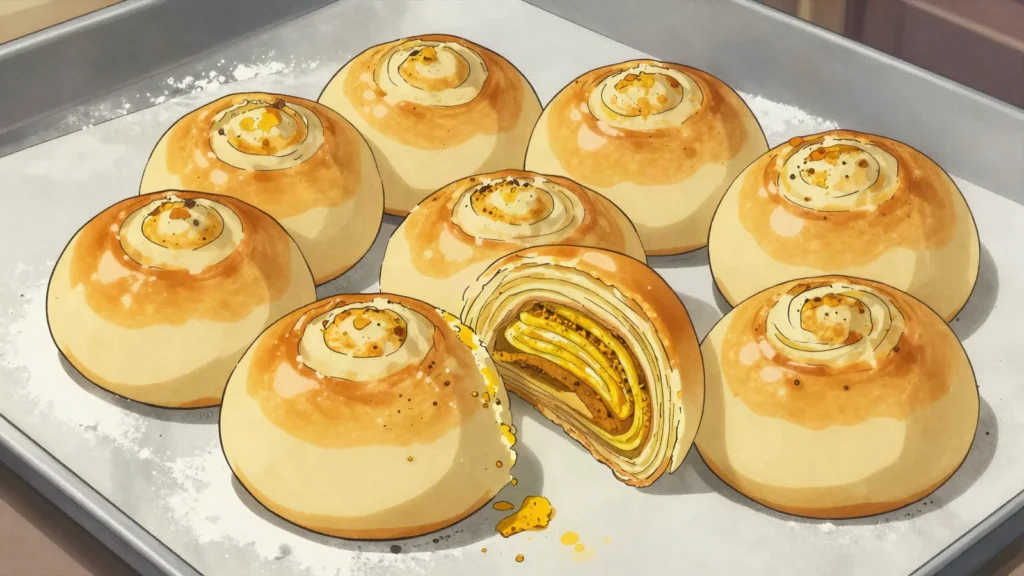
- Stand each cut piece on its end so the spiral faces upward, then press it down to about two centimetres — that is what leaves the spiral of layers visible on top. A blunt knife squashes the layers, so cut the log cleanly with a sharp one.
- This contains wheat, dairy and egg throughout — the dough carries milk, butter and a whole egg, and the filling is almost entirely butter.
Substitutions
- Caraway seeds replace poppy seeds for scattering and both are genuinely traditional. Caraway and cumin are different spices, confused because the seeds look similar — caraway is sharper and slightly aniseed — and both go into this filling.
- The most elaborate traditional versions butter and stack many separate thin sheets before rolling, giving an extraordinary number of fine layers; the atlas gives the simpler roll-and-coil method.
Variations
- Enriched dough with butter and egg rises more slowly than plain dough, so give it a full ninety minutes to double, and do not skip the second thirty-minute prove after shaping — that is what keeps the buns from baking dense and heavy.
- Roll the dough to about three millimetres and roll the buttered sheet up from the long edge, keeping it tight: more turns in the log means more layers in the bun, while thick dough gives a bready bun with no visible layers.
- Bake to deep golden rather than pale, with the base sounding hollow when tapped — a pale bun tastes doughy inside, and the colour tells you far more than the clock. They go on the Novruz tray beside the sweet shekerbura and pakhlava, where the savoury bun deliberately balances the sweet ones.
History
Layered savoury bun with turmeric, caraway and fennel, baked for Novruz as a symbol of the sun.
Frequently asked questions
What is Shor gogal?
Shor gogal is a bread & pastry from Azerbaijan: flaky spiced savory bun baked for Novruz. Layered savoury bun with turmeric, caraway and fennel, baked for Novruz as a symbol of the sun.
How long does Shor gogal take to make?
Shor gogal takes 1 hour plus rising of preparation and 30 minutes of cooking. The recipe makes makes 12. It is rated hard to make.
What can I substitute in Shor gogal?
Yes, within limits. Caraway seeds replace poppy seeds for scattering and both are genuinely traditional. Caraway and cumin are different spices, confused because the seeds look similar — caraway is sharper and slightly aniseed — and both go into this filling. The most elaborate traditional versions butter and stack many separate thin sheets before rolling, giving an extraordinary number of fine layers; the atlas gives the simpler roll-and-coil method.
What is the most important thing to get right in Shor gogal?
Butter between dough sheets keeps them from fusing. Steam from the dough pushes those sheets apart in the oven. The filling butter must be very soft but not melted. Take it out of the refrigerator well in advance. Each thin sheet is buttered and stacked before rolling. Warm the milk gently until it is just lukewarm. It should feel barely warm on the inside of your wrist.