
Ingredients
Sauce
- 5 tbspolive oil
- 2onions, sliced thin
- 2red peppers, cut into strips
- 1green chilli, sliced
- 6garlic cloves, sliced
- 1 kgripe tomatoes, peeled and chopped, or 800 g tinned plum tomatoes
- 1 tbsptomato paste
- 2 tspground cumin
- 1 tbspsweet paprika
- 1 tspcaraway seeds, ground
- 1–2 tspharissa
- 1 tspsugar, if the tomatoes are sharp
- 1.5 tspsalt
- black pepper
To finish
- 6–8eggs
- 3 tbspchopped coriander or parsley
- 100 gfeta or Bulgarian cheese, crumbled (optional)
- olive oil, to drizzle
To serve
- challah, pita or good white bread
Directions
- Warm the olive oil in a wide, shallow pan, ideally cast iron, and cook the onion and pepper over medium-low heat for 15 minutes until completely soft and beginning to caramelise at the edges.
- Add the garlic and chilli and cook 2 minutes more, then the cumin, paprika and ground caraway, stirring for 30 seconds until they smell toasted.
- Stir in the tomato paste and cook it out for 2 minutes until it darkens, then add the tomatoes, harissa, salt and pepper.
- Simmer uncovered for 15–20 minutes, stirring occasionally, until the sauce is thick, jammy and glossy with oil separating at the edge. Too loose and the eggs will sink and poach into soup.
- Taste and balance: it should be sweet from long-cooked peppers, sour from tomato and warm rather than sharply hot. Add sugar only if needed.
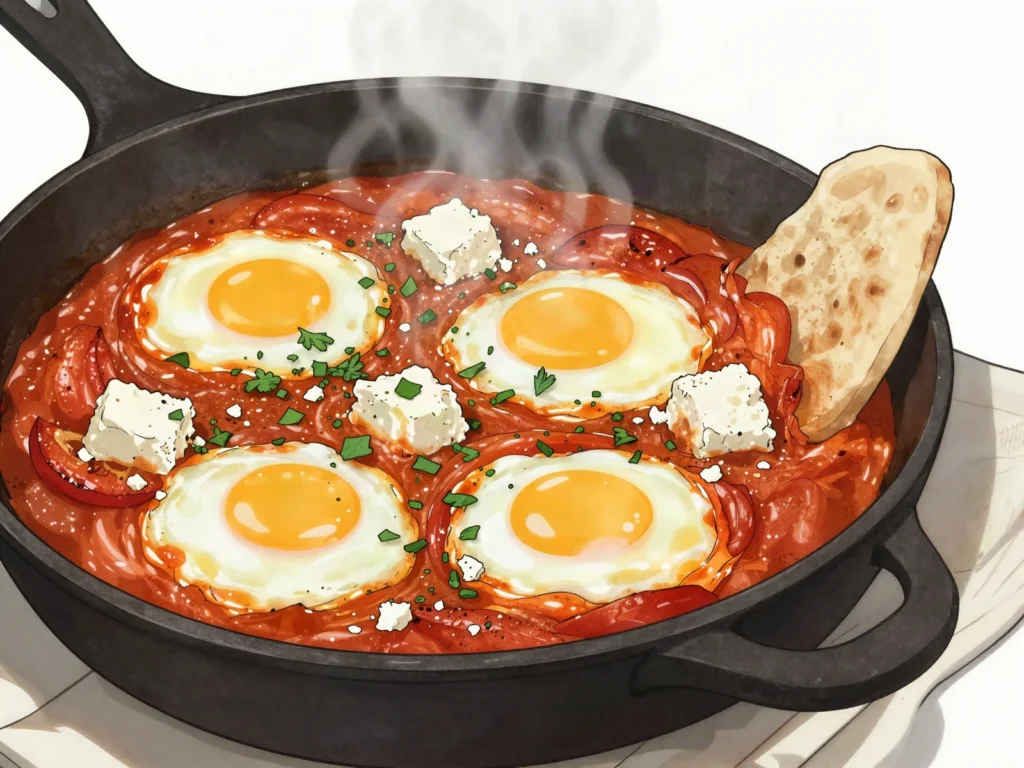
- Make 6–8 wells in the sauce with the back of a spoon and crack an egg into each. Season the yolks with a little salt.
- Cover the pan and cook on low heat for 6–9 minutes, until the whites are just set and opaque but the yolks are still liquid when nudged. Residual heat keeps cooking them at the table, so pull the pan early.
- Scatter with coriander, crumbled cheese if using, and a last drizzle of olive oil.
- Bring the pan straight to the table and eat communally, tearing bread and dragging it through the yolk and sauce. Never plate it.
Technique
- Shakshuka is North African, most often traced to Tunisia and Libya, and came to Israel with Jewish immigrants in the 1950s, where it became a national breakfast and late-night dish.
- The sauce is the dish; the eggs are the last five minutes. Many cooks make a large batch of sauce and reheat portions to order, which is how cafes do it.
- Cook the peppers and onions long enough. Fifteen minutes of real softening is what gives the sweetness the tomatoes cannot.
- Cover the pan rather than putting it in the oven if you want set whites with liquid yolks; the trapped steam sets the tops without overcooking the base.
Substitutions
- No harissa: a mix of chilli flakes, ground caraway, garlic and olive oil gives roughly the same heat and warmth.
- Out of season, tinned plum tomatoes are better than poor fresh ones; break them by hand rather than blending.
- Feta can be replaced by any salty white brine cheese, or left out entirely.
Variations
- Green shakshuka replaces tomato with spinach, chard, courgette and herbs, finished with yoghurt.
- Shakshuka with aubergine, or with a whole roasted pepper per person, is common in Jaffa.
- Matbucha, a cooked salad of the same tomatoes and peppers reduced much further, is the eggless relative served as a meze.
History
Eggs poached in a spiced tomato and pepper sauce, most commonly traced to Ottoman-era North Africa, particularly Tunisia, where similar tomato-and-egg dishes were established well before the term shakshuka is documented; the name itself likely comes from a Tunisian Arabic word roughly meaning a mixture or a shaken-up combination, describing the eggs stirred into the sauce. Tunisian Jewish immigrants and other North African Jewish communities carried the dish to Israel in large numbers after Israel’s founding in 1948, and it was adopted widely enough across Israeli cooking, Jewish and Arab alike, that it is now commonly treated as an Israeli national dish, even though its specific technique and name trace directly back to North Africa rather than originating in the Levant.
Frequently asked questions
What is Shakshuka?
Shakshuka is a breakfast from Israel: eggs poached in spiced tomato-pepper sauce; North African Jewish import. Eggs poached in a spiced tomato and pepper sauce, most commonly traced to Ottoman-era North Africa, particularly Tunisia, where similar tomato-and-egg dishes were established well before the term shakshuka is documented; the name itself likely comes from a Tunisian Arabic word roughly meaning a mixture or a shaken-up combination, describing the eggs stirred into the sauce. Tunisian Jewish immigrants and other North African Jewish communities carried the dish to Israel in large numbers after Israel’s founding in 1948, and it was adopted widely enough across Israeli cooking, Jewish and Arab alike, that it is now commonly treated as an Israeli national dish, even though its specific technique and name trace directly back to North Africa rather than originating in the Levant.
How long does Shakshuka take to make?
Shakshuka takes 15 min of preparation and 35 min of cooking. The recipe makes 4 servings. It is rated easy to make.
What can I substitute in Shakshuka?
Yes, within limits. No harissa: a mix of chilli flakes, ground caraway, garlic and olive oil gives roughly the same heat and warmth. Out of season, tinned plum tomatoes are better than poor fresh ones; break them by hand rather than blending. Feta can be replaced by any salty white brine cheese, or left out entirely.
What is the most important thing to get right in Shakshuka?
Taste and balance: it should be sweet from long-cooked peppers, sour from tomato and warm rather than sharply hot. Add sugar only if needed.