Ingredients
The leaves
- 500 gkplala leaves
- a mucilaginous green
- shredded very finely
- see the honesty note
- or 500 g jute mallow leaves
- corète potagère, or molokhia
- or 400 g okra, blended, plus 300 g spinach
The protein
- 250 gsmoked fish
- soaked and boned
- or 300 g beef, cut small
- or crab, or dried prawns
- or a mixture
The base
- 4 tablespoonsred palm oil
- or vegetable oil
- 2onions, chopped
- 4 clovesgarlic, crushed
- 1or 2 hot chillies
- 1 tablespoondried crayfish powder
- or ground dried prawns
- 1stock cube
- about 800 ml water
- salt and black pepper
Sometimes added
- 1tomato, chopped
- a little potash
- kanwa, see the note
- a handful of okra, to draw further
To serve
- foutou
- or placali
- piment, the chilli sauce
Directions
- Soak it before use. The leaves must be shredded extremely finely. Stack the leaves and roll them tightly. Slice across as finely as you can.
- Wash the leaves thoroughly first. Dry them before shredding. Soak it in hot water twenty minutes.
- Pick out the bones carefully. Flake the flesh. Heat the palm oil in a large pot. Add the onions. Cook them about eight minutes. Add the garlic and chillies. Cook them two minutes. Add the water and stock cube.
- Add the crayfish powder. Add the smoked fish or meat. Bring it to a simmer. If you use beef, simmer it forty minutes first. Add the shredded leaves. Stir them in. Do not cook them long. Stir it gently.
- Lift a spoonful and let it fall. It should string and stretch. Add water only if it is far too thick. Season with salt and black pepper.
- Taste carefully. Add no lemon or vinegar. Serve it hot over or beside the starch. It is smooth and elastic.
- Take a piece of the starch with the right hand. Press a dent into it. Scoop up the sauce. It keeps two days refrigerated.
Technique
- The atlas cannot verify which plant kplala is and does not name one. Naming the wrong plant would be worse than naming none. Several mucilaginous leaves are used across West Africa, jute mallow — Corchorus, called molokhia in Egypt and corète potagère in French — being the most widespread and the closest widely available substitute, and the method here is given for it.
- Do not gather unfamiliar leaves to cook. Many plants are toxic and cooking does not make a toxic plant safe — buy from a shop or learn identification in person from someone experienced.
- Shred the leaves extremely finely. Whole leaves do not release their mucilage and eat badly in a sauce; fine shredding is what makes it draw. In Egypt a two-handled blade called a makhrata is used to reduce molokhia to a fine green mince, and that fineness is what everyone is aiming for.
- Cook the leaves ten to fifteen minutes only. Long cooking breaks the mucilage down so the sauce thins rather than thickens, and the leaves turn grey-brown — the commonest failure with any drawn sauce.
- Add no lemon or vinegar. Acid reduces the draw, which is the opposite of what this dish is for.
- Test it by lifting a spoonful and letting it fall. It should string and stretch rather than drip.
- The drawn texture is functional, not incidental. The sauce is eaten with a starch dough that is swallowed rather than chewed, and it coats the dough and helps it go down. It divides people sharply, and there is no version without it.
- Frozen chopped molokhia works well and saves all the shredding. Dried leaves give a less bright result and draw less.
- Potash — kanwa — increases the draw and is a genuine traditional technique, but it is alkaline and used in very small quantities. Too much gives a soapy taste and is not good to eat. Use food-grade potash from an African grocer, never garden or industrial potash, and note that many households use none and the dish works without it.
- Some cooks stir hard to build the draw and others say hard stirring breaks it. Both views are held and the atlas does not adjudicate.
- Simmer beef until tender before the leaves go in. The leaves cannot take the forty minutes the meat needs.
- A handful of blended okra alongside the leaves increases the draw, and combining the two is genuinely done.
- This contains fish and often dried crustaceans, both potentially severe allergens. Say so plainly.
Substitutions
- Jute mallow, sold as molokhia or corète potagère, is the closest available leaf.
- Frozen chopped molokhia replaces fresh and saves the shredding.
- Blended okra with spinach approximates the texture where no mucilaginous leaf is available.
- Beef, crab or dried prawns replace or join the smoked fish.
- Vegetable oil replaces red palm oil, at the cost of colour and character.
- Potash is optional and the sauce works entirely without it.
Variations
- Sauce gombo uses okra for the same drawn effect.
- Molokhia in Egypt uses the same leaf with garlic and coriander in a clear broth.
- Ewedu in Nigeria is the Yoruba version of the same leaf sauce.
- Soupou kandia in Senegal draws with okra and palm oil.
- Sauce claire and sauce arachide are the light and thick sauces on the same table.
- A version combining leaf and okra together is made for a stronger draw.
Frequently asked questions
What is Sauce kplala?
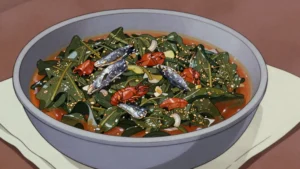
Sauce kplala is a soup & stew from Côte d’Ivoire: slippery green leaf sauce, drawn and stretchy, poured over foutou or placali.
How long does Sauce kplala take to make?
Sauce kplala takes 25 minutes of preparation and 45 minutes of cooking. The recipe makes serves 6. It is rated medium to make.
What can I substitute in Sauce kplala?
Yes, within limits. Jute mallow, sold as molokhia or corète potagère, is the closest available leaf. Frozen chopped molokhia replaces fresh and saves the shredding. Blended okra with spinach approximates the texture where no mucilaginous leaf is available. Beef, crab or dried prawns replace or join the smoked fish. Vegetable oil replaces red palm oil, at the cost of colour and character. Potash is optional and the sauce works entirely without it.
What is the most important thing to get right in Sauce kplala?
Soak it before use. The leaves must be shredded extremely finely. Stack the leaves and roll them tightly. Slice across as finely as you can.