
Ingredients
Dhal filling
- 250 gyellow split peas, soaked 2 hours
- 4garlic cloves
- 1 tspground turmeric
- 1 tspground cumin (geera)
- 1 tspsalt
- 1whole scotch bonnet
Dough
- 600 gplain flour
- 2 tspbaking powder
- 1.5 tspsalt
- 1 tspsugar
- 380 mlwarm water
- 4 tbspneutral oil, for brushing
- Extra flour, for dusting
Curry chicken and potato
- 1 kgchicken, cut in small bone-in pieces
- 3 tbspgreen seasoning (chadon beni, thyme, garlic, spring onion, blended)
- 3 tbspneutral oil
- 1onion, chopped
- 4garlic cloves, crushed
- 3 tbspTrinidadian curry powder mixed with 4 tbsp water
- 1 tspamchar masala
- 500 gpotatoes, cut in 3 cm chunks
- 1whole scotch bonnet
- 2 tspsalt
- 500 mlwater
Directions
- Boil the split peas with the garlic, turmeric, cumin and whole pepper for about 20 minutes until just tender but still holding shape – overcooked peas turn to paste and cannot be used. Drain thoroughly and dry in the pot for 2 minutes.
- Discard the pepper and grind the peas to a fine, dry, sandy powder in a food processor or hand mill. Season with salt. It must be dry or it will tear the dough.
- Mix the flour, baking powder, salt and sugar, add the water and knead 5 minutes to a soft dough. Cover and rest 30 minutes.
- Divide into 4 balls (loyas). Flatten each in your palm into a cup, fill with 4–5 tbsp of the pea powder, gather the edges over the top and pinch closed. Rest another 20 minutes, seam down.
- Meanwhile season the chicken with the green seasoning for 30 minutes. Fry the onion and garlic in oil 5 minutes, add the curry slurry and fry 3 minutes until it darkens and the oil separates.
- Add the chicken, turn to coat, cover and cook 10 minutes in its own juices, then add water, potatoes, amchar masala, salt and the whole pepper. Simmer 30 minutes until the potatoes are soft enough to crush and the gravy is thick.
- Roll each filled ball out to a 25–30 cm round, dusting lightly, working from the centre and turning often so the dhal stays evenly distributed and does not burst through.
- Cook on a hot tawa or heavy griddle for about 1 minute a side, brushing each side with oil, until pale brown blisters appear. Slap the hot roti between cupped hands or clap it with a wooden paddle to loosen the layers, then stack under a cloth. Fill with the curry and fold into a parcel.
Technique
- The ground dhal must be bone dry. Any moisture turns it to paste inside the dough, which then splits when rolled – the single most common failure.
- Clapping the cooked roti (or beating it with a paddle) is what makes it soft and layered rather than stiff. Do it while it is too hot to hold comfortably.
- Dhalpuri is one of several roti skins: paratha (buss-up-shut) is layered with oil and shredded, while sada roti is plain and eaten at breakfast.
Substitutions
- Chana dal can replace yellow split peas and grinds slightly finer.
- Curried goat, beef, duck, shrimp or channa and pumpkin all fill a dhalpuri equally traditionally.
Variations
- Buss-up-shut (paratha roti), oiled, folded and beaten into torn shreds, served alongside the curry rather than wrapped.
- Dosti roti, two skins cooked together and peeled apart, common in Trinidadian home kitchens.
History
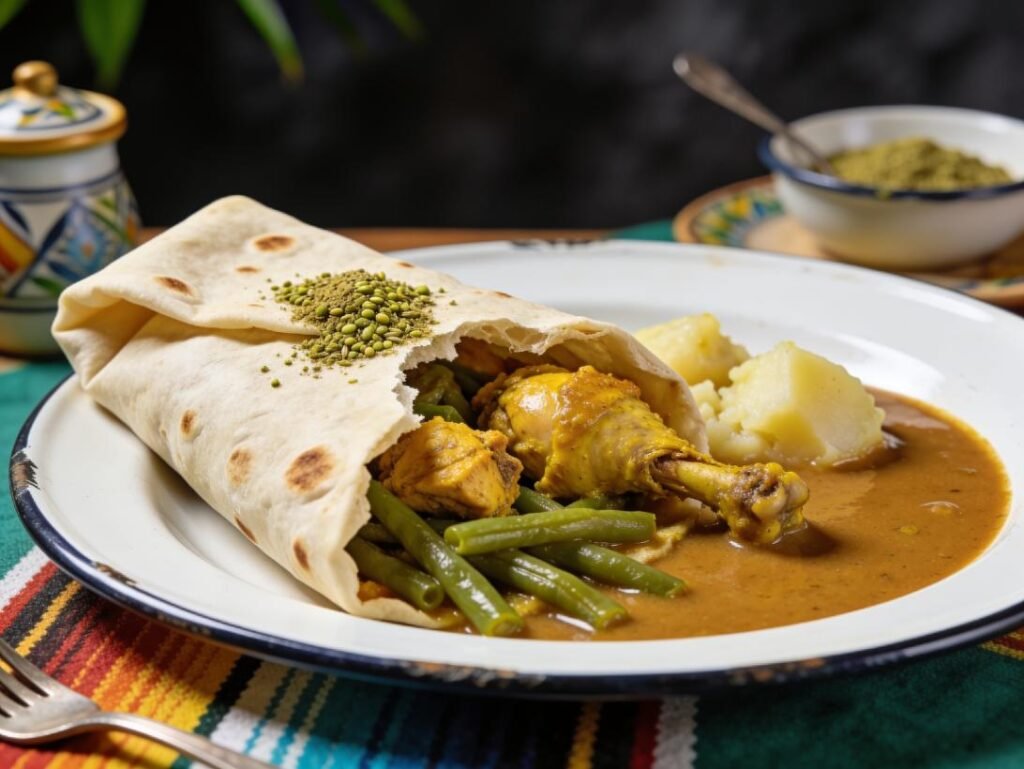
A flatbread and curry meal brought to Suriname by Indian indentured laborers, whom Dutch colonial authorities transported to the colony beginning in 1873 to work on plantations following the abolition of slavery, part of a much larger movement of Indian indentured workers sent by British and Dutch colonial powers to various Caribbean and South American colonies during that period. Surinamese roti developed its own regional character distinct from Indian and Trinidadian versions, generally featuring a thicker, more elastic flatbread wrapped fully around curried chicken, potato and often a hard-boiled egg, rather than served alongside the curry as a separate accompaniment. It became one of Suriname’s most widely eaten everyday meals across all of the country’s various ethnic communities, not only its Indo-Surinamese population specifically.
Frequently asked questions
What is Roti?
Roti is a main from Suriname: flatbread with curried chicken, potato and yardlong beans, Hindustani staple. A flatbread and curry meal brought to Suriname by Indian indentured laborers, whom Dutch colonial authorities transported to the colony beginning in 1873 to work on plantations following the abolition of slavery, part of a much larger movement of Indian indentured workers sent by British and Dutch colonial powers to various Caribbean and South American colonies during that period. Surinamese roti developed its own regional character distinct from Indian and Trinidadian versions, generally featuring a thicker, more elastic flatbread wrapped fully around curried chicken, potato and often a hard-boiled egg, rather than served alongside the curry as a separate accompaniment. It became one of Suriname’s most widely eaten everyday meals across all of the country’s various ethnic communities, not only its Indo-Surinamese population specifically.
How long does Roti take to make?
Roti takes 1 hr of preparation and 1 hr 30 min of cooking. The recipe makes 4 servings (4 large roti). It is rated hard to make.
What can I substitute in Roti?
Yes, within limits. Chana dal can replace yellow split peas and grinds slightly finer. Curried goat, beef, duck, shrimp or channa and pumpkin all fill a dhalpuri equally traditionally.
What is the most important thing to get right in Roti?
Discard the pepper and grind the peas to a fine, dry, sandy powder in a food processor or hand mill. Season with salt. It must be dry or it will tear the dough.