
Ingredients
The leaves
- 1 kgsweet potato leaves
- young and tender
- washed and pounded
- or finely chopped
The proteins
- 400 gbeef, in pieces
- 200 gsmoked fish
- flaked and boned
- or dried fish
- soaked
The pot
- 200 mlred palm oil
- 2onions, chopped
- 1or 2 hot chillies
- 2stock cubes
- about 500 ml water
- salt
To serve
- plain white rice
- eaten with the right hand
Directions
- Reduce it a little if you prefer. They must be picked out carefully. Flake it and feel right through it. Give it thirty minutes in warm water. Taste a flake to check the salt. Pick the leaves off the stems.
- Use the leaves and the tender tips. Discard the thick woody stems. Wash them in several changes of water. Fill a bowl and lift the leaves out. Repeat it until no grit settles.
- Pound the washed leaves in a mortar. It takes real sustained pounding. Work in batches if the mortar is small. Keep going until it is genuinely fine. Stop before it becomes a puree. Put the beef in a pot with water. Add a stock cube and some onion.
- Simmer it gently until tender. That takes about forty minutes. Keep all of the cooking liquid. Do not throw that liquid away. Heat the palm oil in a wide pot. Do not let the oil smoke at all. Add the chopped onions to the pot. Cook them for a good eight minutes.
- Add the pounded leaves to the pot. Stir them through the hot oil. Coat them thoroughly in the oil. Add the meat and its cooking liquid. Add more water if you need it. Add the stock cubes and chillies. Season the whole pot with salt. Bring it up to a gentle simmer. Let it cook for about forty minutes. Sweet potato leaves need real cooking.
- Add all the flaked smoked fish. Twenty minutes is enough for it. Stir it every ten minutes or so. Stir right into all the corners. Judging it takes a careful taste. Cook it on until it is smooth. It should be thick and clinging.
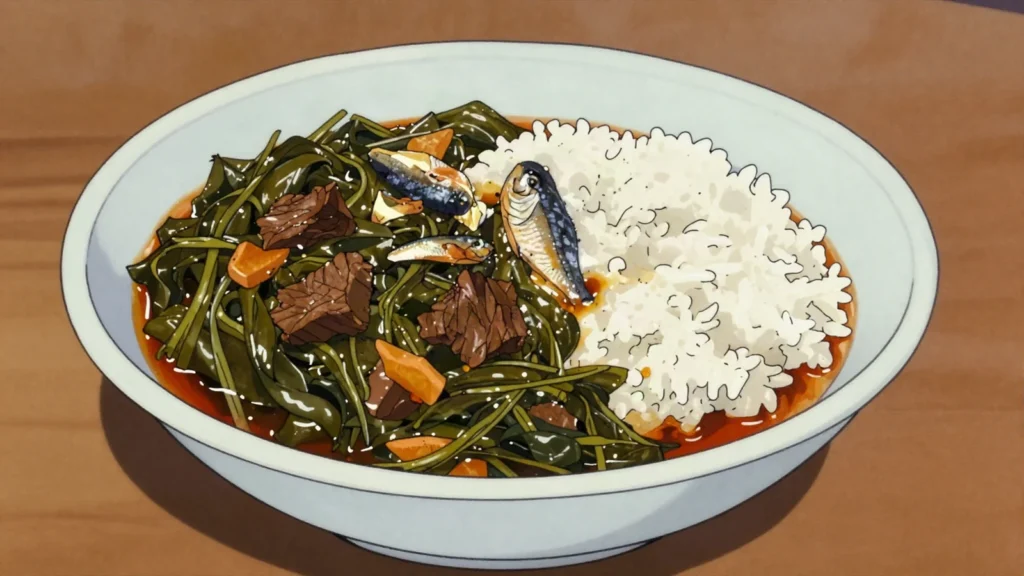
- Taste it and adjust the salt as needed. Taste it before adding any more. Adjust the seasoning right at the end. Serving it is always done hot. Spoon it out over plain white rice. Both of those arrangements are done.
Technique
- The leaves are pounded rather than chopped, which breaks them into a fine dark mass so the stew coats the rice properly — chopped leaves stay in recognisable pieces. A food processor pulsed in short bursts approximates it; stop before it becomes a puree.
- Smoked and dried fish carry many fine bones, and in a pounded stew a bone is hidden where you cannot see it. Flake the fish and feel right through it, pulling every bone out. Dried fish also needs soaking thirty minutes in warm water to soften it and draw out some salt; taste a flake to check.
- Two hundred millilitres of red palm oil is not a mistake — it gives the colour and richness and the finished stew should be deep orange-red. That is a great deal of oil and characteristic of the dish; reducing it changes the result considerably.
Substitutions
- Wash the leaves in several changes of water, filling a bowl and lifting them out so the grit sinks and stays behind, and repeat until none settles — one rinse does not remove field soil.
- Discard the thick woody stems, which stay fibrous however long they cook; any stringiness in the finished stew means stems were left in.
Variations
- The sweet potato plant gives two foods: the tuber underground and the leaves on the vine, picked while the tuber grows so one planting feeds twice. Picking too many weakens the plant and reduces the tuber, so growers take the young tips.
- Plasas is the Sierra Leonean word for these leaf stews, from the English palaver — a colonial-era borrowing covering a whole family of dishes. The atlas carries several relatives: muboora and nkhwani use pumpkin leaves and ngunza cassava leaves.
- Do not let the palm oil smoke, since overheated palm oil loses its colour; it is semi-solid when cool and melts to a clear orange liquid.
History
One of the core Sierra Leonean plasas, cooked with the leaves of the sweet potato rather than the tuber.
Frequently asked questions
What is Potato leaves?
Potato leaves is a soup & stew from Sierra Leone: sweet potato leaves pounded and stewed in palm oil with fish and meat. One of the core Sierra Leonean plasas, cooked with the leaves of the sweet potato rather than the tuber.
How long does Potato leaves take to make?
Potato leaves takes 40 minutes of preparation and 1 hour of cooking. The recipe makes serves 6. It is rated medium to make.
What can I substitute in Potato leaves?
Yes, within limits. Wash the leaves in several changes of water, filling a bowl and lifting them out so the grit sinks and stays behind, and repeat until none settles — one rinse does not remove field soil. Discard the thick woody stems, which stay fibrous however long they cook; any stringiness in the finished stew means stems were left in.
What is the most important thing to get right in Potato leaves?
Reduce it a little if you prefer. They must be picked out carefully. Flake it and feel right through it. Give it thirty minutes in warm water. Taste a flake to check the salt. Pick the leaves off the stems.