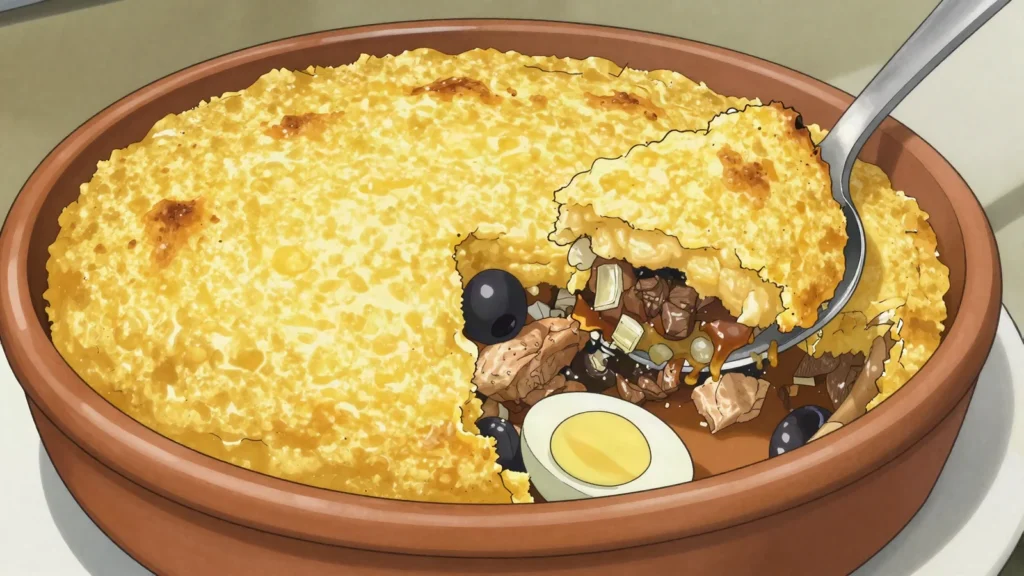

Ingredients
Pino
- 500 gbeef (chuck or posta), in 5 mm dice
- 700 gonions, finely diced
- 60 glard or beef dripping
- 1 tbspají de colour (sweet paprika)
- 2 tspground cumin
- 1 tspdried oregano
- 1 tbspplain flour
- 150 mlbeef stock
- Salt and black pepper
Choclo topping
- 1.2 kgfresh corn kernels, cut from about 8 cobs (Chilean choclo, or the starchiest sweetcorn you can find)
- 20fresh basil leaves
- 60 gbutter or lard
- 200–250 mlwhole milk
- 1 tspsalt
- 1 tspsugar
To assemble
- 4 piecesbone-in chicken thigh, poached and skinned
- 3hard-boiled eggs, sliced
- 12black olives
- 60 graisins, soaked in warm water
- 3 tbspcaster sugar, for the crust
Directions
- Sweat the onions in the lard over medium-low heat for 20–25 minutes until soft and sweet, then brown the beef briefly with them, add the spices, flour and stock and simmer 15 minutes to a loose, glossy pino. Cool.
- Poach the chicken thighs in salted water with a bay leaf for 25 minutes, then drain and pull off the skin, keeping the pieces whole and on the bone.
- Grind the raw corn kernels with the basil in a food processor, or traditionally in a stone mortar, to a coarse, still-textured purée; it should not be a smooth cream.
- Melt the butter in a wide pan, add the corn purée, salt and sugar and cook over medium heat, stirring constantly with a wooden spoon, for 12–15 minutes.
- Loosen with milk as it thickens until it becomes a heavy, spoon-coating porridge that holds a furrow when you drag the spoon across the pan. Undercooked, it will weep water in the oven.
- Spoon the pino into individual glazed clay dishes (pailas de greda) or one large earthenware dish, then lay on the chicken, egg slices, olives and drained raisins.
- Cover with the hot corn mixture, smoothing it to the rim so nothing pokes through, and sprinkle the surface evenly with the caster sugar.
- Bake at 200°C (400°F) for 35–40 minutes, then finish under the grill for 3–5 minutes until the sugar caramelises to a blistered, dark-freckled crust.
- Rest 10 minutes and serve straight from the clay, with a bowl of pebre and a glass of Carménère. It is eaten sweet and savoury together, often with extra sugar sprinkled at the table.
Technique
- Chilean choclo is a large-kernelled, starchy field corn, not sweetcorn. If using sweet supermarket corn, cut the added sugar and expect a looser topping; a tablespoon of cornmeal helps it set.
- Basil in the corn is non-negotiable in central Chile and is what makes the topping smell like summer rather than like creamed corn.
- Greda clay dishes hold heat and are how it reaches the table still bubbling; a cast-iron or stoneware dish is the closest substitute.
Substitutions
- Frozen corn kernels work out of season: thaw, drain well and add less milk.
- The dish can be made with pino alone, no chicken, and is still recognisably a pastel de choclo.
Variations
- Pastel de jaiba replaces the pino with crab meat in a white sauce, a Chiloé and coastal speciality.
- Some southern versions layer in sliced boiled potato beneath the pino.
History
A baked casserole with a savory minced beef and onion filling topped by a thick layer of sweet, blended fresh corn, developed in Chile from a combination of Indigenous Mapuche corn cultivation, predating Spanish arrival by many centuries, and Spanish colonial-era casserole and pie-baking technique introduced after the 1500s. Its distinctive sweet-savory contrast, the corn topping is typically slightly sweet while the meat filling beneath is savory and often includes olive, raisin and hard-boiled egg, reflects that same layered Indigenous-Spanish fusion pattern found across many classic Chilean and wider Latin American dishes. It is particularly associated with Chile’s late summer season, when fresh corn is most abundant and at its sweetest, making pastel de choclo something of a seasonal rather than a year-round staple in many households.
Frequently asked questions
What is Pastel de choclo?
Pastel de choclo is a main from Chile: sweet corn crust baked over beef pino and chicken in clay dish. A baked casserole with a savory minced beef and onion filling topped by a thick layer of sweet, blended fresh corn, developed in Chile from a combination of Indigenous Mapuche corn cultivation, predating Spanish arrival by many centuries, and Spanish colonial-era casserole and pie-baking technique introduced after the 1500s. Its distinctive sweet-savory contrast, the corn topping is typically slightly sweet while the meat filling beneath is savory and often includes olive, raisin and hard-boiled egg, reflects that same layered Indigenous-Spanish fusion pattern found across many classic Chilean and wider Latin American dishes. It is particularly associated with Chile’s late summer season, when fresh corn is most abundant and at its sweetest, making pastel de choclo something of a seasonal rather than a year-round staple in many households.
How long does Pastel de choclo take to make?
Pastel de choclo takes 45 min of preparation and 1 hr of cooking. The recipe makes 4 servings. It is rated medium to make.
What can I substitute in Pastel de choclo?
Yes, within limits. Frozen corn kernels work out of season: thaw, drain well and add less milk. The dish can be made with pino alone, no chicken, and is still recognisably a pastel de choclo.
What is the most important thing to get right in Pastel de choclo?
Basil in the corn is non-negotiable in central Chile and is what makes the topping smell like summer rather than like creamed corn.