
Ingredients
Pastry
- 1 kgall-butter puff pastry, or 8 to 12 thin rounds
Custard
- 1.2 litreswhole milk
- 8egg yolks
- 300 gsugar
- 80 gplain flour
- 40 gcornflour
- 300 gbutter, softened
- 2 tspvanilla
- a pinch of salt
To finish
- the trimmed pastry scraps, crushed
Optional
- 2 tbspbrandy or rum in the custard
Directions
- Roll the puff pastry very thin and cut 8 to 12 rounds using a plate as a guide. Roll them thinner than you would for any French pastry. These layers are meant to soften completely and thick ones stay tough.
- Prick each round all over with a fork. Docking the pastry stops it puffing into a pillow, which is exactly what you do not want here. Bake the rounds one or two at a time at 200°C (390°F) for 10 to 12 minutes until deep golden and dry.
- Bake them properly dry and well coloured, because pale underbaked layers go soggy rather than tender. Trim each hot round neatly with a knife and keep every scrap. Trim them while hot, because cooled puff pastry shatters under the blade. For the custard, whisk the yolks, sugar, flour, cornflour and salt to a smooth paste.
- Heat the milk until steaming and pour it into the yolks in a thin stream, whisking constantly. Hot milk poured in at once scrambles the yolks and the custard is finished before it starts.
- Return it to the pan and cook over a medium heat, whisking hard, until it thickens and boils. Let it boil for a full minute, because flour and cornflour only reach full thickening power at boiling point. Whisk right into the corners of the pan, where it catches first.
- Cool the custard to room temperature with cling film pressed onto the surface. Now beat the softened butter until pale, then beat the cooled custard into it a spoonful at a time.
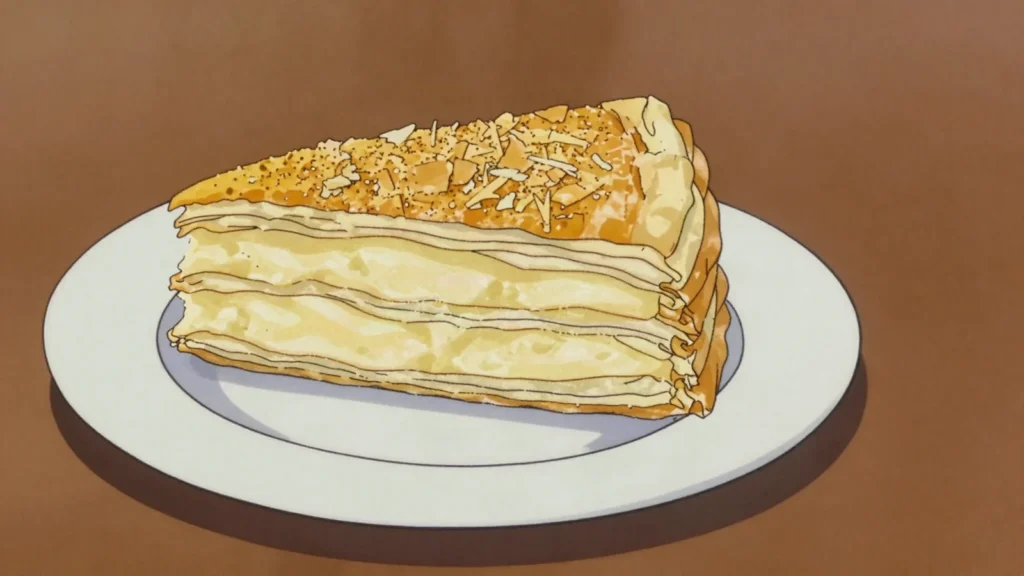
- Assemble on a plate: a layer of pastry, then a generous spread of cream, and repeat. Use plenty of cream between each layer. It is what softens the pastry, and a mean spread leaves you with a stack of dry biscuits. Press down gently as you go to keep it level. Coat the top and sides with the remaining cream.
- Crush the reserved trimmings into fine crumbs and press them all over the cake. Now refrigerate it for at least 12 hours, and 24 is better. Cut it with a long serrated knife, sawing gently rather than pressing down.
Technique
- Home-made rough puff is traditional and shop-bought all-butter pastry is a fair substitute.
- Some households use a condensed milk cream instead of custard.
- It keeps three or four days in the fridge and stays good throughout.
Substitutions
- Ready-rolled all-butter puff pastry.
- A boiled condensed milk filling, which is much quicker.
Variations
- With a condensed milk buttercream.
- With a layer of jam between two of the pastry sheets.
- Mille-feuille, the crisp French relative served fresh.
History
Created in Moscow for the 1912 centenary of the defeat of Napoleon’s invasion, and cut in triangles.
Frequently asked questions
What is Napoleon cake?
Napoleon cake is a dessert from Russia: many puff pastry layers with custard cream, softened overnight. Created in Moscow for the 1912 centenary of the defeat of Napoleon’s invasion, and cut in triangles.
How long does Napoleon cake take to make?
Napoleon cake takes 1 hr 30 min of preparation and 1 hr of cooking. The recipe makes 12 servings. It is rated hard to make.
What can I substitute in Napoleon cake?
Yes, within limits. Ready-rolled all-butter puff pastry. A boiled condensed milk filling, which is much quicker.
What is the most important thing to get right in Napoleon cake?
Prick each round all over with a fork. Docking the pastry stops it puffing into a pillow, which is exactly what you do not want here. Bake the rounds one or two at a time at 200°C (390°F) for 10 to 12 minutes until deep golden and dry.