
Ingredients
Spices
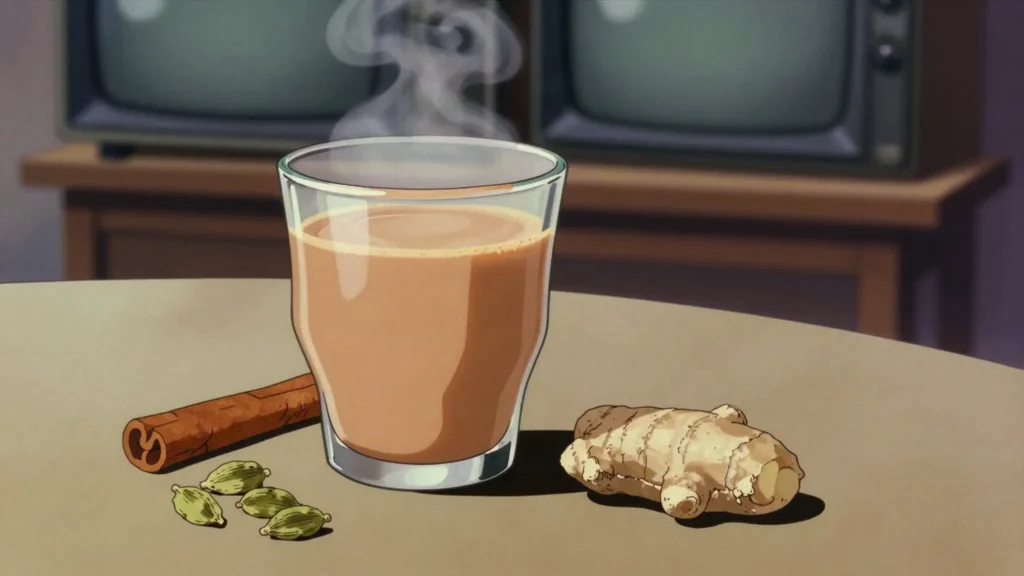
- 4cm ginger, crushed
- 6green cardamom pods, crushed
- 6black peppercorns
- 4cloves
- 1cinnamon stick
- 1star anise, optional
- ½ tspfennel seed, optional
Tea
- 500 mlwater
- 3 tbspstrong black tea, Assam CTC
- 400 mlwhole milk
- 4 tbspsugar, to taste
Optional
- a few fresh tulsi or mint leaves
- a pinch of grated nutmeg
Directions
- Use CTC Assam tea, the small hard granules sold for Indian tea. Delicate whole-leaf teas are wasted here, because they cannot stand up to boiling in milk.
- Crush the cardamom pods, peppercorns and cloves roughly in a mortar, and bash the ginger rather than slicing it.
- Crush rather than grind, and crush rather than slice the ginger. Broken surfaces release far more than clean cuts, and powder makes the chai cloudy and gritty.
- Bring the water to a boil with all the crushed spices and boil them for 3 to 4 minutes.
- Boil the spices in the water first, before any tea or milk. This is the step most home versions skip, and it is why theirs tastes only faintly spiced.
- Add the tea and boil hard for 2 minutes, until the liquid is very dark.
- Add the milk and the sugar and bring it back to a boil.
- Watch it constantly once the milk is in, because it climbs the pan without warning and boils over in a second.
- Now the pulling, which is the technique that makes street chai taste different from home chai.
- Let it rise up the pan, then pull the pan off the heat as it climbs, let it fall back, and return it to the heat.
- Repeat that rise and fall three or four times.
- Each rise aerates the tea and drives the extraction further, and this repeated boiling is what gives chai its body and its slightly caramelised depth.
- The colour should end up a deep tan, not pale beige. Pale chai means it has not been boiled enough.
- Add the sugar early rather than at the table, because it is boiled in rather than stirred in.
- Strain it through a fine sieve into cups, pressing the spices with a spoon.
- Pour it from a height between two vessels a few times if you want the froth on top.
- Serve it very hot in small cups or glasses, which is how it is drunk.
- Every household has its own masala and the proportions here are a starting point rather than a rule. Ginger and cardamom are the constants; everything else is negotiable.
- Mass tea drinking in India followed Indian Tea Association campaigns from the early 1900s, which promoted British-planted Assam tea to a domestic market that had not previously drunk much of it.
- The spices, the milk and the sugar were the vendors’ own additions, and the Association initially objected to them.
Technique
- Kadak chai means strong, boiled hard and long, and is what most street vendors serve.
- A dry spice mix can be made in advance and kept in a jar, though fresh ginger is always added at the pot.
- The tea is boiled, not steeped, and the usual warnings about over-brewing black tea do not apply.
Substitutions
- Any strong black tea, using rather more of it.
- Jaggery or condensed milk in place of sugar.
Variations
- Kashmiri kahwa, a green tea with saffron and almond, quite different.
- Made with more ginger alone, as adrak chai.
- Noon chai, the pink salted tea of Kashmir.
History
Spiced milk tea; mass tea drinking in India followed Indian Tea Association campaigns from the 1900s promoting British-planted Assam tea.
Frequently asked questions
What is Masala Chai?
Masala Chai is a drink from India: milky black tea boiled with ginger and warming spices. Spiced milk tea; mass tea drinking in India followed Indian Tea Association campaigns from the 1900s promoting British-planted Assam tea.
How long does Masala Chai take to make?
Masala Chai takes 10 min of preparation and 15 min of cooking. The recipe makes 4 cups. It is rated easy to make.
What can I substitute in Masala Chai?
Yes, within limits. Any strong black tea, using rather more of it. Jaggery or condensed milk in place of sugar.
What is the most important thing to get right in Masala Chai?
Crush the cardamom pods, peppercorns and cloves roughly in a mortar, and bash the ginger rather than slicing it.