
Ingredients
Cheese
- 2 litreswhole milk
- 3to 4 tbsp lemon juice or white vinegar, in a little water
- a pinch of salt, optional
To serve
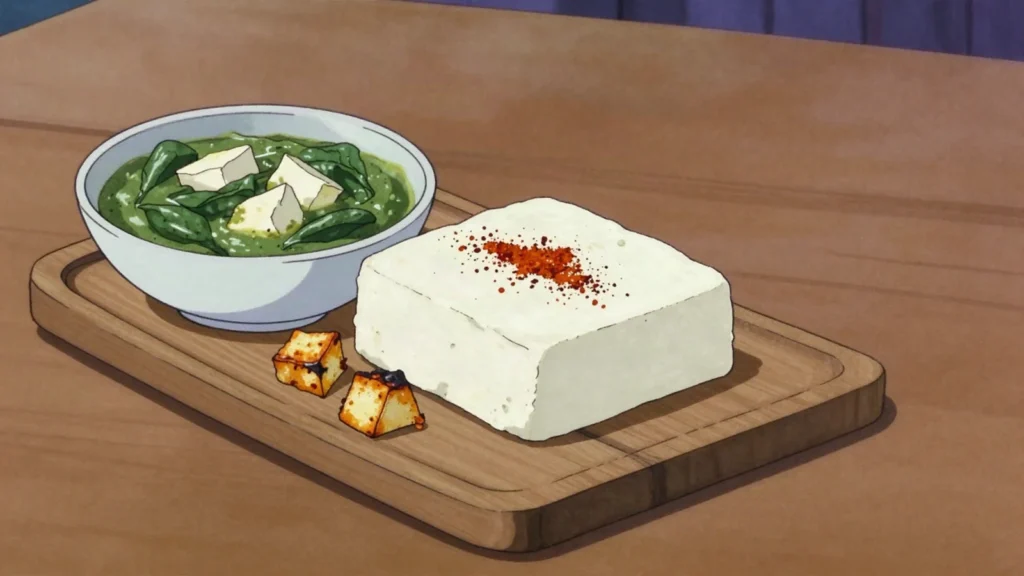
- cubed into curries, or
- sliced and grilled with spice
Directions
- Bring the milk to a full boil in a heavy pan, stirring so it does not catch, then take it off the heat and let it stand for one minute. Adding acid to milk at a rolling boil gives hard, rubbery curd.
- Stir in the acid a tablespoon at a time, stirring gently after each. Stop the moment the milk separates cleanly into white curds and pale greenish whey — usually within a minute.
- Use only as much acid as it takes to separate. Excess acid toughens the curd, and paneer that squeaks unpleasantly is almost always over-acidified.
- Let it stand five minutes, then pour into a colander lined with muslin and rinse briefly under cold running water. The rinse washes off the lemon or vinegar so the finished cheese tastes of milk rather than of acid.
- Gather the cloth and squeeze out most of the whey, then twist the top and shape the curd into a flat block.
- Press under a weight — a pan with a few tins in it, about 2 kg — for an hour. Longer gives a firmer paneer that holds up in a curry; shorter gives a softer one for crumbling.
- Chill for at least an hour before cutting. Warm paneer crumbles under a knife; cold paneer cubes cleanly.
- Use within three days. Keep it submerged in water in the fridge, changing the water daily, which stops the surface drying and cracking.
Technique
- Off the boil, minimum acid, quick rinse. Those three things separate good paneer from squeaky paneer.
- Keep the whey. It is excellent in dough, in dal, or for cooking rice.
- It does not melt, which is the whole point of it — that is why it can be cubed into a simmering curry or grilled on a skewer.
Substitutions
- Yoghurt whey or citric acid in place of lemon juice, both of which give a very clean flavour.
- Full-fat milk only. Semi-skimmed gives a poor yield and a dry, crumbly block.
Variations
- Pressed harder and longer for a firm paneer that can be grated.
- Chhena is the same curd left unpressed and kneaded, which is the base of rasgulla and most Bengali sweets.
History
Acid-set fresh cheese of the north; several food historians credit Portuguese settlers in Bengal with spreading acid curdling, which enabled chhena sweets.
Frequently asked questions
What is Paneer?
Paneer is a cheese & dairy from India: fresh unaged cheese set by curdling milk with acid, cubed into curries or grilled. Acid-set fresh cheese of the north; several food historians credit Portuguese settlers in Bengal with spreading acid curdling, which enabled chhena sweets.
How long does Paneer take to make?
Paneer takes 20 min plus 1 hour pressing of preparation and 20 min of cooking. The recipe makes makes about 350 g from 2 litres. It is rated easy to make.
What can I substitute in Paneer?
Yes, within limits. Yoghurt whey or citric acid in place of lemon juice, both of which give a very clean flavour. Full-fat milk only. Semi-skimmed gives a poor yield and a dry, crumbly block.
What is the most important thing to get right in Paneer?
Let it stand five minutes, then pour into a colander lined with muslin and rinse briefly under cold running water. The rinse washes off the lemon or vinegar so the finished cheese tastes of milk rather than of acid.