
Ingredients
Dough
- 200 gkhoya, grated
- 40 gplain flour
- ¼ tspbaking powder
- 2 tbspmilk, as needed
Syrup
- 600 gsugar
- 600 mlwater
- 4green cardamom pods, crushed
- 1 tbsprose water
- a few strands of saffron
- 1 tsplemon juice
To fry
- ghee or oil, for deep frying
Directions
- Make the syrup first. Boil the sugar and water with the cardamom for 5 to 7 minutes, until just sticky but nowhere near thread stage.
- A one-thread syrup will not soak in. It must stay thin enough for the dumplings to drink it up, and a thick syrup leaves them dry in the middle.
- Add the lemon juice, which stops the syrup crystallising, then the rose water and saffron off the heat, and keep it warm.
- Grate the khoya and knead it with the flour and baking powder to a smooth soft dough, adding milk only a few drops at a time.
- Knead it smooth but keep it soft and do not overwork it. A stiff dough gives hard centres, and any crack in the surface opens up in the fryer.
- Roll balls of about 2.5 cm between your palms, with no cracks anywhere.
- Every crack becomes a split in the hot fat and the ball falls apart, so roll each one until the surface is completely smooth.
- Heat the ghee to about 120°C (250°F), which is far lower than for anything else you deep fry.
- Low and slow is the entire method. At normal frying heat the outside browns in seconds while the centre stays raw dough.
- Fry the balls in batches, moving them constantly and gently with a slotted spoon so they colour evenly.
- They sink at first and then rise. Once they float, raise the heat slightly and fry for 8 to 10 minutes in all, until an even deep brown.
- Lift them out, let them drain for a moment, and drop them straight into the warm syrup.
- Warm dumplings into warm syrup. If either is cold they refuse to absorb.
- Leave them to soak for at least 2 hours and preferably 4, turning them once.
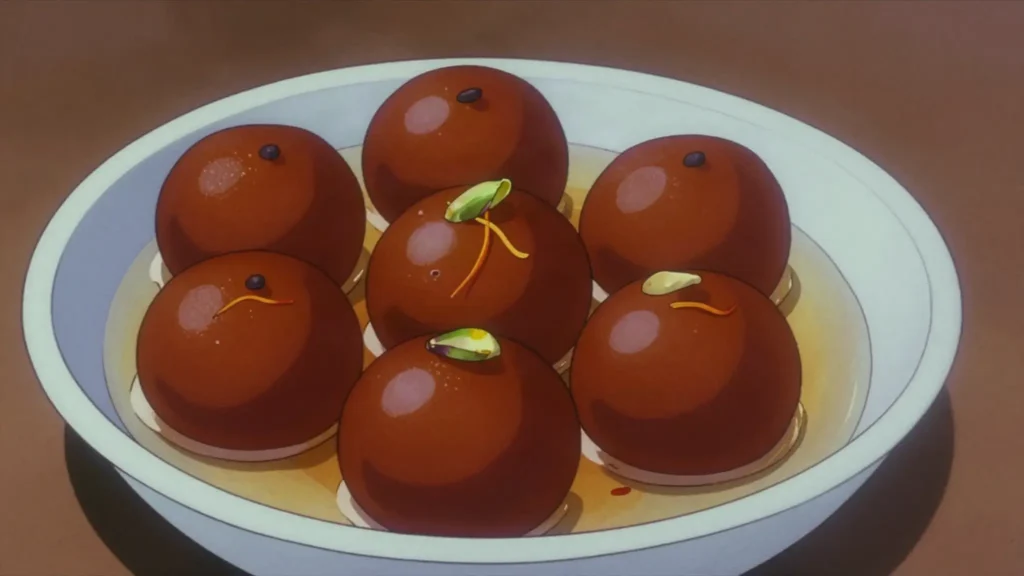
- They are ready when they have swollen to nearly twice the size and are soft the whole way through.
- Serve warm or at room temperature, two or three to a bowl with a little syrup, and with rabri or ice cream if you like.
- They descend from the Persian luqmat al-qadi and came into Indian kitchens through Mughal court cooking.
Technique
- Khoya is milk reduced to a solid. It is the correct ingredient, and everything else is a substitute for it.
- Milk powder versions are quick and reliable and taste noticeably different, which is worth knowing rather than pretending otherwise.
- The syrup should be at drinking temperature when the dumplings go in, not hot from the boil.
Substitutions
- 200 g full-fat milk powder with 2 tbsp ghee and a little milk, in place of khoya.
- Kewra water instead of rose water.
Variations
- Kala jamun, fried much darker, to nearly black.
- Stuffed with a pistachio or a single clove.
- Pantua, the Bengali relative.
History
Deep-fried balls of milk solids soaked in rose-and-cardamom-scented sugar syrup, whose name combines Persian gol, flower, by way of gulab, rosewater, and jamun, a dark Indian fruit the fried balls are thought to resemble in size and colour. The dish traces back through Persian and Central Asian influence carried into the subcontinent by the Mughal Empire from the 1500s onward, closely related to luqmat al-qadi and other fried, syrup-soaked sweets found across the historically Persian-influenced Islamic world. Regional Indian variations differ in whether the milk-solid base, khoya, is made fresh or from milk powder, and in exactly how long and at what temperature the syrup soak is done, with slow, patient soaking generally considered essential to properly softening the fried dough through to its center.
Frequently asked questions
What is Gulab Jamun?
Gulab Jamun is a dessert from India: fried milk-solid dumplings soaked in rose-cardamom syrup. Deep-fried balls of milk solids soaked in rose-and-cardamom-scented sugar syrup, whose name combines Persian gol, flower, by way of gulab, rosewater, and jamun, a dark Indian fruit the fried balls are thought to resemble in size and colour. The dish traces back through Persian and Central Asian influence carried into the subcontinent by the Mughal Empire from the 1500s onward, closely related to luqmat al-qadi and other fried, syrup-soaked sweets found across the historically Persian-influenced Islamic world. Regional Indian variations differ in whether the milk-solid base, khoya, is made fresh or from milk powder, and in exactly how long and at what temperature the syrup soak is done, with slow, patient soaking generally considered essential to properly softening the fried dough through to its center.
How long does Gulab Jamun take to make?
Gulab Jamun takes 30 min plus 2 hr soaking of preparation and 30 min of cooking. The recipe makes about 20. It is rated medium to make.
What can I substitute in Gulab Jamun?
Yes, within limits. 200 g full-fat milk powder with 2 tbsp ghee and a little milk, in place of khoya. Kewra water instead of rose water.
What is the most important thing to get right in Gulab Jamun?
A one-thread syrup will not soak in. It must stay thin enough for the dumplings to drink it up, and a thick syrup leaves them dry in the middle.