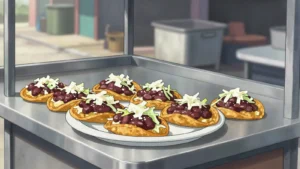
Ingredients
Dough
- 500 gplain flour
- 100 glard or butter, melted
- 1egg
- about 180 ml warm water
- 1 teaspoonsalt
- 1 teaspoonsugar
- 1 teaspoonachiote paste
- or a pinch of paprika, for colour
Cheese filling
- 500 gfresh white cheese
- queso fresco, crumbled
- 500 mlwhole milk
- 4 tablespoonscornflour
- 40 gbutter
- 1onion, finely chopped
- 1 tablespoonají amarillo paste
- or mild chilli paste
- salt and white pepper
To finish
- 1beaten egg, to glaze
To serve
- hot, in the mid-morning
- with api
- beside salteñas
Directions
- Melt the butter in a heavy pot. Add the finely chopped onion to it. Cook it for a good eight minutes. Let it soften without colouring. Stir in the aji amarillo paste.
- Cook it for one more full minute. Mix the cornflour with a little cold milk. Whisk it into a smooth thin paste. Dry cornflour tipped into hot milk lumps at once. Pour the rest of the milk into the pot. Bring it all up to a bare simmer.
- Pour the slurry in very slowly. Whisk it hard as you pour it in. Let it thicken for about three minutes. It should be quite thick indeed. Take the pot right off the heat. Stir in all the crumbled cheese. Season it with salt and white pepper. Spread the filling in a shallow dish.
- Let it cool right down completely. Then refrigerate it until firm. Warm filling cannot be filled with at all. Give it at least two full hours. Put the flour, salt and sugar in a bowl.
- Melt the lard and let it cool slightly. Dissolve the achiote in the warm lard. Make a well in the middle of the flour. Add the egg and the coloured lard. Bringing it together takes care. Add the warm water in gradually.
- Bring it together into a firm dough. It should be firm rather than soft. Knead it for about eight minutes. It should become smooth and pliable. Wrap the dough and let it rest. Give it at least thirty minutes. Divide the dough into even pieces. Roll each one into a smooth ball.
- Roll each ball out into a thin round. Aim for about fifteen centimetres. Roll it thin but not paper thin. Too thin and it splits under the filling. Put a generous spoonful on one half. Leave a clear border around it. But leave enough border to seal properly.
- Brush the border with beaten egg. Fold the round over into a half moon. Press the edges together firmly. Press the whole edge very firmly. Fold the sealed edge over on itself.
- Pinch it into a rope as you go. Take the time to crimp properly. Set them on a lined baking tray. Chill them for twenty minutes. Cold pastry holds its seal better. Brush them all over with beaten egg. Heat the oven as hot as it will go.
- Bake them for about fifteen minutes. A hot oven sets the pastry fast. Take them straight from the oven. Warn people that they are very hot inside. Let them stand a few minutes first. Hold it over a plate or a napkin. Serve hot api alongside them all. They do not keep or reheat well.
Technique
- The filling is deliberately liquid inside and flows when bitten, which is the whole point; it is made much thicker than the finished result because it must be firm enough to handle when cold, and it loosens again as it heats and the cheese melts.
- The filling liquefies in the oven and any weak point lets it run out, so the edge is folded over on itself and pinched into a rope crimp rather than pressed with a fork; that doubles the dough at the seal and is what holds the liquid in. Some will leak anyway, which happens in bakeries too.
- The molten filling is extremely hot and holds heat far longer than the pastry, so it burns the mouth badly; let them stand a few minutes, then bite a corner and drink the filling holding it over a plate.
Substitutions
- A young feta or mozzarella stands in for queso fresco, melting without going stringy.
- Paprika gives a similar colour to achiote, which has little flavour of its own.
Variations
- La Paz sits at high altitude, where bakers use less raising agent and a hotter oven; this recipe is written for ordinary altitude.
- Salteñas with a juicy meat stew are the meat counterpart eaten at the same hour.
- Api, the hot purple maize drink, is the standard accompaniment.
History
A La Paz mid-morning snack sold beside api and salteñas.
Frequently asked questions
What is Llauchas paceñas?
Llauchas paceñas is a street food from Bolivia: baked cheese pastry with a runny filling, eaten in the morning. A La Paz mid-morning snack sold beside api and salteñas.
How long does Llauchas paceñas take to make?
Llauchas paceñas takes 1 hour plus resting of preparation and 25 minutes of cooking. The recipe makes about 12 pastries. It is rated hard to make.
What can I substitute in Llauchas paceñas?
Yes, within limits. A young feta or mozzarella stands in for queso fresco, melting without going stringy. Paprika gives a similar colour to achiote, which has little flavour of its own.
What is the most important thing to get right in Llauchas paceñas?
Bring it together into a firm dough. It should be firm rather than soft. Knead it for about eight minutes. It should become smooth and pliable. Wrap the dough and let it rest. Give it at least thirty minutes. Divide the dough into even pieces. Roll each one into a smooth ball.