
Ingredients
Biscuit
- 600 gplain flour
- 200 gbutter
- 150 gsugar
- 3egg yolks
- 150 mlmilk
- 1 tspbaking powder
- ½ tspsalt
Manjar blanco
- 2 litreswhole milk
- 500 gsugar
- 1cinnamon stick
- ½ tspbicarbonate of soda
Fillings
- 600 gpineapple jam, very thick
- 400 gpeanut or sesame nougat, sliced
To assemble
- a heavy board and weights
Directions
- Make the manjar blanco first, because it takes the longest and must be completely cold.
- Simmer the milk, sugar, cinnamon and bicarbonate over a low heat for about 2 hours, stirring often, until thick, glossy and caramel brown.
- Cook it far thicker than a pouring caramel. It has to hold layers apart under weight, and a runny manjar blanco slides out of the sides of the finished slab.
- Cook the pineapple jam down until equally stiff, thick enough to hold a spoon upright.
- Both fillings must be genuinely stiff. This is a construction problem as much as a baking one.
- Rub the butter into the flour, sugar, baking powder and salt, then bind with the yolks and milk into a firm dough.
- Divide it into four equal pieces and roll each into a rectangle of exactly the same size, about 4 mm thick.
- Roll them to matching dimensions and trim them with a ruler. Uneven sheets make a slab that leans and cannot be cut into neat bars.
- Prick each sheet all over with a fork.
- Bake at 180°C (355°F) for 12 to 15 minutes, until pale gold and firm, then cool them completely on a flat surface.
- Cool them flat. A warped biscuit sheet will not sit level and the whole slab collapses.
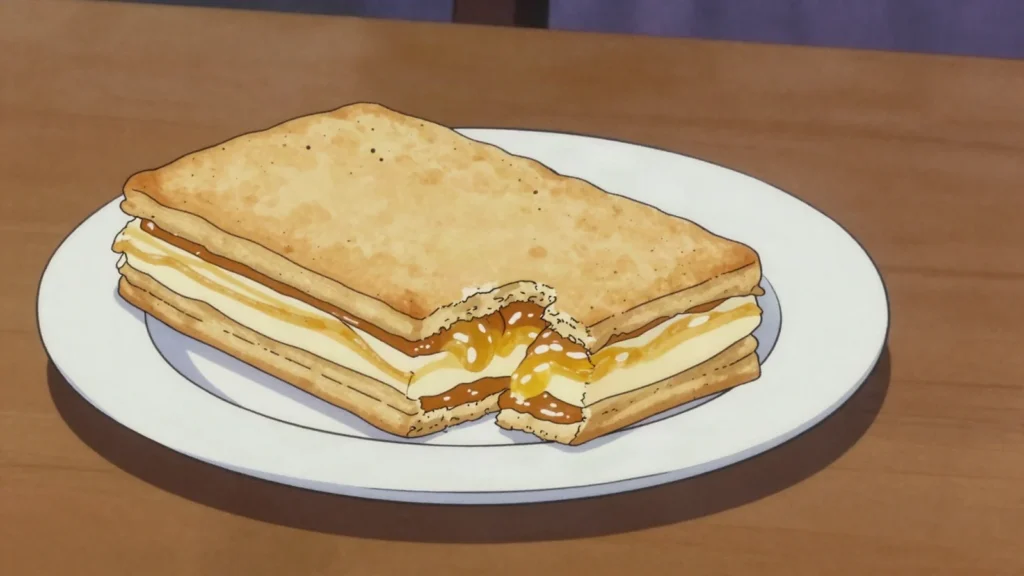
- Now build it. Lay the first biscuit down, spread it with manjar blanco, and lay the second on top.
- Spread pineapple jam on the second, then the third biscuit.
- Lay slices of nougat over the third, then the final biscuit on top.
- Alternate the fillings between layers rather than mixing them. The point of a King Kong is that each bite carries three distinct sweets, and blended together it is just a caramel biscuit.
- Press the whole thing down firmly, put a board on top, and weight it for several hours or overnight.
- The weighting is essential. It compresses the layers into a single sliceable block and forces out the air pockets that would make it crumble.
- Trim the edges square and cut into bars with a long sharp knife.
- Wrap each bar. They keep for weeks, which is why it became a travelling sweet.
- It comes from Lambayeque on Peru’s north coast and is said to be named after the 1933 film, which was showing when it was first made.
Technique
- It is enormous, extremely sweet, and sold by the kilo as a gift to take home from Lambayeque.
- Manjar blanco is the Peruvian dulce de leche and it is the backbone of the whole thing.
- The nougat layer, made with peanuts or sesame, is what gives the crunch.
Substitutions
- Shop-bought dulce de leche, cooked down further to thicken it.
- Any stiff fruit jam in place of pineapple.
Variations
- With a fig or lucuma layer.
- Made small, as individual bars.
- With only two fillings, which is the simpler everyday version.
History
Made in Lambayeque since the 1930s and said to be named after the 1933 film shown in Chiclayo.
Frequently asked questions
What is King Kong?
King Kong is a dessert from Peru: layered biscuit slab filled with manjar blanco, pineapple and peanut sweets. Made in Lambayeque since the 1930s and said to be named after the 1933 film shown in Chiclayo.
How long does King Kong take to make?
King Kong takes 1 hr of preparation and 1 hr of cooking. The recipe makes 1 large slab. It is rated hard to make.
What can I substitute in King Kong?
Yes, within limits. Shop-bought dulce de leche, cooked down further to thicken it. Any stiff fruit jam in place of pineapple.
What is the most important thing to get right in King Kong?
Make the manjar blanco first, because it takes the longest and must be completely cold.